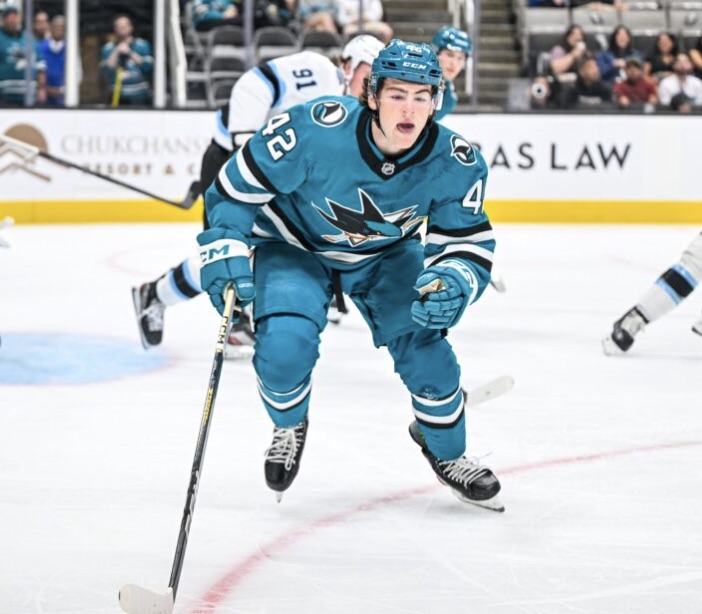
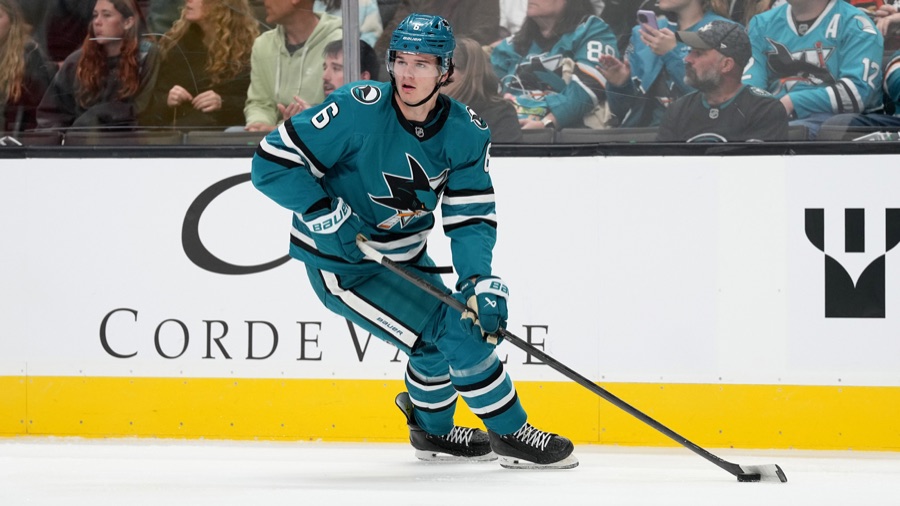
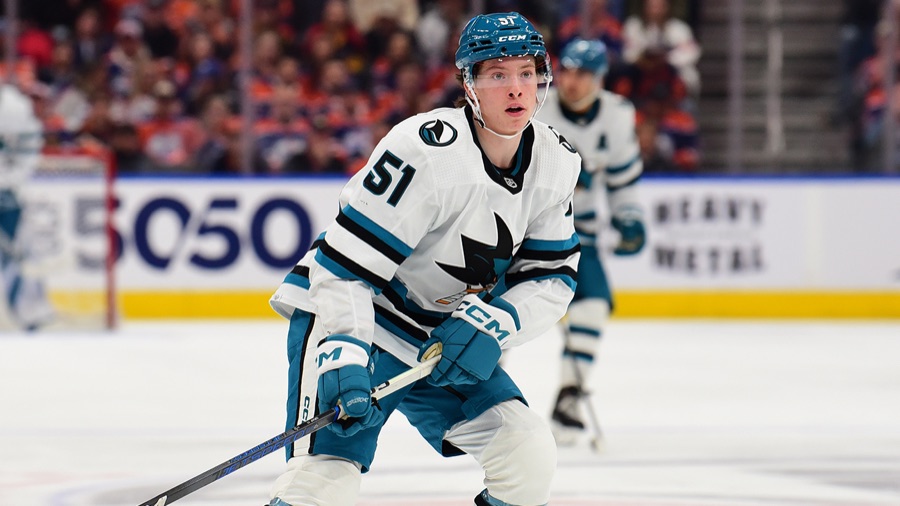
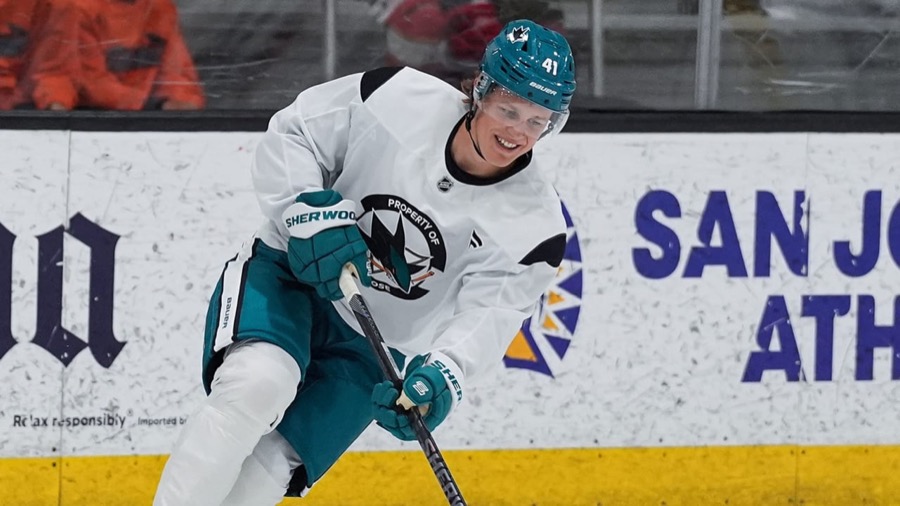
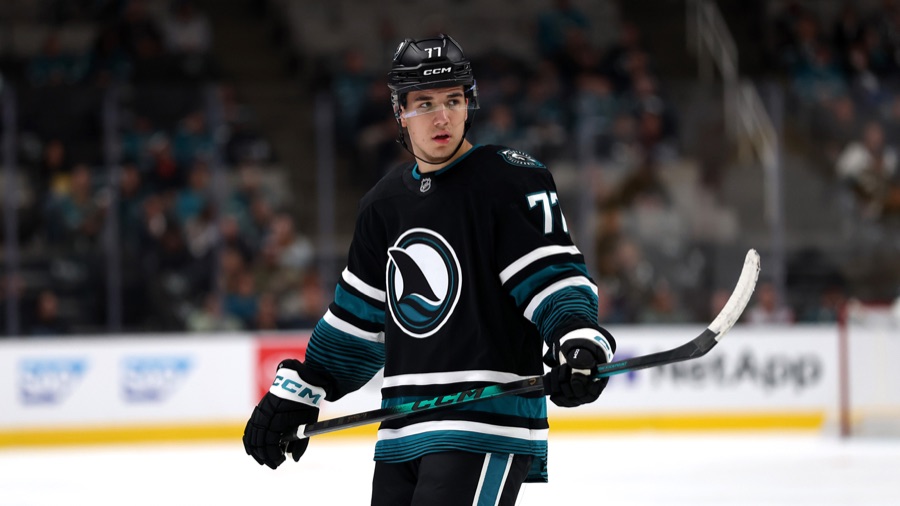
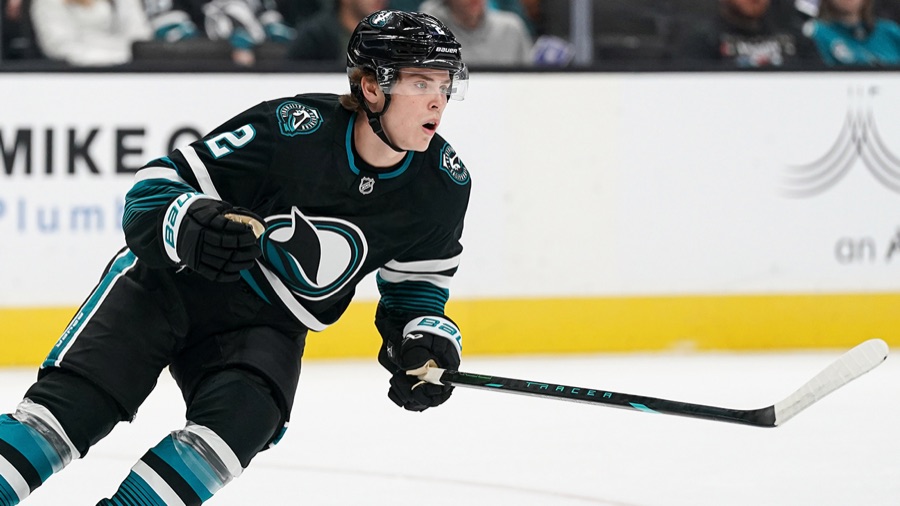
Michael Kesselring Went From Seventy Power Play Minutes To Two Seconds In One Season
The Sharks 25, No. 11. John Klingberg took more than a third of San Jose's blue-line power-play time last season and he shot right. The only defenseman the Sharks have with the same shot and any recent power-play history has never averaged a minute a night at it.
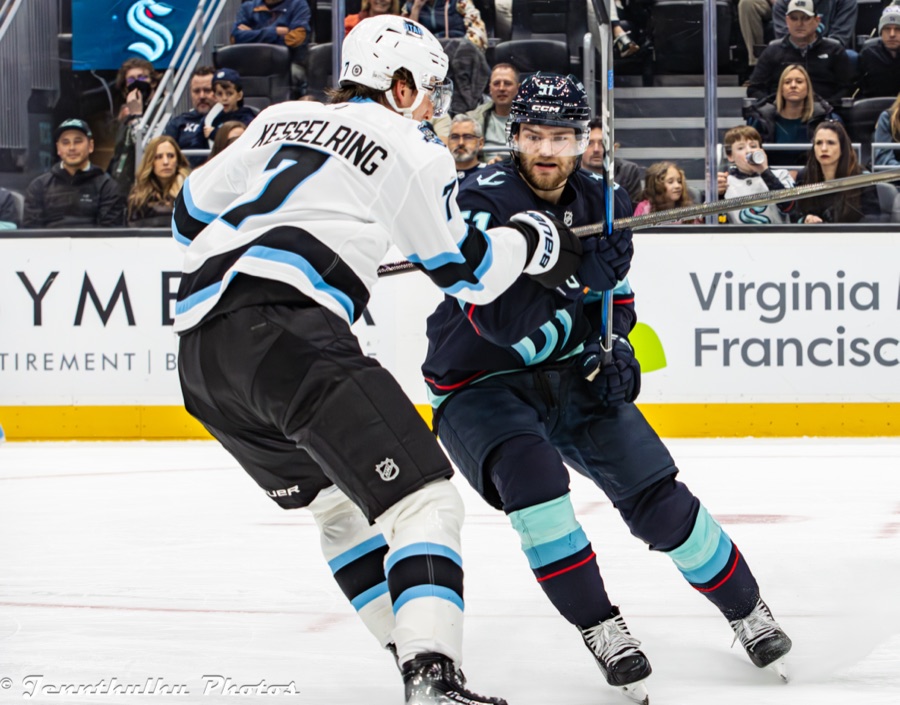
Michael Kesselring spent 69 minutes and 49 seconds on the power play for Utah in 2024-25. He dressed for all 82 games to get there.
The next season, in Buffalo, he spent two seconds.
Not two minutes. Two seconds, across 34 games, on a knee and then a high ankle that took most of his year. Everything worth arguing about him sits in the gap between those two numbers, because San Jose has a hole shaped like the Utah season and nothing else on its roster that fits.
The seat that opened#
John Klingberg dressed 56 times for the Sharks last season and spent 165:29 of it on the power play, 2:57 a night. Dmitry Orlov led the blue line with 202:55 across all 82, 2:28 a night.
Sorted off the league's own time-on-ice database, scoped to San Jose's games only, those two took 82.1 percent of every power-play minute the Sharks gave a defenseman. The rest of the blue line split 80 minutes eight ways. Timothy Liljegren had 37:20 in his 43 games here before the trade, Sam Dickinson 21:57 across 72 games, and Mario Ferraro, Shakir Mukhamadullin, Nick Leddy, Vincent Desharnais and Vincent Iorio combined for 12:39 all year.
Klingberg alone was 36.9 percent of it, and he is not in the building. He is also a right shot, which is the part a depth chart does not show you.
Deployment, not depth#
This desk argued on August 19 that moving Luca Cagnoni or Orlov into that seat fills a different hole than the one that exists, because both shoot left and Klingberg did not. Nobody outside has answered it since. Professor Hockey's August 28 opening-night units reach the same conclusion about Cagnoni by a different route and never mention shot side.
Built from the club's own roster feed rather than from a depth chart, San Jose carries four right-shot defensemen: Jacob Trouba, Kesselring, Mattias Havelid and Eric Pohlkamp. Havelid and Pohlkamp have never played an NHL regular-season game between them.
Trouba has played 906. He also has one power-play point in his last 158 of them, and 64:56 of power-play time across those two seasons combined, which is less than Kesselring had in Utah in one.
So the population is one. That is the whole reason a 26-year-old with a $4.5 million cap hit is eleventh on this list rather than eighteenth.
What Utah actually gave him#
Kesselring played 17:41 a night that season, 16:24 of it at even strength, and scored 7-22-29 on 150 shots.
His power-play usage ranks two ways and both need saying. By total power-play minutes he was second among the twelve defensemen Utah dressed. By rate he was third, at 0:51 a game, behind Mikhail Sergachev at 3:18 and Sean Durzi at 1:18. He is second on the totals and third on the rate because he played every night and Durzi played 30 times.
The distance to the top of that list is what keeps the case modest. Sergachev had 255:05, more than three and a half times Kesselring's total. Kesselring held a real second-unit job across a full season, which is more than anybody else on San Jose's right side can say, and it is not the same thing as having quarterbacked a power play.
Best case for the Sharks#
His interests and the club's point the same way here, which is not true of every man in this series, so this is short.
San Jose's best case is that the right point stops being a question in the first week of October. Kesselring takes the second unit, the club never runs a left shot into Klingberg's chair, and the knock-on is worth as much as the unit itself. A right side that works lets Dickinson and Cagnoni be deployed on merit at even strength instead of by handedness, and it means Trouba's $8.25 million does not have to buy a top-four defenseman for this to hold together.
At $4.5 million with no trade protection, per PuckPedia, that is the cheapest exit San Jose has from the corner it spent the summer building.
Worst case for the Sharks#
The worst case is not that Kesselring is bad. It is that he is fine.
He plays 13 or 14 minutes on the third pair, competent and unremarkable, and the power play goes back to being left-handed by default because the alternative is Trouba. San Jose spent $17.5 million a year on Nurse and Trouba and added this contract on top, and it would still hold the exact hole it held in June, now under contract through 2028-29.
That is the version where the blue line gets sorted by shot side rather than by ability, and where Dickinson and Cagnoni spend their development years covering for it.
What to watch early, and it is one column#
Power-play time on ice, first two weeks. Anything at or above 51 seconds a game says the Utah role travelled and the second unit is his. A run of zeroes says Buffalo read him correctly and San Jose is back to Orlov, Cagnoni, or nobody.
The second reading is on the same line and points the other way. Buffalo used Kesselring 0:49 a game shorthanded; Utah used him 0:25. If San Jose puts him on the kill at the Buffalo rate and not on the power play, that is the club telling you, in a box score, which of the two seasons it believes.
Even-strength time is the third. Utah gave him 16:24. Under 15 in October means third pair, whatever the depth chart said in September.
The stakes#
San Jose has not reached the playoffs in seven seasons. The last berth was 2018-19, and last year's 39-35-8 and 86 points was the best of the rebuild.
The Sharks fixed a lot of things this summer. A right-shot defenseman who can play in the top four and run a unit was not one of them, and it had been on the club's list since Klingberg left. They traded for one man who has done half of that job, on the strength of a season now two years old, and the other half has never been asked of him.
Eleventh is where that belongs. The season does not turn on Michael Kesselring. The right point does, and San Jose has nobody else to ask.
Yesterday: Tyler Toffoli lost eleven goals last season and not one of them came off the power play.
Sources: The NHL's own time-on-ice-by-strength database and player pages for every deployment, games-played and scoring figure here, San Jose's and Utah's 2024-25 and 2025-26 seasons read on September 7. The league's club roster feed for shot handedness and the right-shot count. PuckPedia for the contract, term and cap hit. Professor Hockey, August 28, for the projected opening-night power-play units.
This piece closes on the right point turning San Jose's season and the club having nobody else to ask. The 32-club count published here on September 20 undercuts the premise rather than the reporting: 17 clubs led their power play with a left-shot defenseman last season. Kesselring's 69:49 in Utah and the thin evidence behind it are unchanged. I would cut the claim that the opening is specifically a right-side one.
CP