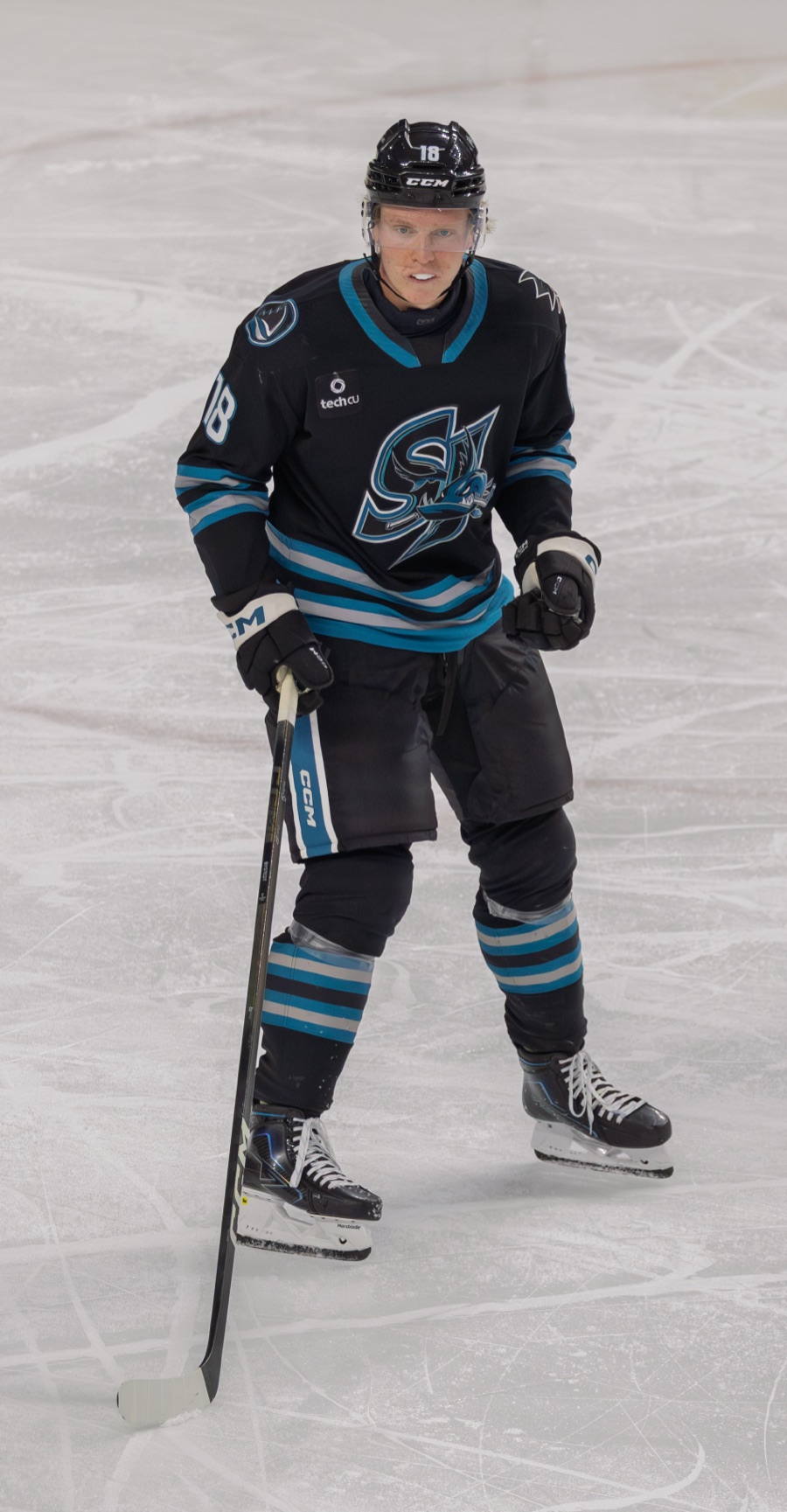
Will Smith led the Sharks in goals on his shifts, but not in chances
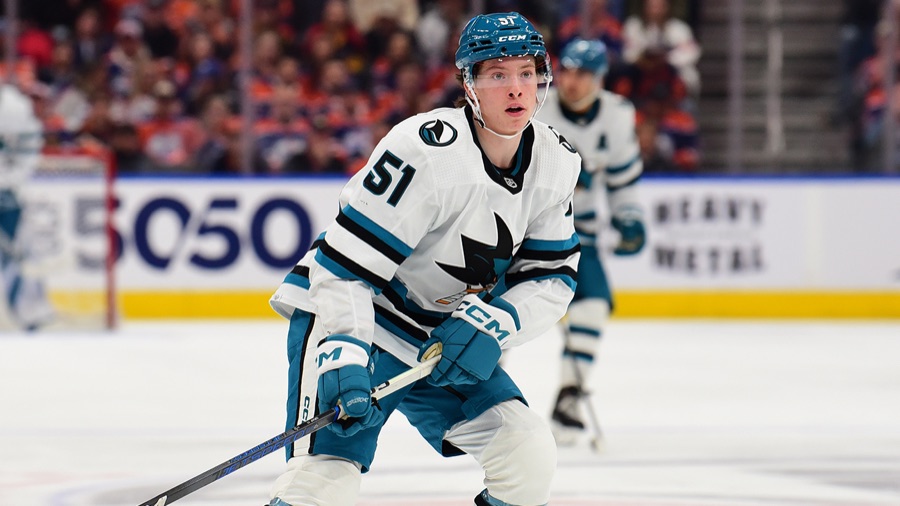
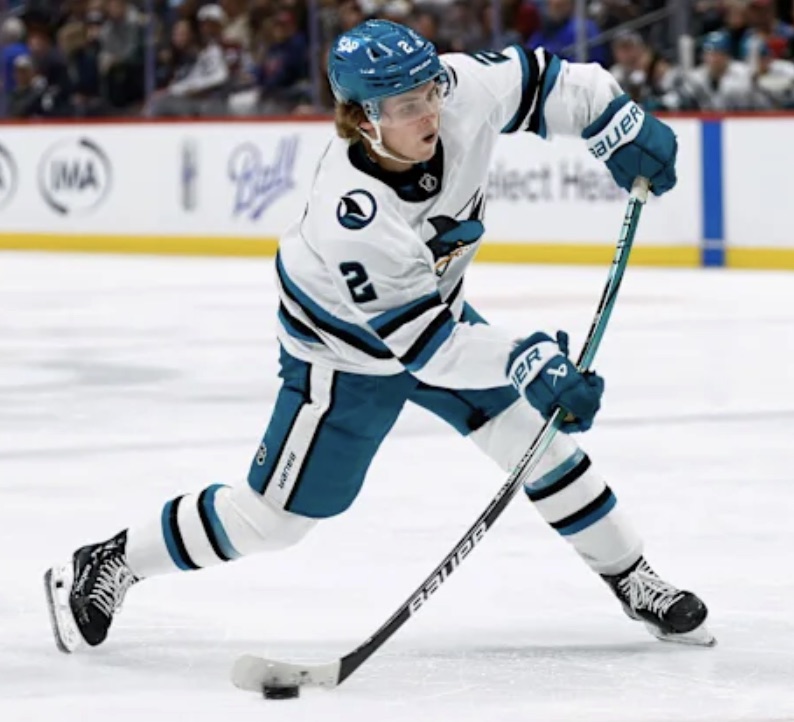
The Sharks 25, No. 2. Smith's five-on-five shifts produced 50 goals for and 37 against last season, the best goal share of any Sharks forward who played 750 minutes. The chances underneath those same shifts came to 47.9 percent, sixth of those eight men. He is unsigned past this season, and from today the longest contract San Jose may offer him is seven years rather than eight.
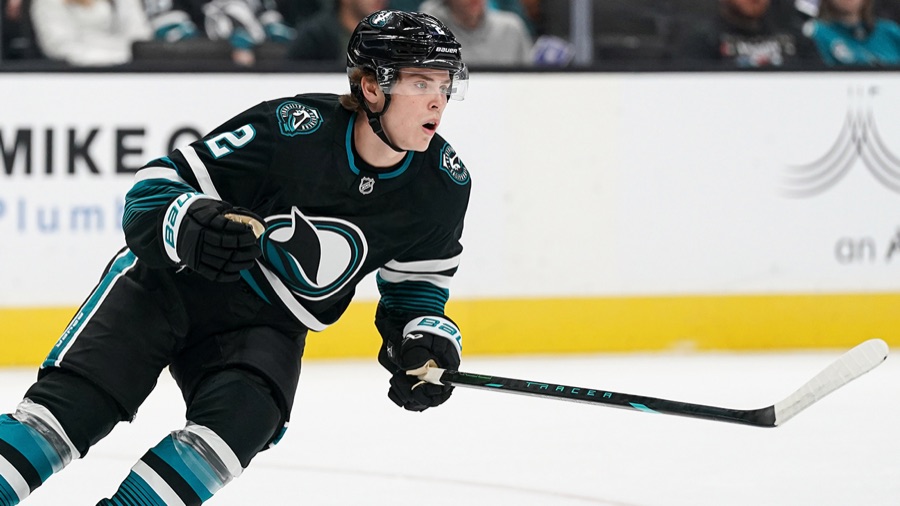
Take the eight San Jose forwards who played 750 minutes or more at five-on-five last season. Sort them by the share of goals scored while they were on the ice. Will Smith is first.
Now sort the same eight by expected-goal share, which is those identical shifts measured by the quality of the chances rather than by what went in. Smith is sixth.
Fifty goals for and 37 against, with him on the ice. The chances behind them were 40.97 expected goals for and 44.54 against. The first pair is 57.5 percent and the second is 47.9 percent, and the 9.6 points between them was the 24th largest gap of the 285 NHL forwards who skated 750 five-on-five minutes last season.
First in goals, sixth in chances, same eight men
On-ice goal share at five-on-five, 2025-26, for the eight San Jose forwards who played 750 or more five-on-five minutes, from MoneyPuck's season summary file. The bar is the share of goals scored while the player was on the ice; the expected-goal share for those same shifts is printed beside each name, along with the actual goals for and against. Even is 50 percent. The axis runs from 25 to 60 percent. William Eklund has since been traded to Ottawa.
The company that gap keeps#
The 23 forwards with a bigger separation than Smith's include Nathan MacKinnon, Anze Kopitar, Nick Suzuki and Martin Necas. They also include Marat Khusnutdinov and Fraser Minten. A list holding both halves of the league's talent distribution settles nothing, and San Jose has to price Smith anyway.
Why he matters now#
He turned 21 in March, scored 24 goals and 35 assists in 69 games, and played 18 minutes and 11 seconds a night. Of the forwards San Jose still has, only Celebrini and Alexander Wennberg were given more ice. That is the on-ice case, and it is why he sits second in this series.
The calendar is the rest of it. Smith is in the last season of his entry-level deal at $950,000 and becomes a restricted free agent on July 1, 2027. The collective bargaining agreement that expired yesterday let a club re-sign its own player for eight years; the one that takes effect today caps it at seven. Sheng Peng of San Jose Hockey Now asked Mike Grier about the extension on July 30 and got back that Smith "is definitely someone we'd like to lock up long-term as well." Forty-eight days later the club has finished Collin Graf and signed Macklin Celebrini for five years at $18,800,000 a season. Smith is still unsigned, and no outlet has reported a negotiation.
So the price gets set by the 84 games in front of him.
Three arguments against reading that gap as luck#
One, and it is real. Smith scored 15 goals at five-on-five against 12.19 individual expected goals. He finished above the model, and finishing repeats better than most things in hockey do.
Two. Expected-goal models grade the shot, not the pass that made it. Smith had 16 primary assists at five-on-five. A playmaker's contribution lands in his linemate's shot quality, not his own.
Three. Nine hundred and eighty-two minutes is a thin denominator. A goal share moves a long way on that sample.
Here is what survives all three. San Jose scored 9.03 more goals than expected on his shifts and allowed 7.54 fewer, which is 16.57 goals of daylight between what happened and what the chances said. Smith's own finishing surplus accounts for 2.81 of it. The other 13.76 belongs to his linemates' shooting and to the goaltending behind him, and San Jose's goaltenders saved .887 of the 2,413 shots they faced last season.
Best case, for San Jose#
This is the entry where the club's interest and the player's come apart, so it is worth naming whose scenario this is. Smith's best case is a career year that prices his second contract at the top of the range. San Jose's is narrower and cheaper. The expected side climbs to meet the goals rather than the goals falling to meet the chances, and the club signs him before a market that just watched Philadelphia put $18,000,000 a season on Leo Carlsson's offer sheet has to bid for him.
That means his expected-goal share moving from 47.9 toward even while he holds something near his 0.855 points per game across 69 games. A second line that drives play rather than surviving it is the difference between a club that finished four points out of the last Western playoff place and one that is not counting in April.
Worst case, for San Jose#
The gap closes from the wrong end. The goaltending behind his shifts comes back toward the .883 Askarov posted across his 47 starts, the 50-37 turns into something near even, and the points hold anyway because 17 of last season's 59 came on the power play. San Jose then reaches next summer having to pay a restricted free agent on two seasons of good counting statistics and middling underlying ones, with no eight-year term available to buy a discount, against a blue line already costing $17,500,000 a year in two contracts.
That is the damage, and it is not that Smith is a bad player. It is that the club cannot tell from one season which player it is buying. The public model that would help is itself unsettled. Hockey Stat Cards graded his defensive impact in the 19th percentile when it was read in June and the 69th when it was read last week, off identical raw inputs. A model that moves fifty percentile points on unchanged inputs is not evidence about Smith.
What to watch in October#
Two things, and a box score settles both.
His shot count. Smith put 166 shots on goal in 69 games, 2.41 a night. In 23 of those 69 he managed one or none. Finishing is the skill he already has, so volume is the multiplier on it. If the one-shot nights stop, the 24 goals move.
The goals against on his shifts. Last season San Jose allowed 37 even-strength goals across his 982 minutes, 2.26 per 60, against an expected 2.72 per 60 that ranked 229th of those 285 forwards. The expected rate is the one that has to come down, because the actual rate was being held there by saves. Fifteen games is enough to see whether his line is defending or being bailed out.
And the deployment underneath both. Daily Faceoff's July 4 projection kept Smith on Celebrini's right wing. If Ryan Warsofsky splits them to spread scoring onto Michael Misa's line, Smith's chance quality gets measured without a first-line center for the first time.
The stakes#
A club seven seasons removed from a playoff berth has left the second-best forward in the building on a $950,000 deal with nine months to decide what comes next. This desk already carries an open call that Smith signs for five years or fewer by July 1, 2027. What that contract costs is being settled in October, by a 21-year-old and by whoever is in net behind him.
Previously in this series: No. 3, Yaroslav Askarov.
Sources: MoneyPuck's 2025-26 season summary file for skaters, read 2026-09-16, for every on-ice goal, expected goal and rate figure here, including the eight-forward San Jose group and the 285-forward league group, both built from that file rather than inherited. The NHL's own statistics API, read 2026-09-16, for Smith's counting line, ice time, game log, per-game shot distribution, San Jose's team goaltending and the final Western Conference standings. NHL.com, July 21, 2025, Justin Alpert, for the new collective bargaining agreement's term limits and its September 16, 2026 start. Sheng Peng, San Jose Hockey Now, July 30, 2026, for Mike Grier on the extension. Daily Faceoff's July 4, 2026 projected lines. CapWages, PuckPedia and Spotrac, in agreement, for Smith's entry-level terms and his 2027 restricted free agency. Hockey Stat Cards for the defensive rating readings of June 14 and September 10, 2026.