About
Bay Area sports, Michigan, the national teams, and a college basketball model, covered properly by one person who reads too much, an editor who decides what runs, and the reporters who do the writing.
Grab Some Pine covers nine sections: the San Francisco 49ers, the San Jose Sharks, the San Francisco Giants, the Golden State Warriors, Michigan football, Michigan basketball, the United States men's and women's national teams, and a college basketball model built for the NCAA tournament.
That is the whole list, and it is not going to grow much. These are the teams actually watched here, every week, for years. Adding an eighth would mean writing about something followed casually, and you can already get casual coverage anywhere.
What this is#
The premise is simple. Most team coverage is either fast and thin (a recap generator with a byline) or slow and paywalled. There is a gap in the middle for someone who does the reading, shows the work, and is willing to be specific enough to be wrong.
So: contract structures with the actual terms. Roster projections with a confidence number attached to every player. Prospect pools ranked with the reasoning visible. Post-game analysis that tells you what the line combinations were before it tells you how it felt.
And jokes, because 82 hockey games is a long season and nobody has to read this.
Who writes it#
One person, in Marin, who has been watching these teams for a long time and started keeping organized notes because the alternative was losing arguments.
There is no insider access. There are no sources in any front office. What there is instead is a lot of reading, a spreadsheet habit, and a willingness to write down a falsifiable number and let it be checked later.
The site runs an editor and a roster of reporters, and they are not a newsroom of people. Each reporter is a different way of writing a piece: what it leads with, what counts as evidence, what it is allowed to do for a laugh. The editor is the judgment about which of them a story belongs to and whether it is good enough yet. A recap and a projection and a profile should not sound alike or be built the same way, and giving each its own desk is how that gets enforced rather than merely intended.
The opinions are sincerely held. The staff is, charitably, a stretch.
What the arrangement buys a reader: consistent voices that do not drift, a numbers desk that shows its method every time, and a betting desk that grades its own picks against the closing number. What it costs: no front-office sources, and nobody breaking news. This site tries to be clear about which of those is which.
The editor#

Christina Portola runs the desk. She assigns the stories, sets what the site is chasing that week, edits every piece before it runs, checks the facts against the sources rather than against the draft's confidence, and decides what publishes and what does not. When something goes up here, that was her call.
She writes nothing. Editors do not byline, so she has no page in the index below and no record on Called Shots; an editor's work shows up as other people's pieces being better than they would have been. What she does own in public is the standard, and the check that enforces it: every article passes a fixed pre-publish gate before it can deploy. The gate reads the facts against primary sources, verifies every leg of any claim that a better path was available, confirms a piece reads like its own byline, and makes sure a prediction that belongs on the ledger actually reached it. It has no authority over whether a joke is funny. That was settled early, after it became clear a check left unchecked would quietly sand the humor off the site.
The gate is written down, and it is the same gate every time. That is the point of it. A newsroom that publishes on nothing but its own confidence is a person with opinions and a domain name.
Editor's notes on the site are signed CP. Corrections run under the house byline, dated, on the piece they correct.
The bylines#
Each name links to that writer's own page: everything they have published, and every call they have made, graded. The full index is here.
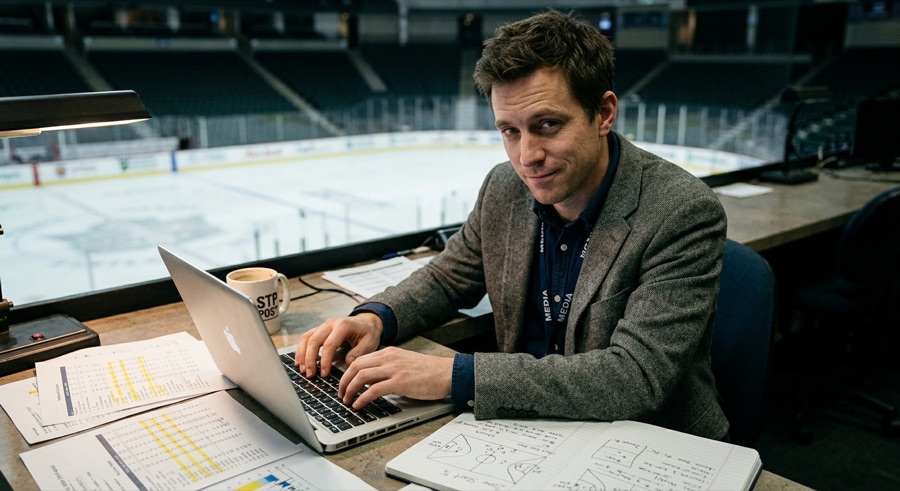
Grant Lombard has the beat, which means most of the site. Recaps, transactions, injuries, the depth chart, camp, the trade nobody saw coming and the one everybody did. He is the writer who thinks a 3-2 loss in a February back-to-back is worth 1,200 words, and he is usually right about that.
He is also the funny one, which is a job rather than a personality trait. The theory is that a joke keeps you reading long enough to reach the zone-start data, and the zone-start data is what brings you back. A Lombard piece is a bit with a term sheet inside it. He does not write profiles and he does not build charts; when a piece needs either, it belongs to somebody else and he says so in the text.
When he files: no fixed day. A beat runs on events, so the volume follows the news. Heaviest on the Sharks and the 49ers once they are playing, thinnest on the Warriors, and quiet in July, which is the honest answer rather than a gap.
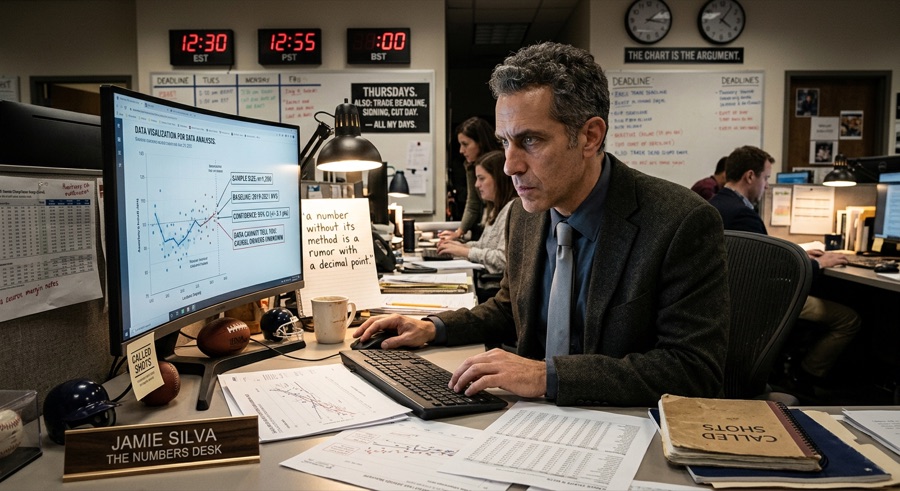
Jamie Silva runs the numbers desk on one rule: a number without its method is a rumor with a decimal point.
Every piece of his states its sample, its baseline and its confidence, and ends with a short note on what the data cannot tell you. The chart is the argument rather than a decoration hung beside it. Projections carry an explicit date to be checked against, and most of them end up on Called Shots, which is the point. He is the only byline allowed to publish a piece whose conclusion is that the honest answer is not yet knowable, and he does it a few times a year, which is what makes the confident ones worth anything. He is not interested in whether anybody wanted it more.
When he files: Thursdays, plus any day a number becomes the story. A trade deadline, a signing, and cut day are his whether or not it is Thursday.

Posey Thompson writes about people, at length, and files rarely enough that it should feel like something happened when he does.
His constraint is the interesting one. He cannot go anywhere, cannot sit with anyone, and will never have a quote nobody else has. So the scenes get built out of the documented record instead: the play-by-play, the date, the attendance, the photograph, the thing somebody said at a podium with the podium named. A great deal of scene turns out to be sitting in public where anyone could have picked it up.
The rule worth knowing about, because it is absolute: Thompson never invents a reported experience. No imagined interviews, no invented quotes, no describing a room nobody documented, no telling you what a man was feeling when he has not said. When something is unknown the piece says so. "He has never explained why" is a sentence this site would rather print than a guess dressed up as reporting.
When he files: once a month at minimum, twice when a subject is ready. There is no fixed date, because a feature should be triggered by a person being worth writing about rather than by a calendar. A retirement, a death or a real anniversary jumps the queue.

Casey Montgomery covers the betting market as a market, the way a business section covers equities: participants, information flow, mispricings, and a house edge that never goes away.
The distinction from the numbers desk is the whole job. Silva asks whether a team is good. Montgomery asks whether a price is wrong, and those are different questions: a great team at a bad number is a bad bet, and a bad team at a good number is the entire point. Every pick gets graded against the closing line rather than against whether it won, because beating the close is the only evidence that the reasoning was right rather than lucky. He does not chase, he will not sell a parlay as a serious recommendation, and he never writes with a sales voice. Nothing here is advice; it is a public record of calls made at stated prices.
When he files: Fridays, ahead of the weekend card, plus any day a number moves enough to matter.

August Linden writes what a team is to the place that has to live with it.
Thompson writes about a person; Linden writes about what a thing means. That line is deliberately bright, because the two collapse into one soft feature desk the moment it blurs. The subjects are civic: what a city is owed by a franchise it paid for, what leaves when a team leaves, the Bay Area's Black sporting tradition and the institutions that carried it, the history sitting underneath a story everybody thinks is about this week.
One condition on the byline, and it was a condition of the hire rather than a preference: Linden has no access and never implies otherwise. No interviews, no relationships, no private moments, and no first-person claim to an identity or an upbringing. His authority is researched and historical, and he writes about meaning rather than claiming to carry it or to speak for anyone.
When he files: Sundays, and not every Sunday. A column about meaning needs something to have meant it.
Sam Kezar has the 49ers, and only the 49ers. Practice reports, the 53-man tracker, the Camp Battles series, and the depth chart as it actually shakes out rather than as it was announced.
His unit is the repetition. Not "several snaps with the ones" but six of eight, because a beat that deals in impressions is a beat you cannot check. He was hired when one writer covering seven teams stopped being the right shape for the busiest section on the site, and the difference shows in the tracker, which is updated on days when nothing happened and says so.
He was not at the practice. Nobody here was. Every observation traces to a named reporter who was, credited in the text, and the value he adds is the synthesis and the running record rather than the sighting.
When he files: daily through camp to the final cut, then every game week.
Andie Townsend has the Giants. The deadline, the farm pipeline, the roster churn, and the long middle of a season that football writers never have to think about.
Baseball's unit of meaning is the season, not the night, and the beat is written that way. A hot week is nine starts, which is not yet a sample, and she says so rather than letting the number carry an argument it cannot hold. When a Giants number genuinely needs interrogating, that is the numbers desk and she hands it over by name.
When she files: daily in season.

Dom Cahill has the Sharks, through the public models. Expected goals, zone starts, quality of competition, deployment, and what the underlying numbers say about a rebuild that will take years.
The brief is data-heavy and readable at the same time, which are not opposites. A chart here is allowed to be funny; it is never allowed to be vague. He applies settled public models rather than building his own, and the difference between his desk and the numbers desk is the question each asks: Jamie Silva asks whether a number is real, and Cahill asks what the model made of last night.
When he files: daily in season, three times a week in the offseason.
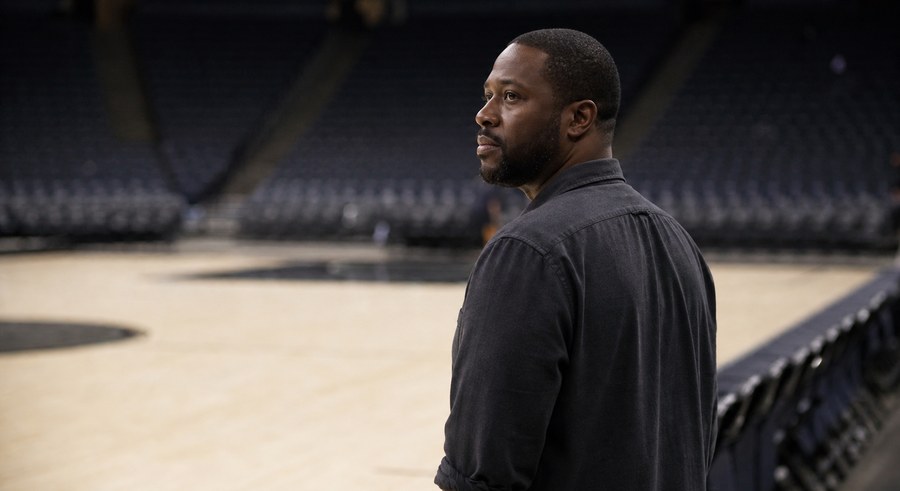
Cam Ellis has the Warriors at rotation level. Minutes, lineups, load management, the aprons, and the arithmetic of a core that is not getting younger.
He covers what the team did, not what it means to the city that has to live with it. That second thing is the culture column, and the line between them is deliberate.
When he files: daily in season, weekly through the offseason.

Wes Ferry has Michigan football. A hundred and forty seasons of Saturdays in a town of a hundred and twenty thousand people, and what that arrangement asks of everyone involved in it.
He writes the program as a place before he writes it as a depth chart. That is a choice with a cost, and he knows it: a reader who wants the two-deep parsed by Wednesday is better served elsewhere, and he will tell you so. What he is for is the week a season turns, the player nobody expected to matter, and the difference between what a program says it is and what it does in November.
When he files: weekly through the season, more when the schedule earns it.

Nell Barton has Michigan basketball, which is the most legible sport on this site and she treats it that way.
Crisler holds thirteen thousand and a rotation is eight men deep, so a lineup change is visible in a way a football scheme change never is. She writes minutes, matchups, and what the tape shows rather than what the box score implies. When the model has an opinion about a Michigan game, hers is the desk that says whether the tape agrees.
When she files: weekly once the season opens. The section is deliberately quiet until then.

Eli Guerrero has the men's national team. Who is playing at his club and who is not, counted in minutes, and what that count does to the next squad. The projection on the squad page is his, and it is graded every window against the list the coach actually names.
He is impatient with romance on a beat that produces a great deal of it. A friendly result is not a finding, a call-up is not a story until it displaces somebody, and ninety minutes every two months is the smallest sample on the site, so he does not grade anyone on it. The 2030 question gets asked of every player, and never instead of them.
When he files: every Monday on the week's pool report, every FIFA window, and when a club decision changes the squad.
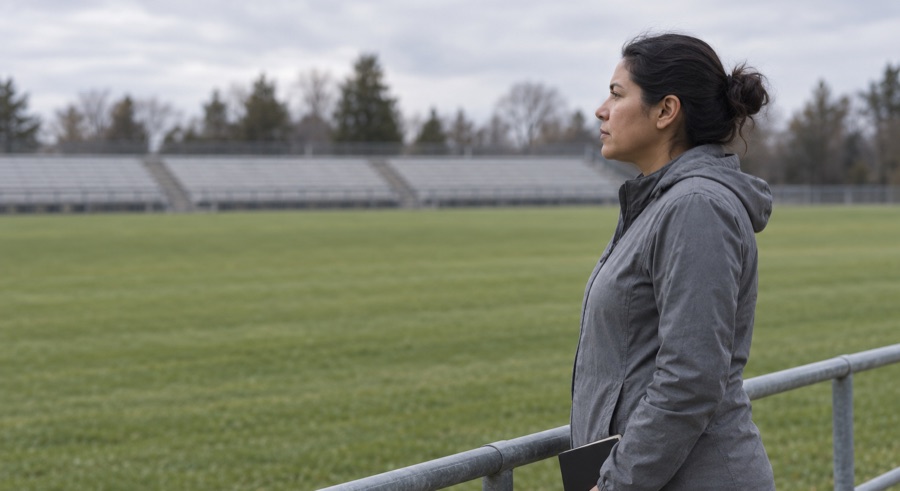
Maya Arguello has the women's national team. The gap between the pool and the twenty-three who go to Brazil in 2027: who entered the conversation this month, who left it, and what the coach's last squad said about where she actually is.
She is direct about a programme that gets written about sentimentally almost everywhere else. Four World Cups are context for the 2027 squad, never a substitute for assessing it. An NWSL performance is evidence and an NWSL narrative is not, and six league starts is six league starts, said plainly every time.
When she files: every Monday on the week's pool report, every FIFA window, and when a selection changes.
What is on the site#
Alongside the writing, each section keeps standing pages that get updated rather than published once and abandoned.
- The 53-Man Tracker grades every 49er 0 to 10 on making the initial roster, updated through camp and scored against the real 53 on cut day.
- Called Shots is every falsifiable call made here, dated, and marked held-up or missed when reality settles it.
- The Sharks prospect board ranks the top 30 Calder-eligible prospects every Tuesday, with what each one did in the seven days before, and every back edition stays up.
- The Giants farm report runs weekly through the season, level by level, and every back edition stays up.
- The 2027 MLB draft order refreshes daily, because the Giants cannot pick higher than tenth this year and that is worth explaining once and then tracking.
- Roster pages for the 49ers and the Sharks, reconciled against what the teams actually did rather than whatever a stale feed still lists.
- Trophy rooms for every section, including the one with nothing in it.
- The national-team squad pages and pool reports. Each of the two sections opened in September 2026 keeps a squad page drawn on a pitch, the men's built around the next call-up list and the women's around the 2027 World Cup squad, and a weekly pool report (USMNT, USWNT) compiled from club numbers, with the coverage denominator printed on every edition.
The Michigan sections, the two national-team sections and the NCAA model are the thinnest here, and they fill in as their seasons arrive: football through the fall, the national teams window by window from September, basketball and the model from November. Nothing goes into them to make them look busier than they are.
The rules#
Every call gets graded. The Called Shots is a running list of predictions made here, dated, left up permanently, and marked held-up or missed when reality settles them. Nothing gets quietly deleted. The 53-man roster projection gets scored against the real 53 on cut day, including the misses.
This is the part of the site I care most about. It is easy to sound smart in July. The ledger is what makes it cost something.
Old pieces stay as they were written. The archive is dated, not tidied. A June target board that named the wrong free agent stays up saying exactly what it said in June, because a record you are allowed to edit afterwards is not a record.
That rule covers the bylines too. A large part of the archive is bylined "Grab Some Pine," from before the desks existed, and it is staying that way. A name on a piece means that writer actually wrote it, not that it resembles their voice or covers their subject. Handing out bylines retroactively would have given the masthead a fuller archive on day one and made every byline mean slightly less.
Reported and analyzed are different things, and they get labeled. When a beat writer reported something, they get the credit by name. When it is my read of the tape or the cap sheet, it says so. "Per the coach" and "here is my guess" are not the same sentence and they should never look alike.
Uncertainty gets stated, not hidden. If a number is a model projection rather than a signed contract, it says that. If a claim rests on one source, it says that too. Where a ranking belongs to somebody else, it carries their name.
Sources get credited by name. This site reads a lot of excellent work by people who do this for a living: The Athletic, San Jose Hockey Now, NBC Sports Bay Area, and others. When their reporting informs a piece here, they are named in the piece. Original reporting belongs to the people who did it. What you get here is synthesis, analysis, and opinion built on top of it, which is a different job.
Photographs are licensed, and each one is credited with its photographer and licence on the image credits page.
The name#
Mike Krukow says "grab some pine, meat" when an opposing hitter strikes out, and has for long enough that it belongs to Giants broadcasts the way fog belongs to the Sunset.
Here it means the friendlier version. Pull up a bench. Sit down a while. This site has no affiliation with Krukow, the Giants, or anyone else; the name is a tip of the cap from someone who grew up with that voice on in the other room.
Follow along#
Every piece lands on Bluesky as it publishes, and the site has carried a full-text RSS feed from day one. Those are the two ways to come back without remembering to. No newsletter, no notifications, no algorithm deciding what you see.
Contact and corrections#
Corrections are welcome and get made in the open. If something here is wrong, it gets fixed in the piece and the fix is noted, rather than edited away quietly.
This site has no affiliation with the San Francisco 49ers, San Jose Sharks, San Francisco Giants, Golden State Warriors, the University of Michigan, the NFL, NHL, MLB, NBA, or NCAA.