Sam Dickinson Was Better Against The Best Forwards He Faced Than Against The Worst Ones
The Sharks 25, No. 5. San Jose kept its teenage defenseman away from the other team's top line all of last season and fed him depth minutes instead. He won the minutes he was protected from and lost the ones he was handed. That is the argument for taking the protection off, and a club chasing a playoff spot after seven misses has an obvious reason not to.
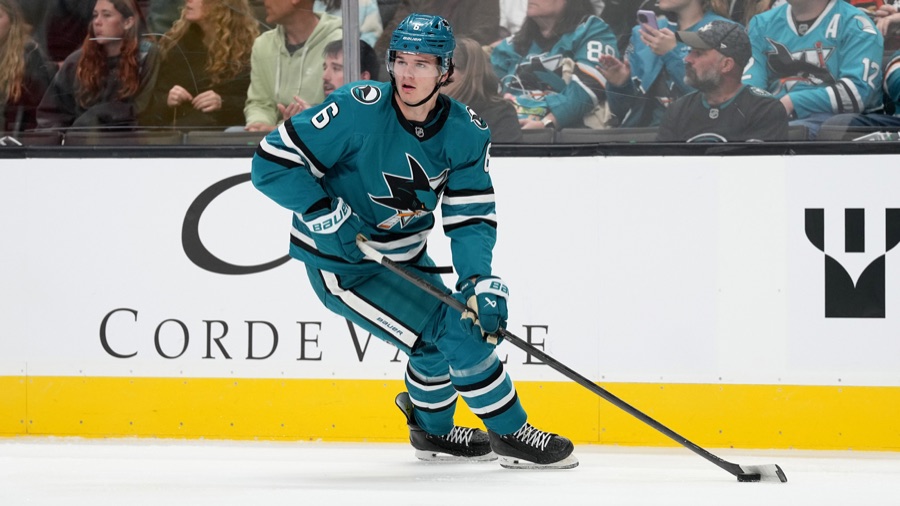
Take the even-strength minutes Sam Dickinson played last season and split them by the quality of the forwards on the other side of the puck. PuckIQ's WoodMoney model does that for you, in three tiers of opponent. Now read his season from the hardest tier down.
Against elite competition he played 220.7 minutes, 23.2 percent of his even-strength time. San Jose outscored the opposition 15 to 11 with him on the ice, and his share of danger-adjusted unblocked shot attempts ran 5.2 points better than his own teammates managed against the same tier.
Against the softest tier he played 385.1 minutes, 40.4 percent of his time. San Jose was outscored 19 to 12, and that same figure against his teammates ran 9.0 points worse.
Both samples are small. What they do is point the same way on two instruments, goals and shot quality, and that way is the opposite of what a protected rookie is supposed to produce. He was hardest to score on in the minutes the staff was working hardest to keep him out of.
Where the shelter actually was#
Ryan Warsofsky pointed Mario Ferraro at elite forwards for 39.0 percent of his even-strength time last season and Dmitry Orlov for 35.3. Dickinson got 23.2. Same roster, same coach, same year, and roughly sixteen points of separation between the rookie and the man given the shutdown job.
He was not protected anywhere else. Hockey Reference has his offensive zone start share at 46.7 percent, the lowest of the six defensemen San Jose has under contract this season. He averaged 16:45 a night across 72 games, third in total minutes on the blue line, and killed penalties at 0:54 a game.
What he did not get was the power play. He averaged 0:18 a game, about 22 minutes all season. John Klingberg and Orlov had that job, at 2:57 and 2:28 a night, and Klingberg announced his retirement on September 11.
Why the cheapest defenseman is the important one#
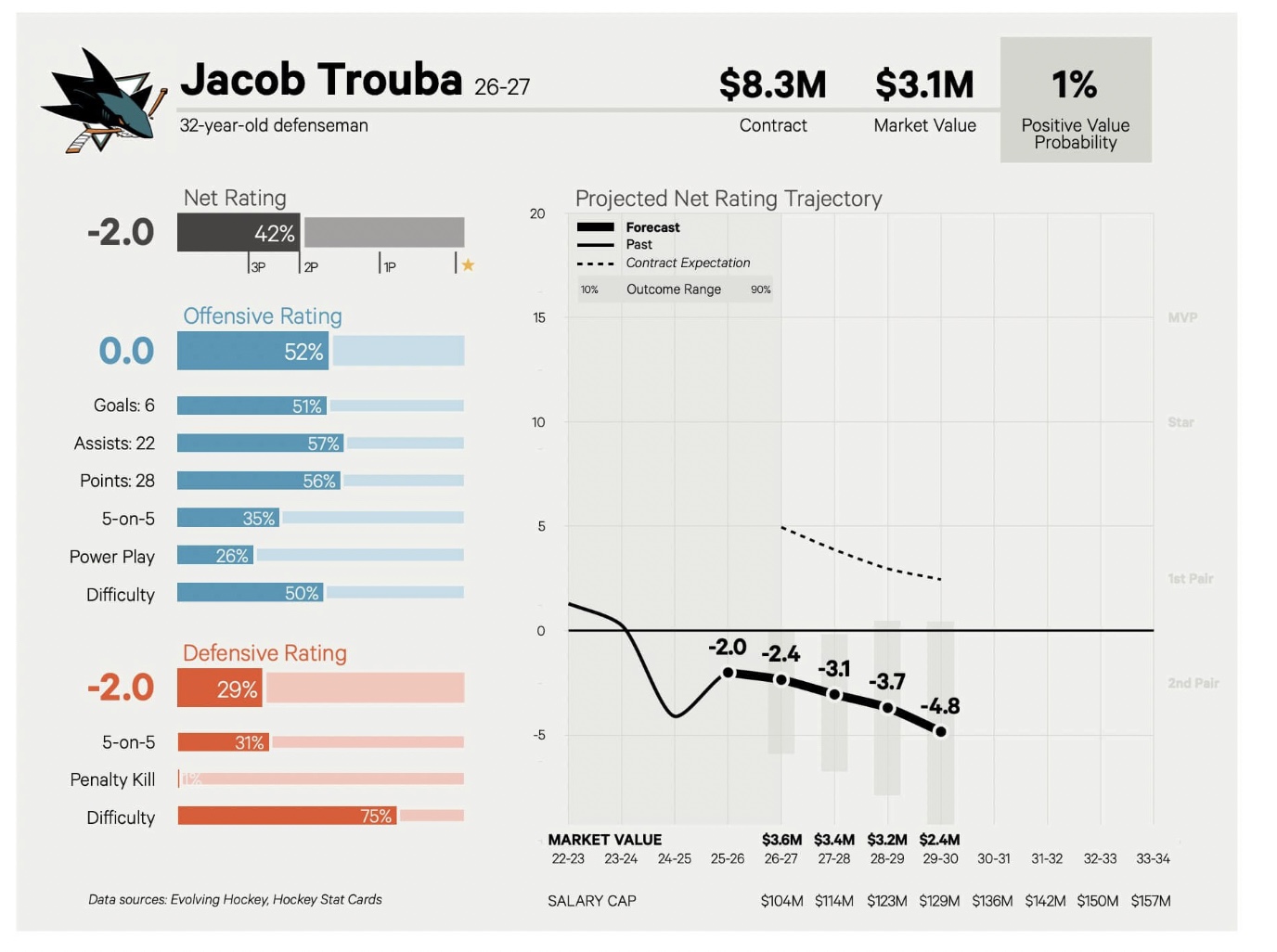
San Jose bought this blue line. Darnell Nurse at $9,250,000 and Jacob Trouba at $8,250,000 are signed through 2029-30. Dickinson is the piece the club drafted, at a cap hit of $953,750 this season and next, per PuckPedia.
That arithmetic works one way. If the 20-year-old handles the hardest even-strength minutes, the $17,500,000 of Nurse and Trouba becomes depth. If he does not, that money is the top pair for four more years, and San Jose is paying market rate for what its own draft was supposed to produce.
Best case for San Jose#
The elite share climbs from 23.2 percent toward the 35-to-39 band Ferraro and Orlov lived in, and the relative results hold when it does. That is worth more to this club than points are. Warsofsky stops having to hand the other team's first line to two veterans in their thirties, and the next two blue lines get built around a defenseman already under contract.
The offense would follow a deployment decision rather than a development one. He attempted 199 shots last season and got 72 to the net, 36.2 percent. Klingberg is gone and Orlov is in the last year of his deal, so a point on one of the two power-play units is open for the first time since Dickinson arrived.
Three arguments against that, and the first one is real#
One. Twenty-three percent elite exposure was a decision, not an accident, and the people who made it watched every shift. Professor Hockey's September 1 read is that the squeeze tightens rather than loosens, because the club is now chasing a playoff spot and "those risks become more risky," and that Dickinson ends up "a 20 to 25 point defensive defenseman."
Two. The soft-minutes sag is not nothing. Minus 9.0 came in the 40.4 percent of his season that was his largest tier, and the simplest reading is a 19-year-old who locked in for marquee shifts and drifted through the grind ones. That is a consistency problem, and consistency does not get fixed by harder assignments.
Three. He committed 83 giveaways against 20 takeaways in 1,206 minutes. Elite forwards punish that more than depth forwards do, which is a reason the 220 minutes could be the noisy number rather than the true one.
Worst case for San Jose#
Not that Dickinson is bad. That the club, seven seasons out of the playoffs and finally trying to end it, protects itself for a second straight year. The elite share stays near 23 percent, the power-play column stays near zero, and San Jose reaches next summer still not knowing whether its own first-round defenseman can carry a top pair, while the two men carrying it are signed through 2029-30.
That is where his interests and the club's come apart. A comfortable role and clean counting numbers are fine for him. For San Jose, a season that answers nothing is a season spent paying $17,500,000 to avoid the question.
What to watch in October#
The power-play column, and it takes one box score. Dickinson has never averaged more than 0:18 a game there. If he is on a unit in the opener against Florida on October 1, the muzzle is off and this staff has changed its mind about what he is for.
Then the zone-start split, which takes longer and says more. Dickinson's 46.7 percent was the lowest on the roster last season and Nurse's at Edmonton was 52.3. Watch which of the two starts more shifts in his own end this year. Watch the raw possession share too, and use the raw one, because a figure measured against your own teammates does not travel between teams. Dickinson and Nurse both finished last season at 47.8 percent of shot attempts, Dickinson for an 86-point San Jose and Nurse for a 93-point Edmonton. Fifty is even. Neither got there.
The stakes#
Zeev Buium went 12th overall in 2024, one pick after Dickinson, and signed an eight-year extension with Vancouver on September 4 worth $75,040,000, an average of $9,380,000 beginning in 2027-28. Dickinson cannot sign anything until July 1, 2027 and is a restricted free agent in 2028.
The window for eight-year contracts closes Tuesday. Under the agreement that starts Wednesday, the longest deal a club can give its own player is seven years. San Jose will negotiate Dickinson's second contract on that shorter ceiling and on whatever this season puts in the file. Another year at 23.2 percent and the file will not say whether it is buying a top-pair defenseman or a good third one.
Previously in this series: No. 6, Ivar Stenberg.
Sources: PuckIQ WoodMoney, 2025-26 San Jose skaters, elite and gritensity tiers, read 2026-09-13, for the competition splits, tier ice time, tier goals and the relative danger-Fenwick figures. Hockey Reference's 2025-26 San Jose and Edmonton team pages, advanced-stats and time-on-ice tables, read the same day, for zone starts, shot attempts, shot-through rate, takeaways, giveaways, Corsi share and the even-strength, power-play and shorthanded splits. PuckPedia for cap hits and contract years, and for the Buium contract. San Jose Hockey Now, September 12, 2026, for John Klingberg's retirement, which he announced on September 11. Professor Hockey, September 1, 2026, for the storyline on Dickinson's role. The club's 2026-27 schedule for the October 1 opener.