Sort San Jose's Blue Line By Zone Starts And Sam Dickinson Is At The Bottom
Mike Grier said in July that Darnell Nurse and Jacob Trouba were brought in so San Jose would not have to force young defensemen into roles they are not ready for. Last season every defenseman now under contract started more of his even-strength shifts in the offensive zone than the 19-year-old did.
Here is one instruction, and following it is most of this piece.
Take the six defensemen San Jose has under contract for next season. Sort them by the share of their even-strength shifts that began with a faceoff in the offensive zone last season, highest first. Then read the list from the bottom.
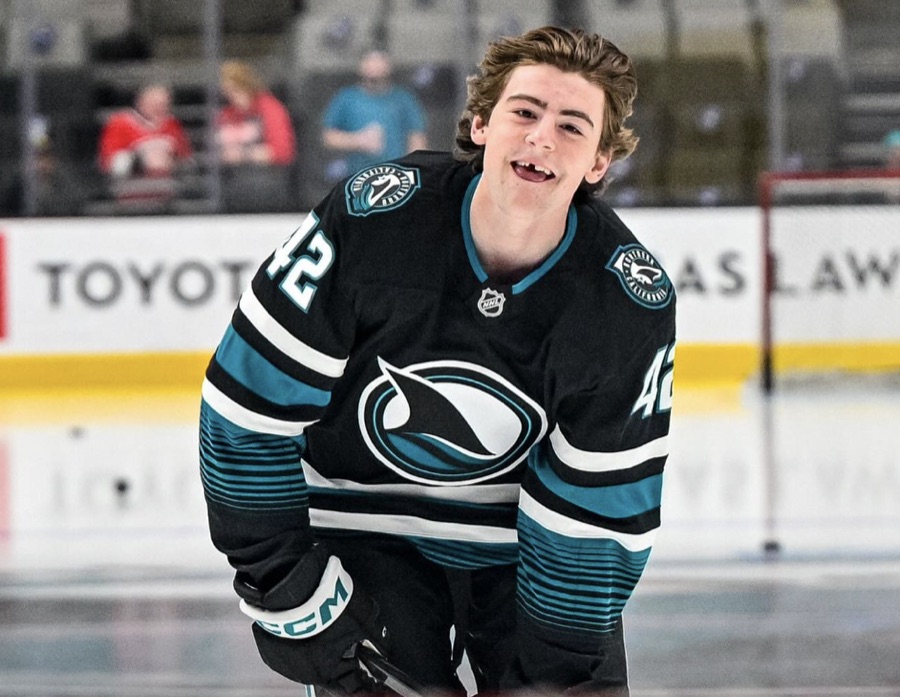
The bottom is Sam Dickinson at 46.7 percent, which he posted at 19 years old across 72 games, one goal and thirteen assists, in the only NHL season he has ever played. Nobody else the Sharks are paying to play defense next year was started in his own end as often as the rookie was.
The four defensemen who took San Jose's defensive-zone faceoffs are all gone
Share of even-strength shifts beginning with an offensive-zone faceoff, 2025-26, per Hockey Reference. The population is every defenseman who played 40 or more games for San Jose last season, plus all six under contract for 2026-27, which is eleven men. Bars run from zero to one hundred, and fifty percent is an even split, so the finding here is the order rather than the length. Teal bars are signed for next season.
The four lowest bars all belong to men who will not be in the room when camp opens. Klingberg sits near the top and is also gone, which cuts against the tidy version of this and is why he is on the chart rather than in a footnote.
Two more names fell under the forty-game line and are off the chart for that reason: Nick Leddy at 54.9 percent in 32 games and Vincent Iorio at 51.6 in 21. Both started higher than Dickinson, so putting them back changes the top of the list and not the bottom.
Grier's deployment claim, July 2#
Mike Grier held a media availability on July 2, the club posted the video, and Sheng Peng of San Jose Hockey Now has him on the record from it:
"Having these two guys on the back-end will allow us to not have to rush any of our young defensemen prospects, and not force them into roles maybe they're not ready for."
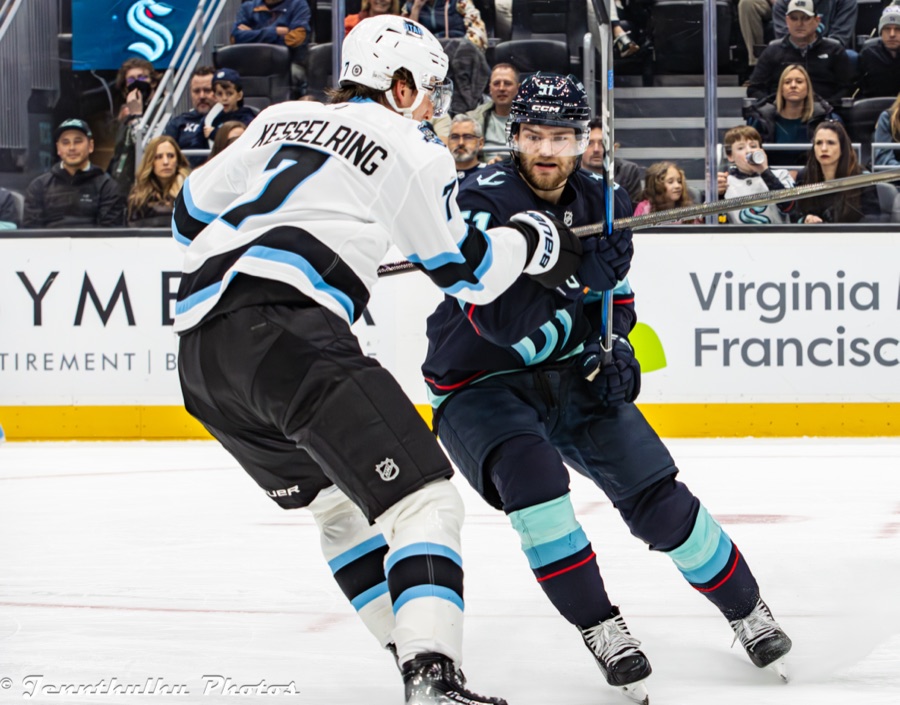
One honest wrinkle before that gets used as evidence. Peng's piece is built around Nurse and Trouba, so that is who "these two guys" reads as. Sharks Hockey Digest carried a version of the same remark the same day pointing at Michael Kesselring and Trouba instead. Two outlets, one availability, two different pairs, and nothing here needs the disagreement settled: all three men were added this summer and all three sit above Dickinson on the chart.
Read the quote carefully, because it is more specific than the usual offseason noise. Grier is not talking about the cap sheet or about ice time in the aggregate. He is talking about a role, and a role on defense is mostly a coach's answer to one repeated question: when the puck goes in our end, who do I send over the boards.
Last season, under Ryan Warsofsky, the four defensemen he sent out for that shift most often were Vincent Desharnais and Timothy Liljegren, both at 36.6 percent offensive-zone starts, Mario Ferraro at 39.4 and Shakir Mukhamadullin at 42.9. Every one of them is off the cap sheet. PuckPedia has exactly six defensemen signed for 2026-27, at $30,373,750, which is 29.2 percent of a $104 million upper limit, and none of the four is among them.
Ferraro went to Winnipeg. The Jets announced him on July 2 at three years and $12 million, a $4 million cap hit, after seven seasons in teal.
Three arguments against me#
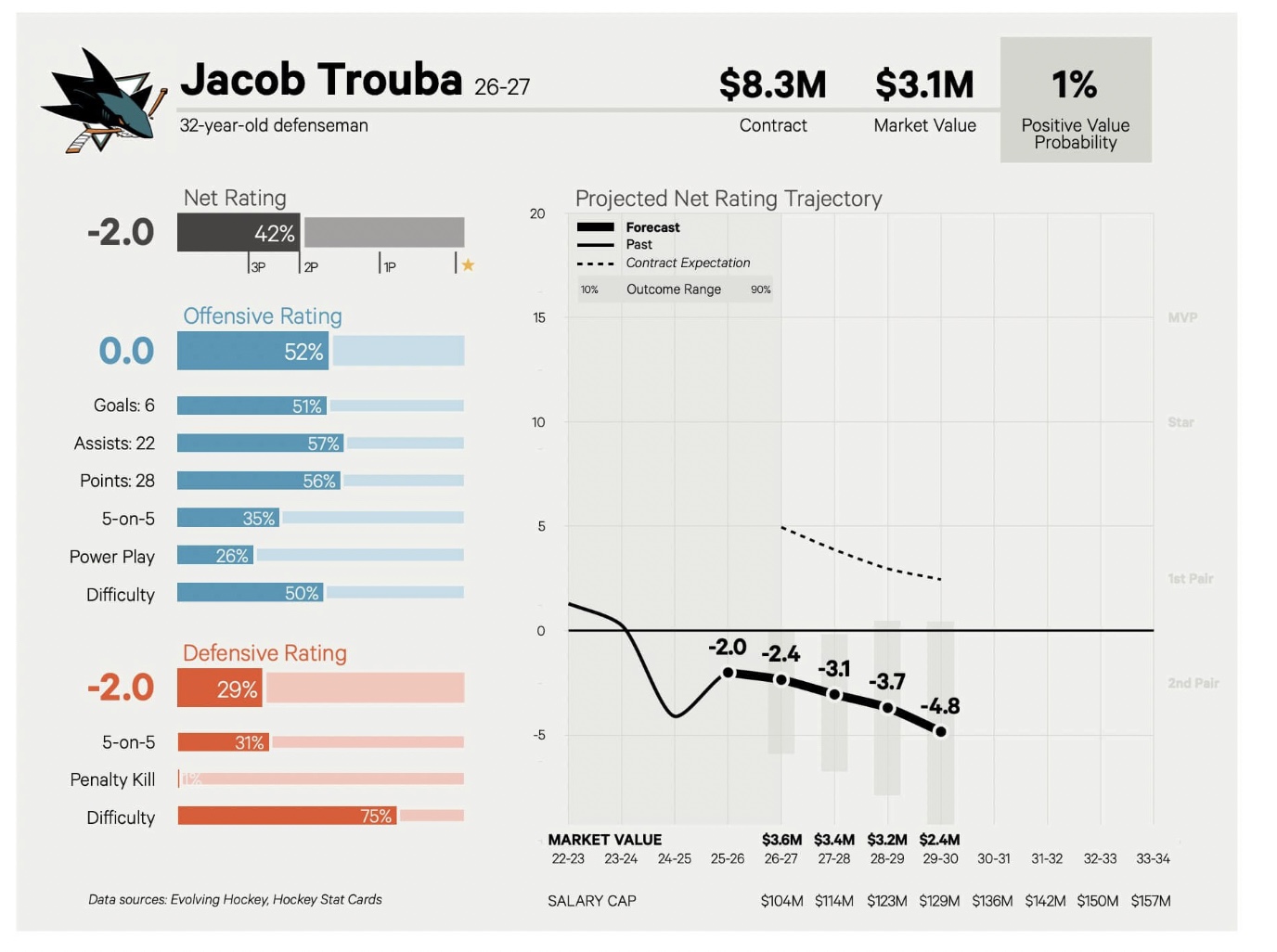
Trouba genuinely does the hardest job on the list. In Anaheim last season he averaged 3:04 a game shorthanded across 81 games, which is within twenty seconds of what Ferraro was doing in San Jose at 3:22. San Jose killed at 76.42 percent against a league average of 78.89, and it just lost Ferraro's 3:22 and Desharnais's 3:13. Trouba is the answer to that specific problem and he is a good one. Nurse averaged 1:29 shorthanded, Kesselring 0:49, Orlov 0:46, Dickinson 0:54.
Volume is its own kind of difficulty. Trouba played 22:50 a night in all situations and 19:03 of it at even strength; Nurse played 20:58 and 19:14. Dickinson played 16:45 and 15:32. Handing a rookie sheltered starts inside a fifteen-minute night is not the same job as handing a veteran neutral starts inside a nineteen-minute one, and anybody who tells you the zone-start column settles that comparison is selling something.
Zone starts are a decision, not a property of the player. Every number above is a record of what four different coaching staffs chose to do, on four different teams, in four different systems. Warsofsky is free to spend October starting Nurse in his own end, and if he does, then everything above is a description of the past and carries no claim about the season that has not been played.
The blind spots#
It has no quality-of-competition component, so it cannot tell you whether Dickinson's defensive-zone starts came against fourth lines. It is even strength rather than five-on-five, which folds in four-on-four, three-on-three and empty-net shifts, so treat it as a close proxy for the five-on-five version rather than the thing itself. The site that computes the true five-on-five splits, Natural Stat Trick, was serving a bot-verification page rather than a table when this was written on Saturday morning, and working around that is not on the table, so the proxy is what there is and the label travels with it.
One more caution on a number that looks like a comparison and is not. Nurse's relative Corsi last season was 4.2 points below his Edmonton teammates and Dickinson's was 1.0 above his, but Edmonton finished with 93 points and San Jose with 86, so those two figures are graded against different classes. The version that survives the trip between teams is the raw one, and it landed in the same place twice: at even strength Nurse finished at 47.8 percent and Dickinson finished at 47.8 percent.
Cagnoni's three games#
Cagnoni's 58.8 percent tops the chart and it is built on three NHL games and 54 minutes and five seconds of total ice time across an entire season. Three games is not a sample, it is an anecdote with a decimal point. It is on the chart because dropping one of the six men under contract to make the picture cleaner is exactly the move this site is supposed to refuse, and because the size of that season is the actual story on him. San Jose's 21-year-old defenseman spent a year not playing, and his contract expires next summer while Nurse's and Trouba's run to 2029-30.
Grier's argument is that the veterans exist so the young defensemen are not forced into roles they are not ready for. Judged on last season's deployment, the only man on the roster who has been taking that role is Dickinson, and he was 19 while he took it. Trouba answers the penalty-kill half of the question and answers it well. Nobody in the group answers the even-strength half. So either Warsofsky changes how at least one of these veterans has been deployed for years, or Dickinson keeps the assignment, and San Jose will have spent $17.5 million a year on two men to protect him from a job he is still doing.
I will put a number on it. Dickinson finishes 2026-27 with a lower even-strength offensive-zone start rate than Nurse. Same table, same site, one line each, scoreable next April by anybody with a browser. If the protection argument is true in the way it was sold, that call loses.
Sources. Zone starts, on-ice Corsi, ice time and games played from Hockey Reference's 2025-26 team and player pages, opened Saturday August 8. Contract terms, ages and the 2026-27 roster from PuckPedia's Sharks cap sheet. Ferraro's terms from the Winnipeg Jets' own release of July 2. The Grier quote is Sheng Peng's reporting for San Jose Hockey Now from the July 2 media availability the club posted to its own site, with a same-day version of the same remark at Sharks Hockey Digest. Natural Stat Trick was unreachable.