Tyler Toffoli Lost Eleven Goals Last Season And Not One Of Them Came Off The Power Play
The Sharks 25, No. 12. His man advantage produced six goals and nine assists in 2024-25, then six goals and nine assists again in 2025-26. Everything that fell, fell at even strength, and the projections now have him off both units.
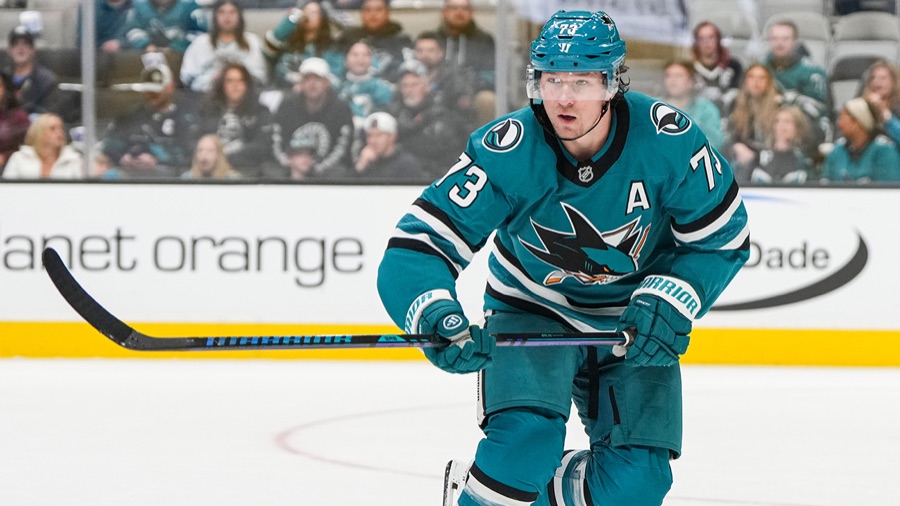
Six goals, nine assists, fifteen points. That is what Tyler Toffoli's power play produced in 2024-25.
It is also what his power play produced in 2025-26.
Not close to it. It. Hockey Reference has him at 240.8 power-play minutes in 2024-25 and 232.9 in 2025-26, 3:05 a night and then 2:57. Same job, same minutes, same six goals, same nine assists.
His goal total across those two seasons went 30, then 19.
All eleven of the missing goals were even-strength goals. His even-strength total fell from 24 to 13. The power play did not give up a point.
The share#
Of the 29 skaters San Jose dressed in 2025-26, nobody gave a larger share of his ice time to the power play than Toffoli did. His was 19.6 percent, ahead of Will Smith at 18.2 across 69 games, Macklin Celebrini at 17.1 across all 82, Alexander Wennberg at 16.3 and William Eklund at 15.7. Sorted off the club's own time-on-ice table, he is first, and not by a tie.
The rate and the total rank him differently, so both need saying. By power-play minutes per game he was fifth at 2:56, behind Celebrini, Wennberg, Smith and John Klingberg. By total power-play minutes he was third, because Klingberg dressed 56 times and Smith 69 against Toffoli's 79.
The other end of the sheet is emptier. Toffoli played one minute shorthanded all season. Not one minute a night. One minute, total, in 79 games, and he has not had a penalty-kill role since 2022-23.
So the 14:59 on his card is one job plus a fifth of a job. Underneath it, his even-strength rate was 12:01, ninth among the 19 forwards who dressed.
Why it matters now#
The power play is the one assignment on this roster with a line of people waiting for it. Professor Hockey's August 12 point-total board put Toffoli at 30 for 2026-27, on a structural argument: San Jose now has ten top-nine forwards and eight forward seats across two power-play units, so two of the ten sit. He named Toffoli among them. Fifteen days later he published his opening-night units, with Celebrini, Luca Cagnoni, Smith, Wennberg and Mason Marchment on the first and Michael Misa, Michael Kesselring, Ivar Stenberg, Igor Chernyshov and Kiefer Sherwood on the second. Toffoli is on neither.
He also flagged it as the call he trusts least: "maybe a little controversial, probably one that I'm not super confident in. I very well could be wrong." His reasoning is not that Toffoli declined. It is that last season's second unit finished as Misa, Chernyshov, Eklund and Sherwood, that Stenberg is a side grade for Eklund, and that keeping Sherwood high changes least. He expects Toffoli on a unit eventually.
Best case#
San Jose's power play does not have a seat for him, and it is better for it.
Toffoli played 2:56 a night on the man advantage last season, behind only Celebrini, Wennberg and Will Smith. The best case is that those minutes go to Michael Misa, Igor Chernyshov, Kiefer Sherwood and Ivar Stenberg instead, and that the group is good enough that nobody misses the 15 power-play points. That unit is not a rebuilding concession. Chernyshov scored nine goals in 28 games here at 20; Misa arrives with a full season in front of him for the first time; Sherwood put up 23 goals in 72 games last season. San Jose finds out what it has in them, on the one part of the ice where a young forward's mistakes are cheapest, and it finds out this October rather than in 2028.
What makes that the best case rather than a write-off is the half of Toffoli's game that did not move. Strip the man advantage out of last season and he was still a 34-point player at even strength in 79 games, 13 goals and 21 assists. Professor Hockey's 30 is a forecast over an 84-game schedule, and it sits below the even-strength half of Toffoli's own 2025-26 by itself. Thirty-four even-strength points from a winger playing down the lineup is a real thing to have. The best case does not need him to improve, and it does not need him on the power play. It needs him to hold that half while somebody younger takes the minutes he is no longer the best answer for.
Worst case#
He keeps the power-play seat, and the money keeps him in the lineup after the rest of it has gone.
The decline that took his even-strength goals from 24 to 13 does not stop. His shot volume falls again from last season's 172, his expected goal share on the ice drops with it, and by December he is a fourth liner playing 12 or 13 minutes who is miscast in the role, because a checking line wants a forechecker and he is a finisher without the volume to finish. That version of Toffoli should be a healthy scratch some nights.
He will not be, and the reason is on the sheet rather than the ice. He is $6,000,000 against the cap this season and $6,000,000 again next, per PuckPedia, on a winger who turned 34 in April and turns 35 during this one. A coaching staff does not sit that number, and a club that sits it has to explain why it is paying it. So the worst case is not that San Jose gets a fourth-line season out of a $6,000,000 winger. It is that the fourth-line season keeps getting dressed, the power-play minutes stay with him because he is the veteran, and the two seasons the young forwards should have spent taking those minutes are the two seasons this contract runs.
Three arguments against me, and the first one is real#
1. The source I am leaning on told you not to lean on him. Professor Hockey flagged the Toffoli call himself and said he expects him on a unit eventually. A projection with a hedge on it is evidence about a lineup question, not a verdict, and hardening it past its author would be my error, not his.
2. His even-strength assists went up, 15 to 21. He did not stop contributing at five-on-five. He stopped finishing there, and those are different injuries.
3. His shooting rate was close to normal. He shot 11.0 percent last season against 11.6 across 969 career games and 2,657 shots. The goals did not vanish into a cold streak. They vanished with 61 shots, and shot volume follows ice time.
What to watch early, and it is in every box score#
Power-play time on ice, first two weeks. Over two minutes a night says he held a unit and the least confident call on the board missed. Under a minute says the units opened as drawn.
Even-strength time is the second reading on the same line. Above 13:30 says losing the power play bought him five-on-five minutes, the trade that keeps his goal total alive. Stuck at 12 says he lost the one and gained nothing.
Then the even-strength goals. He needs the first one early: 13 in 79 games is a pace that produces long stretches without one, and a 34-year-old winger who goes ten games dry in October hears about the contract before he hears about the shot.
The stakes#
San Jose has not made the playoffs in seven seasons. The last berth was 2018-19, and last spring's 39-35-8 was the best year of the rebuild.
Toffoli is not the reason this team makes it or misses, which is why he is twelfth on this list. He is two years of committed money attached to a skill the roster has been steadily buying replacements for, and the season answers whether the club still has a use for the one thing he has done at the same rate two years running. That answer starts arriving on the special-teams line of the first box score, October 1.
Yesterday: No San Jose skater started as often in the offensive zone last season as Mason Marchment did in Columbus.
Sources: Hockey Reference for San Jose's 2025-26 time-on-ice, advanced and skater tables, and for Toffoli's career, per-strength and advanced pages. PuckPedia for the cap hits, contract years and age. Professor Hockey, August 12 for the point-total board and August 28 for the opening-night power-play units, both transcripts.
The best case and worst case above were re-cut on the day of publication, at Court Showerman's direction. As first published, both scenarios were written from Tyler Toffoli's point of view rather than the club's: the best case had him keeping a power-play unit and repeating his 15 power-play points. That is his best case. It is close to San Jose's worst, and in a series about what each man means to this team the scenario belongs to the team. No fact in the piece was wrong and none has been changed. The Called Shots row this article filed has been withdrawn separately, and the reason is on the ledger.
CP