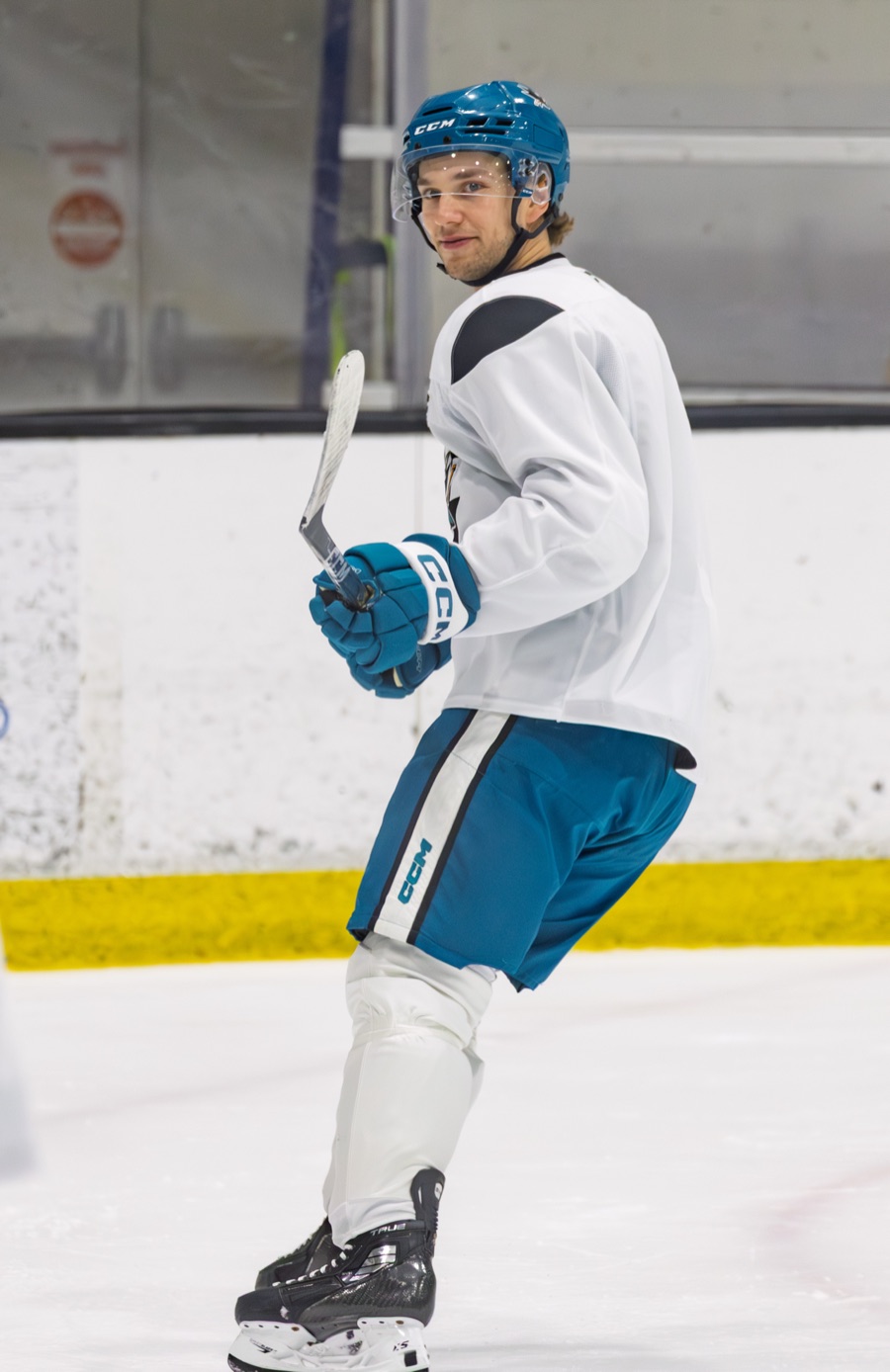
If Quentin Musty Makes The Sharks Out Of Camp, It Will Be For A Skill He Has Not Shown
The Sharks 25, No. 22. Musty put 168 shots on net in 61 games for the Barracuda last season, a rate only Macklin Celebrini beat among the Sharks forwards who played in San Jose. The problem is that the shot is a scoring tool, the jobs San Jose has open this fall are checking jobs, and the two things Corey Pronman grades him below NHL average on are the two a checking job is made of.
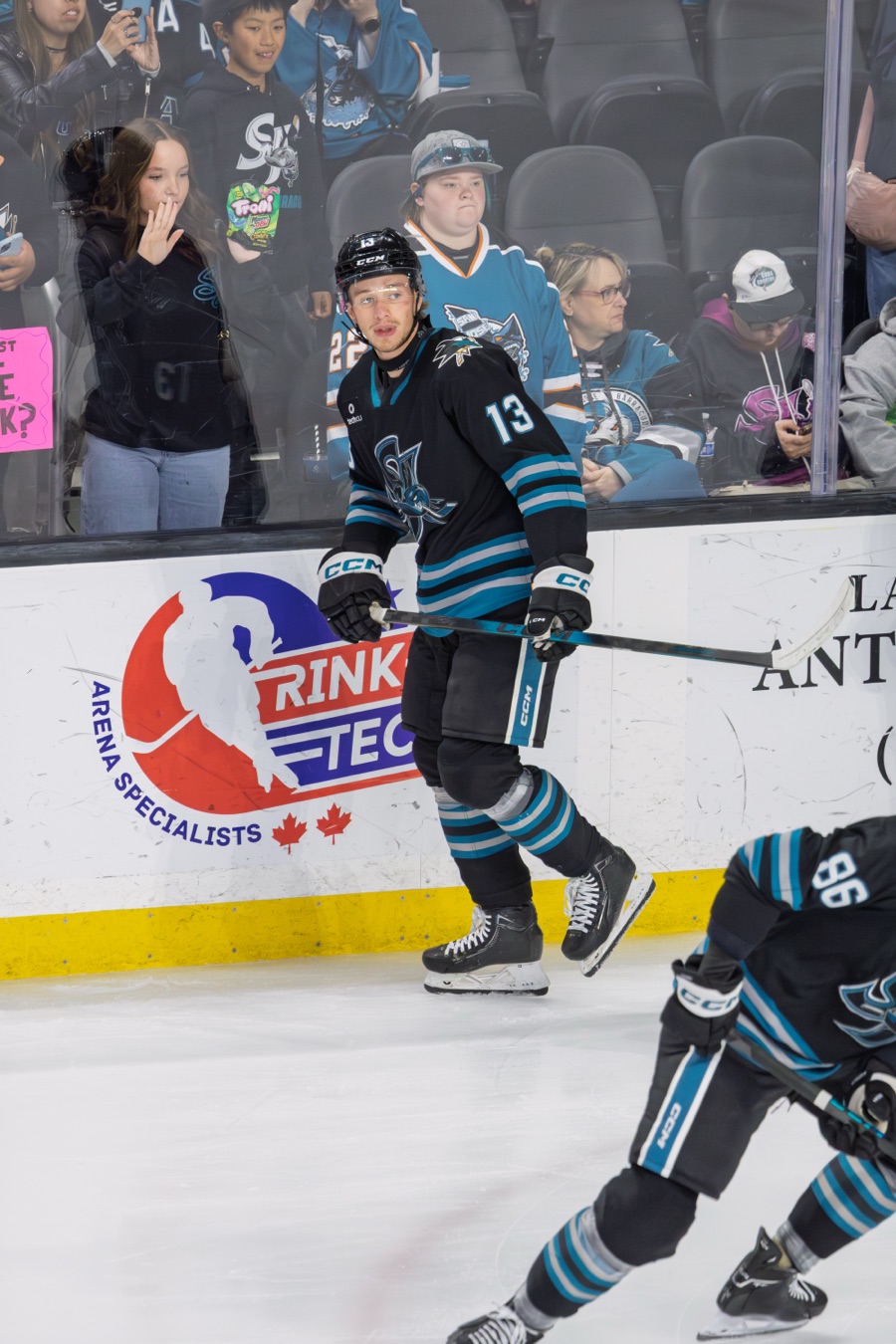
Quentin Musty put 168 shots on net in 61 games for the San Jose Barracuda last season. That is 2.75 a game, and it is the whole reason a 21-year-old who has never played a National Hockey League game is the most interesting forward San Jose owns outside its opening 23.
Set that rate against the twelve forwards under contract for 2026-27 who actually dressed for the Sharks last season, and one man beat it.
One Shark shot more often last season than Musty did in the American Hockey League
Shots on goal per game in 2025-26. The population is the twelve forwards under an NHL contract for 2026-27 who played at least one game for San Jose last season, from the Sharks' final skater statistics, with games played beside each name. Mason Marchment and Ivar Stenberg are absent because neither played for San Jose. Musty's bar is from the American Hockey League and is drawn for reference, not as a rank: shot rates rise as the level falls, so his is the softer number by construction. Axis runs from zero to four shots a game.
The number under the scouting report#
A shot rate is a statement of intent, not of quality, and Musty's conversion is where the honest version lives. Twenty-one goals on 168 shots is 12.5 percent. Filip Bystedt, same team, same season, same building, scored 22 on 119, which is 18.5 percent. Musty fired 49 more pucks at the net than the Barracuda's leading scorer and finished one goal behind him.
Corey Pronman's August 18 pipeline write-up describes a player who "can score goals and is a shot threat from range" and who "plays on the outside at times." Those two clauses are the same clause. Shooting from range at high volume is what a 12.5 percent conversion rate looks like from the inside.
Pronman grades him on five axes and the split is the story of his season. Shot, above NHL average. Hockey sense, above NHL average. Puck skills, NHL average. Skating, below NHL average. Compete, below NHL average.
Why the camp door is the wrong door#
San Jose's top nine is signed and expensive, and there are fifteen forwards under contract before Musty is counted at all. The forwards who could lose a job this fall are at the other end of the sheet, and the work down there is penalty killing, defensive-zone faceoffs and a hard forecheck on eleven minutes a night. Skating and compete are the two tools that job is built out of, and they are the two Pronman puts below the line.
So the scenario in which Musty wins a spot in September requires him to be good at the thing he is graded worst at. The scenario in which he helps this team requires the opposite: an injury in the top nine, a recall, and minutes with a power play attached.
Nothing forces San Jose to choose between them in September, and that is the part worth holding onto. Musty is waiver-exempt. He can be sent down without being offered to the other 31 clubs and brought back the moment the roster needs him, which means the September decision costs the club nothing and settles nothing.
Best case#
He opens on the Barracuda, gets recalled inside the first half of the season, and lands in a scoring role rather than a checking one.
The in-house template for that is one year old. Igor Chernyshov played 28 games for San Jose last season, scored nine goals and added ten assists, and averaged 15:03 a night, which is top-nine ice time. He got there the way Musty would: 41 games in the American Hockey League first, 13 goals and 23 assists, and a recall into minutes rather than into a fourth line.
Worst case#
Not that he plays badly. That he plays another full season in the American Hockey League and San Jose runs out of runway to find out.
His entry-level contract has two years on it and he is a restricted free agent in July 2028. Burn 2026-27 in the minors and the club arrives at that negotiation holding a 22-year-old first-round winger with a strong AHL record and no NHL evidence to price. The version of this that should worry San Jose is his plus-minus: minus-14 across those 61 games, on a team whose leading scorer was minus-2. Plus-minus is a crude statistic, and the usual objection to it is that it grades a player on his own team's quality. Here both men played for the same team in the same season. Whatever separates minus-2 from minus-14 is not the Barracuda.
Three arguments against this, and the first is the one I cannot answer#
One. Comparing an AHL shot rate to NHL shot rates is not a comparison. It is a reference mark, and I have labeled it one twice. Rates rise as the level falls. There is no honest conversion factor between the two columns and I am not pretending to have one.
Two. A 12.5 percent conversion rate on 168 shots moves. Shooting percentage is the noisiest thing on a scoring line and one season of it is thin evidence about a finisher. Bystedt's 18.5 percent is thinner still, on 119.
Three. The camp door has opened before. Max Miller of Sharks Hockey Digest, writing August 14, called Musty's 2025 training camp a very strong one and argued that when there is no room for a prospect, Mike Grier makes room. Musty did not make that opening-night roster. The general claim about how this front office behaves is Miller's, it is real, and my argument needs it to be wrong.
What to watch early, and it is two cells in the same box score#
Not his goals. His shots, and then the percentage on them.
San Jose hosts the Rookie Faceoff on September 12 and 13 and plays four preseason games starting September 20. His shot total there is the first thing available, and if it holds near three a night the volume travels.
The second cell is the one that decides which scenario is running. A player who has found the middle of the ice scores on a higher share of the same number of shots. A player who has not scores on the same share from farther out. By late November there will be enough of both columns, at whichever level he is playing, to tell those two apart.
The stakes#
San Jose has not made the playoffs in seven seasons, since 2018-19, and this is the first roster that makes the question serious. A team on that line does not miss because its best prospect started in the minors. It misses in the three weeks when two top-nine forwards are hurt at once and the man recalled to replace them is a checker. The highest-ceiling forward outside the opening 23 is a scorer, and whether that matters this season depends on which of the two open doors San Jose puts him through.
I called on August 12 that neither Musty nor Filip Bystedt is on San Jose's active roster for the opener against Florida on October 1. That row is still open and I would make it again today. Nothing above argues that he starts the season here. It argues that he finishes it here.
Previously in this series: The Sharks 25, No. 23, Filip Bystedt.
Sources: San Jose Sharks 2025-26 final skater statistics; San Jose Barracuda and American Hockey League 2025-26 skater statistics; PuckPedia, CapWages and Elite Prospects contract and biographical pages; The Athletic, Corey Pronman, August 18, 2026; Sharks Hockey Digest, Max Miller, August 14, 2026.