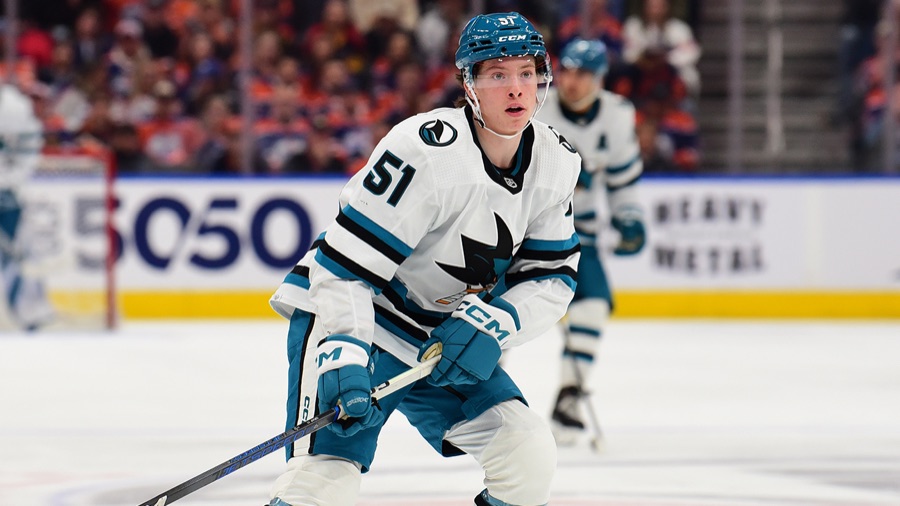
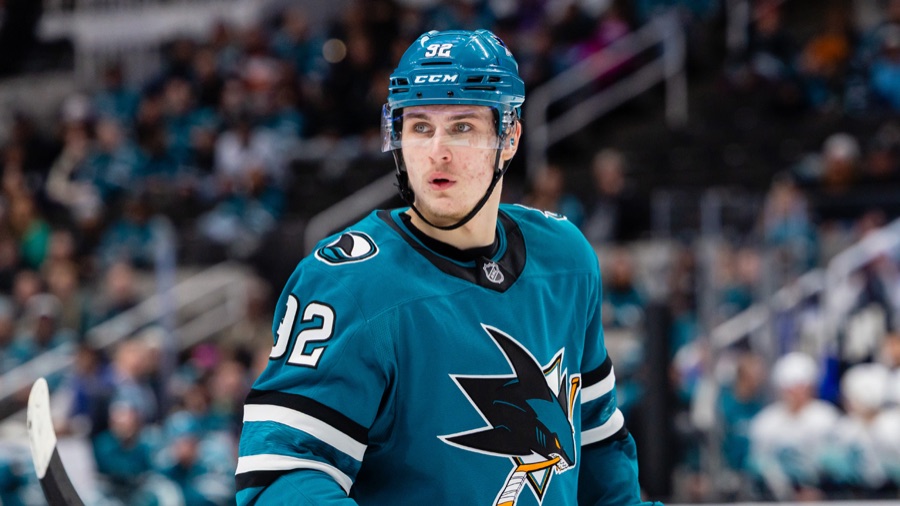
Re-judging the Eklund trade: the data says they sold a rising player at the bottom of his luck

Brendan Farrell's breakdown comes with three pieces of evidence that the box score hides, and together they change the texture of the Eklund trade. Not the verdict, exactly, but the risk. The short version: William Eklund is a meaningfully better player than his 15-goal, minus-25 season says, he was trending up, not down, and the Sharks moved him at the precise bottom of his luck. That does not make the trade a mistake. It does make the downside sharper and the bet more honest to name.
1. The down year was luck and a wrist, not decline#
The first chart is a goals-versus-expected scatter, and Eklund sits clearly below the line: roughly 15 goals on about 23 expected at all strengths, one of the worst finishing seasons in the entire league relative to the chances he generated. That is eight-ish goals of pure shooting misfortune, and it came in a year he was playing through a wrist injury suffered at the World Championships. You do not need a model to know that a 23-year-old who creates 23 expected goals and converts 15 is going to score more next year. Finishing that far below expectation is the single most reliable thing in hockey to bounce back.
2. The skill is real, and the tracking data proves it#
Corey Sznajder's All Three Zones project tracks the stuff that does not show up on the scoresheet, and Eklund's profile is loud. These are standardized scores, so think of anything past +1.0 as roughly a full standard deviation above an average NHLer:
| What he does (5v5, per 60) | vs league avg |
|---|---|
| Deflection assists (tips off his feeds) | about +1.4 |
| One-timer assists | about +1.3 |
| Exit off a retrieval (clean breakouts) | about +1.3 |
| Chances created off zone entries | about +1.2 |
| Controlled entry rate | about +1.0 |
| Exits with possession | about +0.8 |
| D-zone puck touches (the one real hole) | about -0.9 |
That is a textbook modern playmaking winger: he carries the puck in with control, he creates off the rush, and his passes turn into one-timers and tips. The lone weakness is that he does not do much defensive-zone retrieval grunt work, which is fine for a player you are paying to make plays, not to dig pucks out of corners. Farrell's line nails it: "when Eklund has the puck on his stick, something is always about to happen."
3. He was trending up, and was just hitting his stride#
This is the chart that matters most. Micah McCurdy's isolated-impact model (his all-in value over a league-average player, stripped of teammates and deployment) has Eklund climbing a clean staircase, year over year, with no plateau:
| Season | Age | Isolated impact (sG) | Tier |
|---|---|---|---|
| 2021-22 | 19 | about -6.5 | 4th line |
| 2022-23 | 20 | about -7.5 | 4th line (low point) |
| 2023-24 | 21 | about 0 | 3rd line |
| 2024-25 | 22 | about +4.5 | 2nd line |
| 2025-26 | 23 | about +5 | fringe 1st line |
Read that staircase and then remember it happened in the same season his counting numbers cratered. The surface said "down year." The isolated impact said "career best, knocking on the first-line door." Those two things are only reconcilable through the finishing luck, which is exactly the point.
The honest counterweight, so we do not oversell him#
Farrell is careful here, and so should we be. The single-season trajectory is bullish, but the multi-year aggregate is more sober: over the last two years Eklund's 1.73 points per 60 at five-on-five rank 156th in the league, and he sits 188th in HockeyStats' WAR model. McCurdy's "fringe top-line" read is, in Farrell's words, "a little optimistic," and his honest landing spot is "a second-line forward who can be a complementary piece on the top line." The eye test runs a step ahead of the production, and at some point the production has to catch up. So the fair description is not "the Sharks traded a star." It is "the Sharks traded a genuinely good, rising, slightly redundant top-six winger at the bottom of his luck."
So how does the trade grade now?#
It holds up as defensible, but the new information sharpens the one risk that was always lurking. The case for the deal is unchanged and still good: the Sharks had a forward surplus and a defense deficit, Eklund was the most movable of a crowded young top six (Celebrini, Smith, Misa, Chernyshov, with Stenberg incoming), and they turned a redundant piece into the ninth overall pick plus the freedom to draft a defenseman they cannot grow internally fast enough. Stenberg, who is NHL-ready and projects to roughly replace Eklund's offense, is the in-house answer to the production they shipped out. None of that breaks.
What the data does is raise the price of what they gave up. If Eklund's age-24 season in Ottawa is the breakout this trajectory and this finishing regression both predict, the Sharks will have sold at the exact low, and Ottawa will look like it bought a 60-point winger for a mid-first-round pick. That is the live downside, and it is more real today than it was a week ago.
Still a defensible, process-sound trade, but with a sharper sell-low edge than the surface numbers suggested. The Sharks did not move a bad player who happened to have a down year. They moved a rising, good, finishing-unlucky 23-year-old who was at his career-best underlying impact, because he was redundant and the pick was worth more to a team this forward-rich. That logic is sound. The bet they are making is explicit now: that Stenberg replaces the offense and the ninth pick becomes a defenseman, and that those two things together beat what a healthy, regressed-to-the-mean Eklund would have been. If Eklund pops in Ottawa, this ages as a sold-low. Watch his goal total next year. It is the whole ballgame on this one.
Sources: Brendan Farrell, "Ottawa takes a big swing on William Eklund" (My Analytics Corner / Substack, June 24, 2026), with the goals-vs-expected chart (Hockey Stats), Corey Sznajder's All Three Zones tracking, and Micah McCurdy's isolated-impact sG model (hockeyviz.com). Z-scores and sG values are read from the published charts and are approximate. Eklund terms (23, turns 24 in October, 5-foot-10, $5.6M for three more years, traded with Halttunen and Svoboda for the No. 9 pick) and his 15-38-53 line are confirmed against the repo cap file. This sharpens, but does not overturn, the repo's standing "bold, defensible, pending" grade on the trade.