Almost Half Of Dmitry Orlov's Points Came On A Power Play He Is Projected To Lose
The Sharks 25, No. 16. Orlov posted the highest point total of his fifteen NHL seasons at 34 and turned 35 in July, and eighteen of those thirty-seven points came on the power play. Two published opening-night projections leave him off both units.
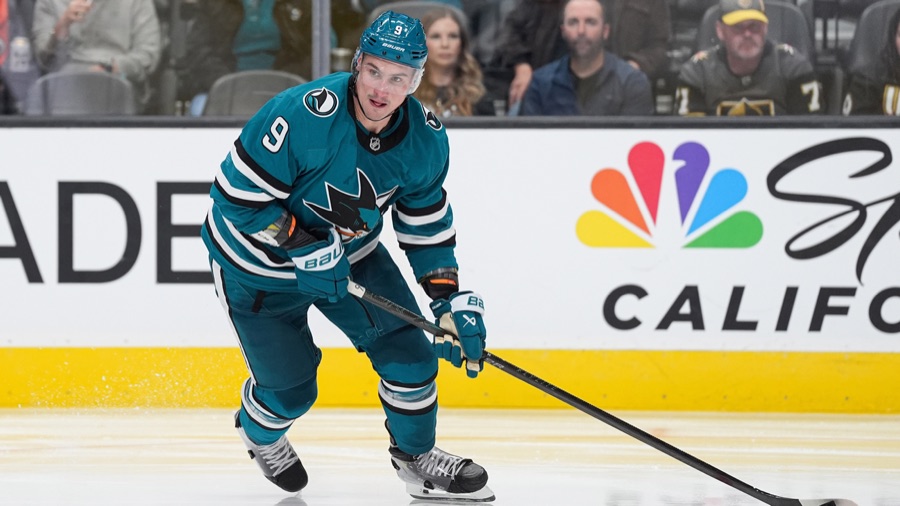
Dmitry Orlov scored 37 points in 82 games for San Jose last season. It is the highest total of his fifteen NHL seasons and he posted it at 34, which is a sentence a rebuilding club is happy to read.
Eighteen of those points came on the power play. One goal and seventeen assists.
He had never had more than eight power-play points in a season before, and that eight was split across Washington and Boston in 2022-23. Seventeen power-play assists is more than triple his old career high of five, which he reached twice. San Jose did not sign a man who produced on the power play. San Jose gave a man the power play and he produced on it.
The other nineteen#
At even strength he scored 19 points in those same 82 games. Orlov has dressed 60 games or more in eleven NHL seasons, and sorted by even-strength points only his 2011-12 rookie year sits below last season, at 17 in 60 games. Nobody is tied with him at 19. His four full seasons immediately before this one produced 20, 27, 27 and 31 even-strength points.
So the career high and the career-low-but-one arrived in the same season, and the difference between them is one special team.
Mario Ferraro played all 82 games on the same blue line and averaged three seconds a night on the power play. He scored 23 points, all of them at even strength. Ferraro is not on San Jose's cap sheet any more.
| Defenseman | Games | Points | Even strength | Power play |
|---|---|---|---|---|
| Dmitry Orlov | 82 | 37 | 19 | 18 |
| John Klingberg | 56 | 27 | 18 | 9 |
| Mario Ferraro | 82 | 23 | 23 | 0 |
| Sam Dickinson | 72 | 14 | 14 | 0 |
| Shakir Mukhamadullin | 50 | 12 | 12 | 0 |
| Timothy Liljegren | 43 | 11 | 9 | 2 |
| Vincent Desharnais | 53 | 7 | 7 | 0 |
| Nick Leddy | 32 | 7 | 7 | 0 |
| Vincent Iorio | 21 | 3 | 3 | 0 |
| Luca Cagnoni | 3 | 0 | 0 | 0 |
Ten defensemen dressed for San Jose last season. Three of them scored a power-play point and Orlov has more of them than the other nine put together.
What the projections do#
Sheng Peng published his opening-night units at San Jose Hockey Now on August 7, with Jack Han and Jason Demers, and put Cagnoni at the point on the first unit and Michael Kesselring on the second. Professor Hockey published his own on August 28: Macklin Celebrini, Cagnoni quarterbacking, Will Smith, Alexander Wennberg at the net front and Mason Marchment on the first; Michael Misa, Kesselring quarterbacking, Ivar Stenberg, Igor Chernyshov and Kiefer Sherwood on the second. Orlov is on neither man's list.
Professor Hockey is not dismissive about it. He says that with Orlov running the show the power play was rather efficient, calls him the closest alternative to Cagnoni, and then says it is not an optimal setup. He also puts San Jose 16th in the league in power-play percentage but 25th in expected goals for per sixty minutes on the power play and 27th at five-on-four, three ranks that are his and are not verified here. Hockey Reference has the same power play at 21.18 percent, which is 16th of 32, so the two agree on where the results landed.
They disagree on what produced them. San Jose scored 9.4 power-play goals per sixty minutes with Orlov on the ice, the highest figure of the ten defensemen who dressed, against 5.8 with John Klingberg out there. Two open calls on this beat's ledger say Orlov keeps the ice anyway: one on his power-play minutes against Cagnoni's in the October 1 opener, one on the season-long lead among San Jose defensemen.
Best case#
He holds the point on the first unit and the 37 holds with it. The schedule grows to 84 games this season, so his own rate carries to roughly 38, and that is the anchor rather than a projection. Professor Hockey forecasts 20 points, using last season's 37 as his stated baseline.
The even-strength half is better than the scoreboard says. Orlov's relative shot-attempt share was plus 5.4, the highest of the ten defensemen who dressed and third among the 29 skaters who played for San Jose, behind Sherwood and William Eklund. Hockey Reference's expected plus-minus put him at minus 5.9. The scoreboard put him at minus 28. His even-strength on-ice save percentage was 87.8 and his PDO was 97.2, the lowest of the ten defensemen with nobody tied. Ordinary goaltending moves that number without Orlov changing a thing.
Worst case#
The point goes to a 21-year-old, the eighteen power-play points do not reappear at five-on-five, and the season lands near the 20 that Professor Hockey has forecast. San Jose then has its third-highest-paid defenseman, $6,500,000 of a $30,373,750 blue line, in a role he has not held here: he killed 46 seconds a night, eighth of the ten defensemen who dressed.
Two things sit underneath that. He gave the puck away 105 times, more than any San Jose defenseman and second on the club only to Celebrini's 150, and that is a career high in his fifteenth season. And the deal ends. PuckPedia has year two carrying a modified no-trade clause with a fifteen-team list, so a February conversation starts with half the league already crossed off.
The October column#
Power-play time on ice is printed by player in every box score. Two questions settle inside a month. Does Orlov take a first-unit shift at all, and do his power-play minutes beat Cagnoni's? The opener against Florida on October 1 answers the second one on its own.
Watch the kill beside it. The three defensemen who killed the most penalties per game last season were Ferraro at 3:22, Vincent Desharnais at 3:13 and Timothy Liljegren at 2:19, and none of the three is here. Somebody absorbs those minutes. Jacob Trouba killed 3:04 a night across 81 games in Anaheim and is the obvious candidate, but if Ryan Warsofsky's answer is Orlov instead, his 46 seconds will move fast, and that is a different job from the one San Jose bought.
The stakes#
San Jose has missed the playoffs for seven straight seasons; the last berth was 2018-19. The power play finished 21.18 percent, 16th of 32. The penalty kill finished 76.42 percent, 26th of 32. A club climbing out of that has exactly one defenseman who has recently made a power play work, and he is 35, on an expiring contract, and off both published units.
If the projections are right, San Jose gets the same production from a defenseman making $920,000 and the summer's money buys a second pair instead. If they are wrong, the club spends October relearning what it had.
Yesterday: Kiefer Sherwood drove play better than any Shark and finished minus eight.
Sources: Hockey Reference (San Jose 2025-26 team, time-on-ice and advanced tables; Orlov career page), PuckPedia (contract, clauses, cap sheet, read September 2), Sheng Peng at San Jose Hockey Now (August 7), Professor Hockey (August 28 power-play units, August 12 point projections).