San Jose Has Four Preseason Games And Nineteen Men Who Can Play Two Of Them
The labor agreement that takes effect on September 16 caps the exhibition schedule at four games, down from the six San Jose has played in each of the last three preseasons, and limits anyone with 100 NHL games to two of them. Nineteen of the 41 players on San Jose's listed roster are over that line. The other clubs are under the same rule, which means the games where the Sharks are supposed to sort out their prospects will be played largely against other people's prospects.
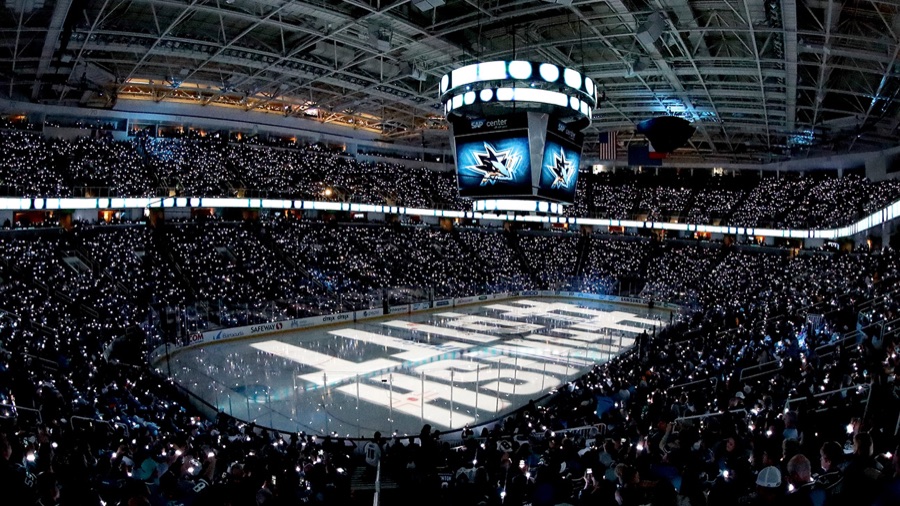
Go find a calendar. September is worth looking at laid out flat this year, because the entire San Jose evaluation season fits inside a space you can cover with one hand.
Saturday, September 12, five in the afternoon, the Sharks' rookies play the Kings' rookies at a tournament San Jose is hosting. Sunday the 13th, same time, they play Utah's. Then a week of nothing anybody outside the organization can watch. Then four preseason games, Sunday the 20th at Anaheim, Tuesday the 22nd against Vegas, Thursday the 24th against Anaheim again, Saturday the 26th at Vegas. Then four days off (the 27th, the 28th, the 29th, the 30th, and then it is October), and on Thursday, October 1, the Florida Panthers are at SAP Center and whoever is wearing teal that night has the job.
Six games. Nineteen days from the first puck to the roster.
That is fewer games than San Jose has had in any recent September, and it is not a scheduling quirk. The Sharks played six preseason games in 2023, six in 2024 and six in 2025. The league's own schedule has them at four this year, and it has 30 of the 32 clubs at four, because the collective bargaining agreement that takes effect on September 16 says four is the maximum. (Montreal and Ottawa are listed at five apiece, each of those lists containing same-day split squad pairs, which is its own small puzzle and not San Jose's.)
The two games came off the front of the calendar and went onto the back of it. The regular season is 84 games now instead of 82. Everybody knew that part.
Here is the part nobody has run yet.
Two games, and no more, for anybody who has done this before#
The same agreement limits any player with 100 or more NHL games to a maximum of two exhibition games. Two, out of four. It is a wear-and-tear provision with a stated second purpose, which is to hand the preseason to young players, and on its own terms it is a perfectly sensible rule.
It has never been applied. The agreement takes effect on Wednesday, September 16. San Jose's first preseason game is the following Sunday, four days later.
So the question is who it catches, and the answer on this roster is almost everybody you have heard of. The San Jose Sharks list 41 players for 2026-27: 25 forwards, 12 defensemen, four goaltenders. Nineteen of them have played 100 or more NHL regular-season games.
Tyler Toffoli has 969. Dmitry Orlov has 949, Jacob Trouba 906, Alexander Wennberg 869, Darnell Nurse 798, Barclay Goodrow 731. Mason Marchment is at 370, Adam Gaudette 367, Kiefer Sherwood 337, Ty Dellandrea 265, Brett Leason 226, Alex Nedeljkovic 219, Michael Kesselring 190.
And then the six names that make the rule interesting rather than administrative.
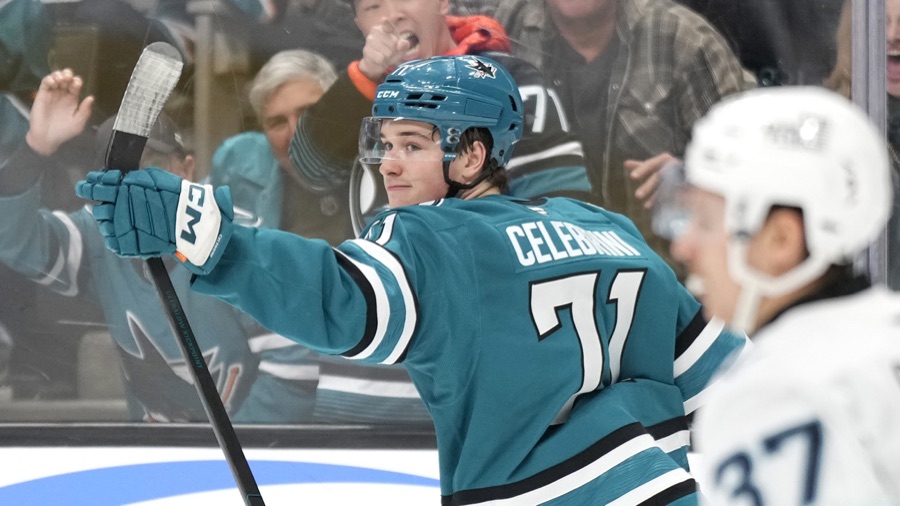
Macklin Celebrini has played 152 NHL games. Will Smith has played 143. The two players this franchise is actually built around are both over the line, which means the player who signed the largest cap hit in league history last month gets two nights of September hockey and no more. Collin Graf, who is 23 until the day after the first preseason game and who signed a three-year deal on July 31, is at 121. Zack Ostapchuk is at 122. Libor Hajek, the defenseman signed to a one-year two-way deal on July 8, is at 110. Eric Comrie is at 102. (Ten games and two games over the line, respectively, which is going to be a sentence somebody writes about somebody every September from now on.)
The other 22 are under it and can play all four. Alex Barre-Boulet and Sam Dickinson sit at 72 apiece, Yaroslav Askarov at 63, Michael Misa at 45, Nolan Allan at 43, Igor Chernyshov at 28, Patrick Giles at 20, Ethan Cardwell at 13, Cam Lund at 11, Luca Cagnoni at nine, Tye Felhaber at five. Eleven men on the list have never played an NHL game at all, Ivar Stenberg and Filip Bystedt and Quentin Musty among them.
Two things about that count are worth pausing on, because a threshold this hard invites a fight about where exactly it falls.
The first is that nobody on this roster is close to it from underneath. The highest total below 100 is 72 and the lowest above it is 102, so the line lands in a 29-game gap with no San Jose player standing in it. The second is that the published summaries of the agreement describe the bar as games dressed in an NHL career without settling whether playoff games count, and on this roster it does not matter: not one of the 22 men under the line has appeared in a single playoff game. The number is 19 either way.
Which makes this a rookie tournament with better catering#
Anyway. Here is the consequence, and it hides in plain sight, because the natural way to think about a preseason is one team at a time.
Every club is under the same cap.
Anaheim cannot dress its regulars more than twice either. Neither can Vegas. So the four games in which San Jose is meant to find out whether Stenberg can play against men are four games in which the men on the other bench are mostly not there. Nineteen capped Sharks at two games each is 38 appearances spread over four nights, an average of nine and a half a game against a regular-season lineup of twenty. Anaheim, which San Jose plays twice, lists 46 players and 15 of them are over the line. Vegas, the other opponent, lists 47 and 20 are.
What that produces is a preseason where prospects are largely evaluated against prospects. Which is a fine thing to watch, and it is precisely what the tournament on September 12 and 13 already is, and it is not the thing an NHL preseason has historically been for.
The Sharks are hosting that tournament, for the second time and the first since 2022, when Tech CU Arena opened. Six clubs, San Jose plus Anaheim, Colorado, Los Angeles, Utah and Vegas, three games a day on the Saturday and the Sunday. San Jose plays twice and is not in the September 15 finale. (That one is Utah against Los Angeles at one in the afternoon on a Tuesday, and somebody will be there.) Tickets were already on sale when the club announced it on August 17. Rink assignments between Tech CU and Sharks Ice were still to be determined when the club announced it, which is a level of logistical looseness you get away with in a tournament nobody used to treat as evidence.
It is going to be treated as evidence.
Mike Grier spent this summer arranging the roster so that a group of young players could be handed real jobs on a schedule the club controlled. The schedule the club controlled turns out to run from September 12 to October 1, and the only four games on it against other NHL organizations will be played by lineups that are more than half men who have not played 100 NHL games.
You can see why a general manager would want the rookie games in his own building.
The evaluation window got shorter, and it also got softer, because the cap that limits San Jose's veterans limits the opponent's too, and a prospect who looks ready against a fourth-line audition has told you less than he used to. Called Shot: at least one San Jose player with zero career NHL games appears in all four preseason games. For it: 19 capped men at two appearances each is at most 38 of the roughly 80 slots in four lineups, so most of the ice has to go to the other 22, and 11 of those 22 have never played. Against it: the club can spread four games across 22 eligible bodies and hold every one of them to two, which is exactly what a cautious staff would do.
Sources: the four-game preseason schedule, opponents, sites and start times are from the Sharks' own release of June 22, 2026 at nhl.com/sharks, read August 21, and independently from the NHL's published club schedule for San Jose, which returns four preseason games and 84 regular-season games for 2026-27, opening October 1 against Florida and closing April 10, 2027. San Jose's six-game preseason totals for 2023-24, 2024-25 and 2025-26, and the preseason game counts for the other 31 clubs, are counted off that same league schedule, read August 21. The Anaheim and Vegas roster sizes and their counts of players at 100 or more career games are from the league's roster and player pages for those clubs, read the same morning. The Rookie Faceoff dates, venues, six-team field, game times, the 2022 hosting note and the ticket on-sale are from the Sharks' release of August 17, 2026, read August 21. The 41-man roster list and every career games-played figure above are from the NHL's own San Jose roster and player pages for 2026-27, read August 21; playoff totals for the 22 players under the threshold come from the same pages. The terms of the collective bargaining agreement, the four-game preseason maximum, the two-game limit for players with 100 or more NHL games, the 84-game regular season and the September 16, 2026 effective date are as reported by ESPN and Flames Nation, and the four-game maximum and 84-game season are separately confirmed on NHL.com's own summary of the agreement. The full text of the memorandum of understanding is not public and nothing above rests on a reading of it.