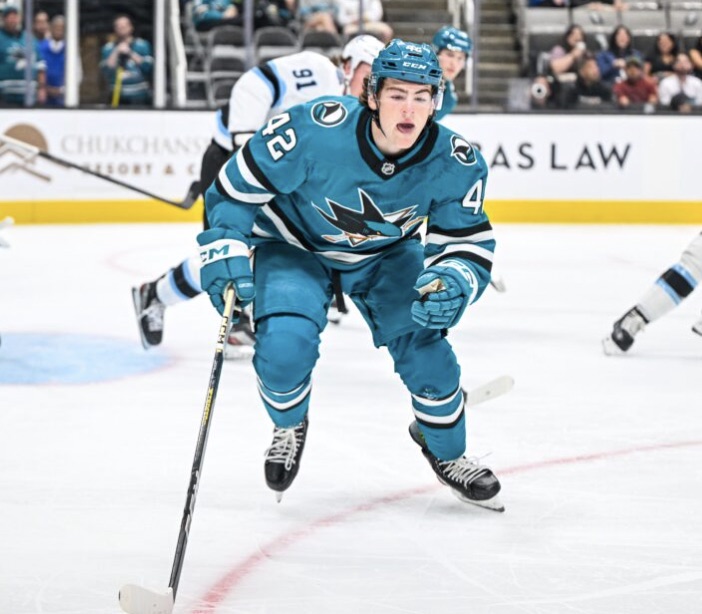
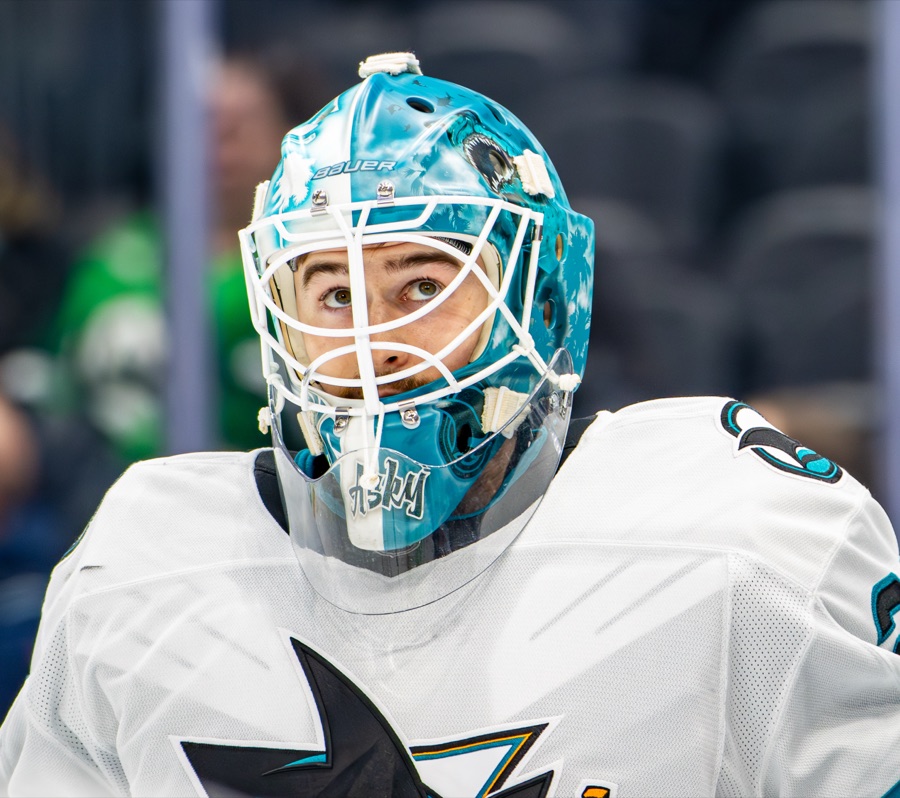
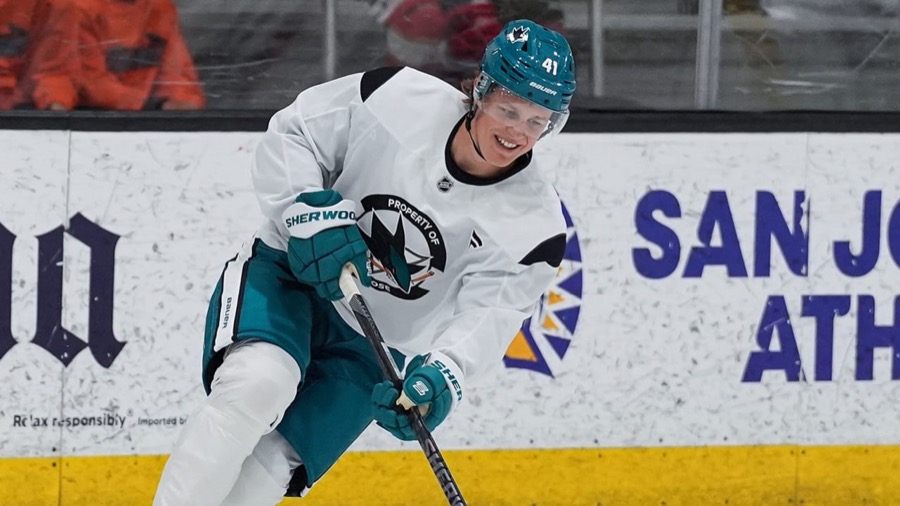
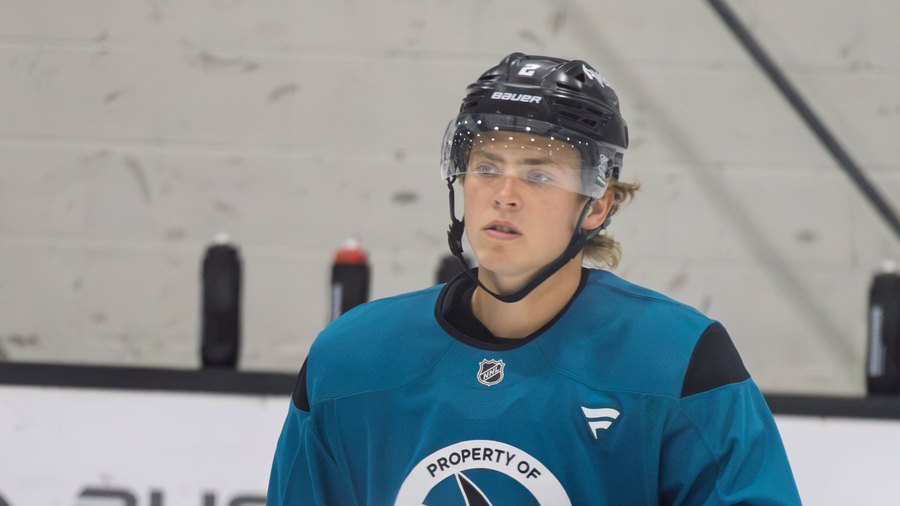
Orlov leads the Sharks' trade board. Two vetoes sit at the bottom
Expiring contracts lead the first list of ten. San Jose's place in the race and its remaining retention slot will decide how much of it survives.
San Jose has 103 days until the reported trade deadline, enough time for a list of departures to become a list of players worth keeping. The Athletic's Michael Russo, as reported by Daily Faceoff, puts the deadline on March 1, 2027.
The NHL standings through Nov. 17 have San Jose at 10-12-2, with 22 points in 24 games, one point behind second-wild-card Utah having played two more games. That is an argument for keeping the board provisional through Thanksgiving.
This is the first board. Contract length sets its order: expiring deals, then term without trade protection, then term with full vetoes; within each band, my judgment of a contender's likely appetite sets the order. Toffoli and Wennberg occupy the final band because each can refuse a trade, leaving them ninth and tenth among these ten candidates.
Buyer or seller#
Nov. 26 supplies the checkpoint: San Jose's gap behind the second wild card. Across 11 Thanksgiving standings, covering 2013-14 through 2018-19 and 2021-22 through 2025-26, 41 of 166 teams outside a playoff position eventually qualified. Within two points, 19 of 47 made it; three or more back, 22 of 119 did. These are standings-point gaps, without a general games-in-hand adjustment. Among the close teams that had played more games than the wild-card holder, 12 of 34 qualified.
Retention makes the order consequential even before the standings do. CapWages lists Karlsson and Hertl occupying two of the maximum three retained contracts, leaving one slot; San Jose can retain up to 50 percent of a traded player's cap hit. A discount for Goodrow would compete with a discount for Orlov or Toffoli for that one remaining slot out of three.
The skater lines below use MoneyPuck's season summary for San Jose's first 23 games, through Nov. 15; they exclude the Calgary loss on Nov. 17. Points cover all situations; minutes are five-on-five minutes per game played, and xG share is San Jose's share of expected goals with that player on the ice. Sorted by those minutes, the nine skaters put Gaudette and Goodrow at the bottom, at 8.24 and 8.43 minutes per game across eight and 23 appearances.
1. Dmitry Orlov#
Why he is here: The left-shot defenseman, 35, is on a deal that expires after 2026-27. His 23 GP yielded 14 points, 14.09 minutes and a 40.2 percent xG share. What stands in the way: His $6.5 million cap hit makes retention attractive, and his 15-team no-trade list narrows destinations. What he brings back: John Carlson is the ceiling: Washington sent him to Anaheim on March 6, 2026, for a conditional 2026 first and a 2027 third; Anaheim could defer the first to 2027 if it missed the playoffs. Carlson, 36, was finishing eight years at $8 million annually, with 46 points in 55 games. Connor Murphy is the retained-floor reference: Chicago sent him to Edmonton on March 3, 2026, for a 2028 second, retaining 50 percent. Murphy, 32, was finishing four years at $4.4 million annually. Both shoot right, limiting the fit. Orlov's age, salary and scoring rate sit closer to Carlson's; his 40.2 percent xG share is the case for a price below that ceiling. Orlov has 14 points in 23 games; Murphy had 13 in 60, Carlson 46 in 55.
2. Adam Gaudette#
Why he is here: The winger, 30, reaches unrestricted free agency after 2026-27. His eight GP produced one goal and one point, 8.24 minutes and a 27.3 percent xG share. What stands in the way: There is no clause, and $2 million looks more portable without retention than Goodrow's contract. The production gives a buyer little reason to hurry. What he brings back: San Jose sent Luke Kunin to Columbus on March 7, 2025, for a 2025 fourth. Kunin was finishing a one-year, $2.75 million deal; matching that return would require a stronger scoring argument than Gaudette currently supplies. Kunin's rental season had produced 18 points in 63 games.
3. Barclay Goodrow#
Why he is here: The left wing, 33, has an expiring 2026-27 contract. Across 23 GP, he had no goals, one point, 8.43 minutes and a 37.6 percent xG share. What stands in the way: His $3,641,667 cap hit and 15-team no-trade list make retention tempting and destinations conditional. Spending the remaining slot here needs a return that justifies it. What he brings back: Toronto sent Scott Laughton to Los Angeles on March 6, 2026, for a conditional 2026 third. Laughton was finishing a five-year deal at $3 million annually; Goodrow's scoring does not support treating that pick as an entitlement. Laughton had supplied 12 points across his 43 games.
4. Filip Bystedt#
Why he is here: The center, 22, is the prospect in this band, with restricted rights after his entry-level deal ends in 2026-27. His five NHL GP brought no points, 9.33 minutes and a 50.0 percent xG share. What stands in the way: No clause and a $918,333 cap hit make retention unnecessary to the case. His restricted status gives San Jose reason to keep developing him; a trade would also bend the site's open call on his NHL games. What he brings back: Boston traded Fabian Lysell to Colorado for forward Ivan Ivan on June 27, 2026. That is a prospect-for-player reference, outside the deadline, with no contract terms available for comparison. Lysell had 42 AHL points in 57 games in 2025-26; Bystedt had 60 in 65.
5. Alex Nedeljkovic#
Why he is here: The goalie, 30, is signed through 2027-28 before unrestricted free agency. His NHL log through Nov. 15 shows eight starts, a 4-3-1 record and a .902 save percentage, with 230 saves on 255 shots. What stands in the way: There is no clause; $3 million with term asks a buyer to commit beyond spring, although retention need not be assumed. Keeping him also preserves San Jose's goalie depth. What he brings back: His own trade is the available comparison; there is no deadline backup-goalie comparison here with both return and contract established. Pittsburgh sent him to San Jose on July 1, 2025, for a 2028 third, entering the final season of a two-year contract paying $2.5 million annually.
6. Ty Dellandrea#
Why he is here: The center/wing, 26, is signed through 2027-28, then unrestricted. His 15 GP yielded two points, 11.05 minutes and a 36.0 percent xG share. What stands in the way: No clause and a $1.625 million cap hit make an unretained deal plausible. His scoring limits the case for a substantial return. What he brings back: The Rangers sent Sam Carrick to Buffalo on March 6, 2026, for a 2026 third and a 2026 sixth. Carrick had another season remaining on a three-year deal at $1 million annually, a cheaper commitment than Dellandrea's. Carrick had produced 10 points across his 60 games.
7. Michael Kesselring#
Why he is here: The right-shot defenseman, 26, is signed through 2028-29, then unrestricted. His 23 GP yielded four points, 16.36 minutes and a 44.9 percent xG share. What stands in the way: Nothing in his contract restricts a trade, but $4.5 million with term could encourage a retention request. San Jose would also be replacing the heaviest five-on-five workload among these nine skaters. What he brings back: San Jose acquired him from Buffalo on June 17, 2026, sending the 2026 No. 20 pick for Kesselring and No. 27. Vancouver sent Tyler Myers to Dallas on March 4, 2026, for a 2027 second and 2029 fourth, retaining 50 percent. Myers was 36, playing 20:13 a game, in the second season of a three-year contract at $3 million annually; Kesselring cost San Jose seven first-round places.
8. Collin Graf#
Why he is here: The versatile forward, 24, is signed through 2028-29, followed by restricted free agency with arbitration rights. His 23 GP brought five points, 12.43 minutes and a 44.1 percent xG share. What stands in the way: There is no clause, but $4.25 million with term requires belief in more production. I would pursue a player exchange before spending retention here. What he brings back: Philadelphia sent Bobby Brink to Minnesota for defenseman David Jiricek on March 6, 2026. It was a hockey trade, not a sale; Brink was finishing two years at $1.5 million annually, with restricted rights afterward. Brink had produced 26 points across his 55 games.
9. Tyler Toffoli#
Why he is here: The winger, 34, is signed through 2027-28, then unrestricted. His 23 GP yielded six goals, 13 points, 10.42 minutes and a 47.1 percent xG share. What stands in the way: His full no-trade clause controls this season, and $6 million makes retention relevant. Selling him makes sense once San Jose falls out of the race, and today's race says hold. Quentin Musty, the winger who would replace him, has not played this season. What he brings back: New Jersey sent him to Winnipeg on March 8, 2024, for a 2024 third and 2025 second, retaining 50 percent on the final season of his four-year, $4.25 million annual deal. The term ceiling is Brayden Schenn: St. Louis sent him to the Islanders on March 6, 2026, for a 2026 first, 2026 third, Jonathan Drouin and Marcus Gidlof. Schenn had two seasons left after that season on an eight-year deal at $6.5 million annually. Neither return can simply be assigned to Toffoli: his rental comparison carried 44 points in 61 games, Schenn's 28 in 61.
10. Alexander Wennberg#
Why he is here: The center, 32, is signed through 2028-29, then unrestricted. His injury-interrupted 11 GP yielded three points, 13.98 minutes and a 40.3 percent xG share. What stands in the way: The $6 million cap hit could require retention, while his full no-trade clause lasts through June 30, 2028. Health adds another obstacle to matching Schenn's return above. What he brings back: Seattle sent Wennberg to the Rangers on March 6, 2024, for a 2024 second and conditional 2025 fourth, retaining 50 percent. He was finishing a three-year contract at $4.5 million annually, a rental whose scoring case was 25 points in 60 games.
Three arguments against this order#
- The race could make keeping players, or adding them, preferable to selling. San Jose trails Utah by one point, and 19 of 47 Thanksgiving outsiders within two points subsequently qualified.
- Toffoli or Wennberg could waive his clause and move above the rentals. Schenn's term did not prevent a return containing a 2026 first-round pick and a 2026 third-round pick.
- Expiration creates no demand by itself. Gaudette has one point in eight games; Goodrow has one in 23.
Outside the board#
Celebrini's extension runs through 2031-32; Misa, Stenberg and Dickinson are entry-level pieces of the rebuild. Smith and Askarov reach restricted free agency after this season, and the site has open calls on Smith's next contract. Summer signings Trouba, Marchment and Sherwood have full no-trade clauses this season, while Nurse has a no-move clause. Couture is on injured reserve in the final year of a contract that carries $8 million.
The Thanksgiving gap will help determine how much selling belongs in this discussion. Across the historical sample, playoff qualification followed for 22 of 119 teams sitting three or more points behind the second wild card.
Sources: CapWages (contracts, clauses, retained salary); MoneyPuck season summary (skater lines through Nov. 15); NHL standings and game logs (api-web.nhle.com); NHL.com trade stories for the comparables and player records; Boston Bruins' site (Lysell trade); Daily Faceoff, reporting The Athletic's Michael Russo (deadline).