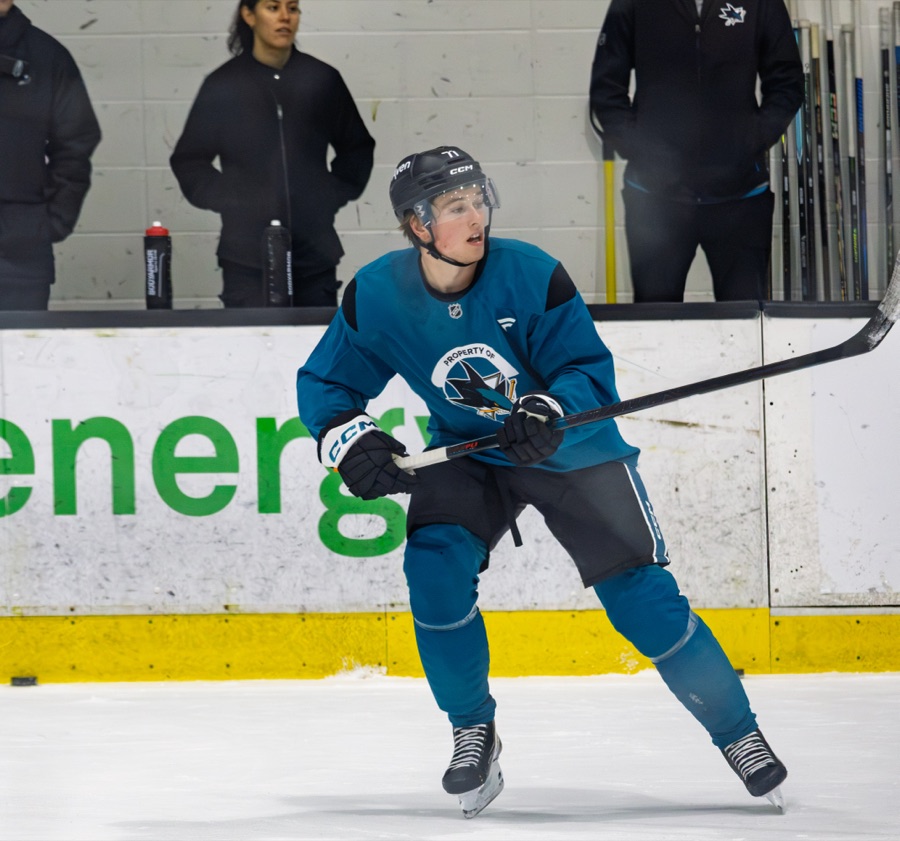
Collin Graf, 2025-26: The Qualifying Offer Was the Easiest Decision of the Summer
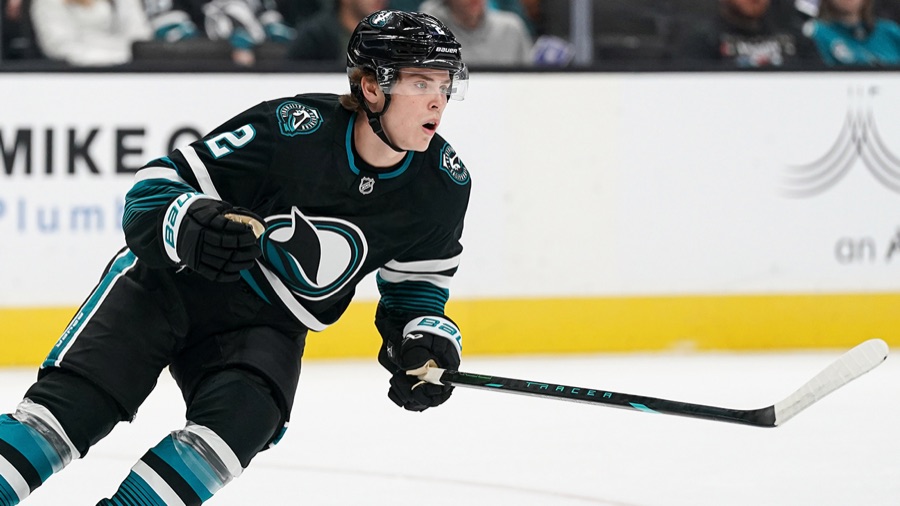
An undrafted right wing from Lincoln, Mass., posted the highest 5v5 expected goals per 60 on a Sharks roster that included Macklin Celebrini, Will Smith, William Eklund, and Tyler Toffoli. The qualifying-offer math says he should have already been signed by the time you read this.
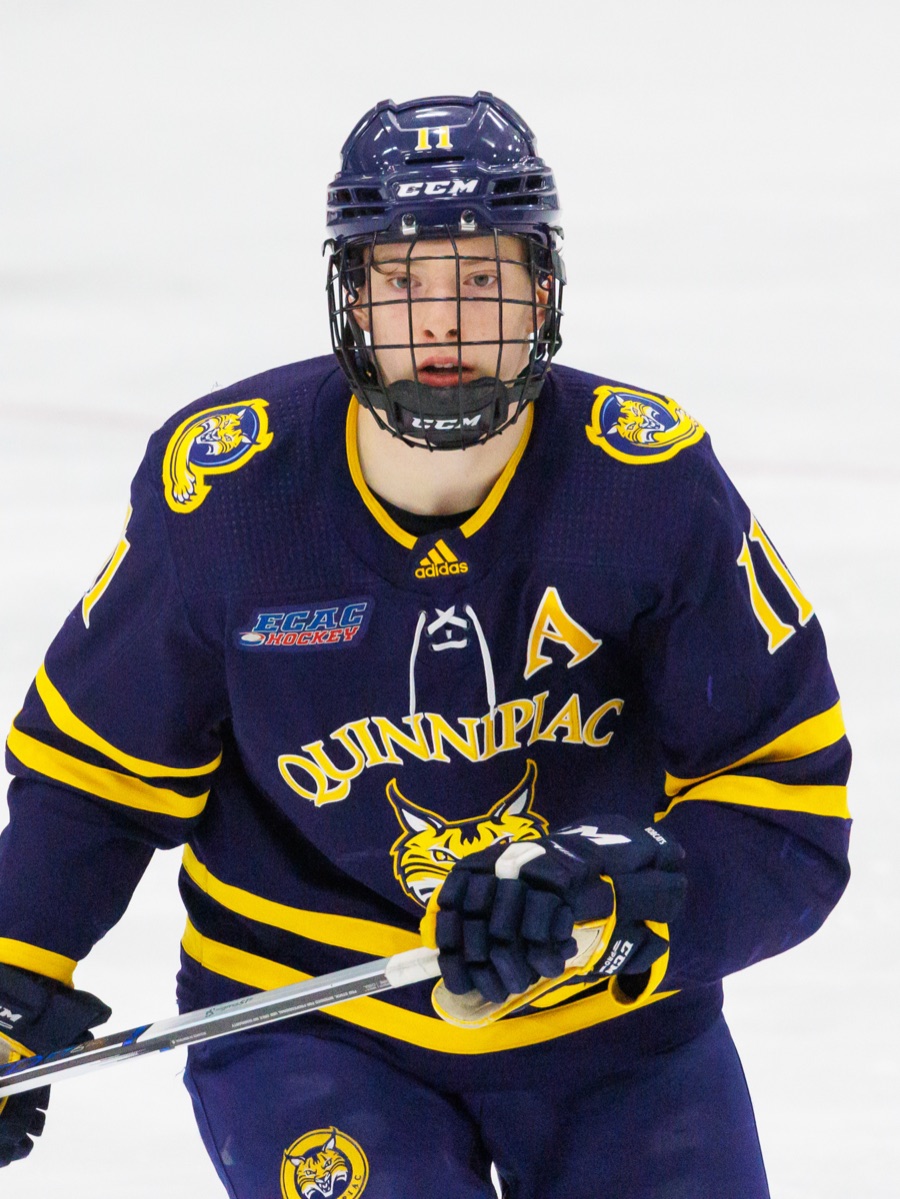
The thesis#
A reasonable observer, presented in May 2026 with a single sentence about the San Jose Sharks' 2025-26 forward group, might guess that the most efficient 5v5 attacker was Macklin Celebrini. Celebrini scored 45 goals and set the franchise points record. He generated chances on a per-minute basis that approached generational rates. He is the player the Sharks reorganized their entire timeline around.
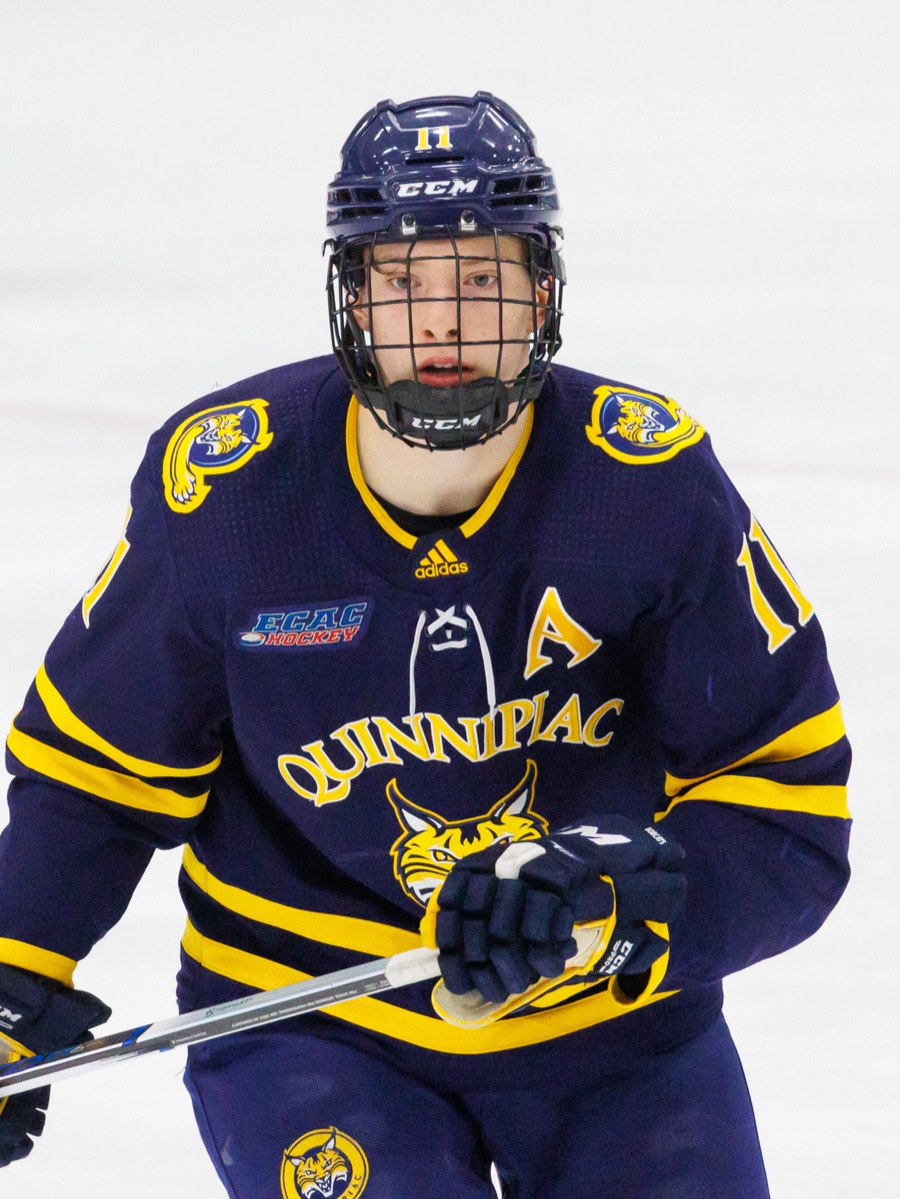
He did not, however, generate the most individual expected goals per sixty minutes at five-on-five among Sharks forwards who held a full-season role. That title belongs to the undrafted, twenty-three-year-old right wing from Lincoln, Massachusetts who was finishing his junior year at Quinnipiac twenty-five months ago.
Collin Graf produced 0.84 individual expected goals per sixty minutes at five-on-five over 81 games and 1,054 minutes (MoneyPuck, accessed May 11, 2026). Celebrini produced 0.72. Will Smith, 0.74. Tyler Toffoli, 0.65. William Eklund, 0.72. (Pavol Regenda and Igor Chernyshov posted higher iXG/60 marks in much smaller samples of 24 and 28 games respectively; the appropriate caveat is applied.) The Sharks roster surrounds a generational nineteen-year-old with the analytically-driven forwards Mike Grier could find, and the one who put the puck in the most dangerous spots the most often per shift among full-season regulars was the kid Grier signed off the Quinnipiac campus for a three-year entry-level deal.
The thesis is direct. Graf is a real top-nine NHL right wing whose first full season produced the kind of underlying numbers that suggest the goal-scoring is sustainable, the role projection is conservative rather than aggressive, and the qualifying-offer math has handed the Sharks one of the most cost-controlled high-floor forwards in the league. The recommendation is the one the planning doc already had in pencil: qualify, bridge two years at roughly $2.25M AAV, and revisit the long-term decision after one more season of NHL data.
What follows defends that thesis with the receipts.
Where he came from#
The shortest version of Graf's pre-NHL résumé is a single fact: he was the most-pursued undrafted college free agent on the board in spring 2024, and Grier won the auction.
The longer version sets up everything that follows.
Graf went undrafted in 2020, 2021, and 2022. NHL teams ran past him three years in a row. He matriculated at Union College and posted 11 goals, 11 assists in 37 games as an ECAC freshman in 2021-22. The numbers were fine for a freshman. They were not the numbers of a player NHL scouts had been wrong about. He transferred to Quinnipiac for his sophomore year.
What happened next is the part that flipped the script. As a Quinnipiac sophomore in 2022-23, Graf put up 21 goals and 38 assists in 41 games, helped the Bobcats win the 2023 national championship (he scored the third-period equalizer with two-forty-seven left in regulation to force overtime), and earned a Hobey Baker Top 10 selection alongside an AHCA All-American East First Team nod. He was nineteen years old. NHL teams started paying attention.
As a junior in 2023-24, he led Quinnipiac with 22 goals and 49 points in 34 games, won ECAC Player of the Year, was a unanimous All-ECAC First Team selection for the second consecutive year, was named All-American East Second Team, and earned a second consecutive Hobey Baker Top 10 selection (per Quinnipiac Athletics and USCHO). His three-year NCAA line totaled 54 goals and 130 points in 112 games. He was, by every available reading, the top undrafted college free agent of the 2024 class.
On April 4, 2024, Graf signed a three-year entry-level contract with the San Jose Sharks. The Boston Globe wrote it up. ESPN wrote it up. Eight days later he made his NHL debut against the Buffalo Sabres. He played seven games to close out the 2023-24 Sharks season, registered two assists, and went into the summer as the only undrafted-NCAA-free-agent signing on the roster who had a credible argument for a real top-nine NHL role in the near term.
The pertinent context for what comes next is that the path from "top undrafted NCAA free agent" to "twenty-one goal, forty-six point NHL right wing in his first full season" is not well-traveled. Jimmy Vesey won the Hobey Baker in 2016, signed with the Rangers as a twenty-three-year-old, and peaked at 17 goals as a rookie. He never broke 20. Drake Caggiula signed out of North Dakota in 2016 as the Hobey runner-up and topped out at 13 NHL goals. Recent NCAA-undrafted scoring forwards, even the headline-grabbing ones, have generally arrived in the league as middle-six contributors rather than primary scorers. Graf cleared 20 goals in his first full season. The reference class is small, and he sits at the top of it.
The 2025-26 statline#
Final 2025-26 regular-season numbers for Collin Graf, sourced from the team's counting-stats file (which itself cites NHL.com, Hockey-Reference, CBS Sports, Wikipedia, hockeydb, and The Game Haus), cross-checked against MoneyPuck's all-situations row:
| Stat | Value | Team context |
|---|---|---|
| Games played | 81 | T-2nd (Celebrini 82, Goodrow 82, Ferraro 82, Orlov 82) |
| Goals | 21 | 3rd on team (Celebrini 45, Smith 24) |
| Assists | 25 | T-7th |
| Points | 46 | 5th on team |
| Plus-Minus | +6 | 2nd among forwards (Celebrini +8) on a team that was -41 |
| Penalty minutes | 12 | One of the lowest among regulars |
| TOI per game | 16:27 | 5th among forwards |
| Shots | 118 | 5th on team |
| Shooting % | 17.8% | 3rd among regulars (Wennberg 19.4%, Regenda 21.4% in 24 GP) |
| PPG | 0 | None |
| PPA | 1 | Minimal PP role |
| SHG | 2 | T-1st on team |
| SHA | 1 | |
| Game-winning goals | 4 | T-2nd (Celebrini 5) |
| Faceoff % | 29.2% (14 attempts) | Wing, not center |
Two numbers in this table are worth pausing on before the advanced stats arrive.
The plus-minus is +6 on a team that finished -41 in goal differential. The Sharks went 39-35-8 for 86 points, fifth in the Pacific, eliminated April 13, missed the playoffs for a seventh consecutive year. The forward group leaked goals against. Eklund (-31), Wennberg (-25), Goodrow (-18), Dellandrea (-18), Skinner (-8), Sherwood (-8) all finished underwater. Two regular skaters on the entire roster finished positive among forwards: Celebrini and Graf. The 12-point gap between Graf and the next-best forward in plus-minus on a team this bad is not noise. It is signal.
The four game-winning goals is signal too. Twenty-one goals, four of them game-winners, on a team that won thirty-nine times. Graf scored the decisive goal in roughly one of every ten Sharks wins. For comparison, Celebrini had five GWG on 45 goals (one of every nine wins). Goal distribution by leverage matters in any honest portrait of a scorer, and Graf's distribution was front-loaded toward high-leverage situations.
The shooting percentage will get its own section.
The 5v5 portrait that should change how the Sharks think about him#
The advanced-stat picture comes from MoneyPuck's season-summary CSV (accessed May 11, 2026). Hockey Stat Cards' game-score decomposition was not accessible at fetch time; the MoneyPuck cuts below cover the same analytical territory. Comparisons run against the most-deployed Sharks forwards.
Five-on-five season totals and rates:
| Player | GP | 5v5 TOI/g | xGF% | xGF% rel | CF% | iXG/60 | iG/60 | iP/60 | oZS% |
|---|---|---|---|---|---|---|---|---|---|
| Celebrini | 82 | 16:25 | 50.0 | +4.0 | 49.0 | 0.72 | 1.16 | 2.76 | 67.7 |
| Smith | 69 | 14:14 | 48.0 | +0.0 | 49.0 | 0.74 | 0.92 | 2.26 | 68.0 |
| Toffoli | 79 | 11:37 | 49.0 | +2.0 | 47.0 | 0.65 | 0.72 | 2.03 | 54.0 |
| Eklund | 78 | 14:31 | 49.0 | +2.0 | 50.0 | 0.72 | 0.58 | 1.64 | 45.4 |
| Gaudette | 66 | 10:21 | 47.0 | +0.0 | 44.0 | 0.80 | 1.05 | 1.49 | 38.1 |
| Sherwood | 72 | 13:28 | 49.0 | +1.0 | 54.0 | 0.80 | 0.80 | 1.30 | 49.6 |
| Graf | 81 | 13:01 | 50.0 | +3.0 | 44.0 | 0.84 | 0.91 | 1.82 | 57.4 |
The headline numbers, with the contextual caveats.
Among Sharks forwards with sustained deployment (60+ GP and 600+ five-on-five minutes), Graf led the team in individual expected goals per sixty minutes. 0.84 iXG/60 across 1054 five-on-five minutes. Pavol Regenda (1.10 iXG/60 in 24 GP) and Igor Chernyshov (0.91 iXG/60 in 28 GP) posted higher rates over much smaller samples; among players who actually held a full-season NHL role, Graf was the chance-generation leader. He converted those chances at 0.91 iG/60 (16 actual 5v5 goals against 14.72 5v5 iXG, a +1.28 over-finish that registers as "modestly hot" rather than "luck mirage"). The shot quality, not just the shot volume, drove the production.
He tied Celebrini for the highest on-ice xGF% on the team. 50.0% xGF% on a Sharks team where the league-wide context is that being above 48% would be an above-average mark for the roster. The +3.0% xGF% relative says he made his lines better when he was deployed, not the other way around.
He did this without sheltering. 57.4% offensive zone start rate (offensive zone faceoffs divided by offensive plus defensive zone faceoffs, ignoring neutral-zone draws). Celebrini was at 67.7%. Smith was at 68.0%. The two players the coaching staff actively protected with the puck were the kids who play first-line center. Graf was deployed at roughly even-strength matchup zones, which means the offense was being generated against tougher quality of competition than the headline scorers faced.
He was outshot on attempts. 44.0% Corsi For percentage. That is the legitimate weakness in the underlying portrait. The Sharks as a team finished sixteenth or below in five-on-five shot-attempt share, and Graf's lines carried that team-level deficit. His CF% relative was negative 4.0. Translating: his shifts generated fewer total shot attempts than the average shift without him, but the attempts they did generate were of higher quality than the team baseline.
The CF% reality is real. It is also a reason to expect his goal production to remain volume-and-quality dependent rather than possession-driven going forward. If the team gets better at carrying the puck under Warsofsky's system maturation, Graf benefits doubly. If it does not, Graf still has the individual scoring tools to produce, because his line's shooting choices are already high-quality.
This is what an underrated NHL forward looks like in the 2026 analytics frame. Individual chance generation per minute is the most predictive single stat for sustained scoring. Graf leads his team in it. He plays middle-six minutes. He kills penalties. He is twenty-three years old, on the back end of his entry-level contract, and his name does not appear on a single league-wide top-100 prospect list because he is too old to be a prospect.
The shooting percentage question, treated honestly#
Seventeen point eight percent shooting on 118 shots will trigger every regression alarm in the analytics literature. League average shooting percentage for forwards in 2025-26 was approximately 10.5%. Graf finished 70% above league average. That is in unsustainable territory by population statistics.
Three counterweights make the regression case less ironclad than the headline suggests.
First, the individual-expected-goals math validates the shot diet. Graf's 5v5 iXG of 14.72 against 16 actual 5v5 goals is a +1.28 over-finish, which is in the band of normal finishing variance for a season of this size. The shots he took were objectively high-quality shots. MoneyPuck's high-danger breakdown: 17 high-danger shots producing 4 high-danger goals (23.5% conversion, near league baseline of roughly 20%). 44 medium-danger shots. 82 low-danger shots. The distribution skews heavily to the lower-danger end (62% of his shots were low-danger), which would normally cap a shooting percentage in the high single digits. The fact that he posted 17.8% on a shot mix tilted toward low-danger looks suggests his finishing on the lower-danger shots was unusually clean. That, not the high-danger conversion, is the regression-vulnerable component.
Second, his NCAA shooting context. Quinnipiac sophomore year: 21 goals on a Quinnipiac team that played a possession-driven, defensively-structured system. Junior year: 22 goals on 34 games (0.65 G/g, a high rate even by NCAA standards). The shooting ability was visible at the previous level. NHL goaltenders are an order of magnitude better, but a player who shoots from the right angles and reads the goaltender's reset cycles is going to outperform shot-volume expectations at every level, not just one.
Third, the player profile from the planning doc. The 2026 offseason outline lists Graf with the explanatory tag "shooter profile" alongside Sherwood's "physicality" and Wennberg's "distribution." The scouting consensus is that Graf is a goal scorer specifically. That is not the same as a player whose scoring will collapse to league-average mean. Designated shooters in the NHL (a category Toffoli has lived in for years on multiple teams) routinely finish above 12-13% sh% on sustained shot diets, because they pick their spots and they shoot with the goaltender in motion.
The sustainable range for Graf, working from xG and player profile rather than raw shooting percentage, sits around 12-14% career sh%. At 118-shot volume, that implies 14-17 goals. At 130-shot volume in a top-nine role with PP2 elevation (which the offseason planning doc projects by penciling him in for net-front duty on the second unit), implication is 17-20 goals.
In short: 21 goals in 2025-26 represents the upper end of his realistic shooting outcomes, not the floor and not too far above the trendline. Mean expectation for 2026-27 is 17-19 goals if the role and ice time hold. Worst-case regression scenario is 12-13 goals with a sub-10% shooting percentage, which would be the bust case and would be a real one. The realistic probability distribution skews toward "stays a 30-46 point right wing for several years."
The Sharks are paying him $941,667 in the final year of his ELC. They are getting top-decile value for the cap hit. That is what produces the qualifying-offer math.
The hidden chunk: penalty kill, takeaways, and how he plays without the puck#
Graf is not just a shooter. The skill profile the Sharks acquired was always closer to a complete-package wing, and the role he carved in 2025-26 reflects that.
The penalty kill carried more weight in his role than the box score suggests. MoneyPuck logs 11,733 four-on-five seconds for Graf in 2025-26, or 195.6 minutes of shorthanded ice time over 81 games. That is 2.41 minutes per game on the kill, which puts him in the rotation as a top-four PK forward. The Sharks PK ranked 28th in the NHL at 75.8%, but the rotation included Goodrow (who killed legitimately), Wennberg, Dellandrea, Sherwood, and Graf, and Graf was the only one of that group to produce more than one shorthanded point. Two shorthanded goals and one shorthanded assist on a team that allowed 290 goals against is genuine defensive value.
The five-on-four numbers go the other direction. Graf's 5on4 (his team on the power play) time totaled 2,303 seconds across 81 games. That is 28.4 seconds per game. Functionally, it means he was not on PP1 or PP2 in any sustained way during 2025-26. The offseason planning doc projects him into PP2 net-front for 2026-27, which is a forward-looking call rather than a reflection of current deployment. Whether he holds that role depends on Eklund's PP1 promotion, Kurashev's return status, and whether the staff trusts Graf's hands enough in tight space. The PP role is the swing factor in his ceiling.
The two-way stats round out the picture. 82 hits at 5v5 (88 hits all situations). 26 takeaways at 5v5 (34 all situations). 50 giveaways at 5v5 (55 all situations). The takeaway-to-giveaway differential is negative, which is normal for a forward who handles the puck in offensive zones, but the hit rate and takeaway count signal an active player rather than a passive one. He is not Sherwood (323 hits at 5v5, the league leader by some distance), but he is not a perimeter scorer who waits for the puck either.
The combined portrait is a six-foot-one right wing who can finish, who kills penalties, who plays the body, who reads passing lanes, and who started 57% of his offensive-versus-defensive zone draws in the offensive zone without being explicitly sheltered. That is a top-nine NHL forward. The Sharks paid $941,667 for him in 2025-26.
The qualifying-offer arithmetic and why this is the easiest contract decision of the summer#
Graf finishes his entry-level contract on July 1, 2026 as a restricted free agent. His ELC final-year cap hit was $941,667. He is not arbitration-eligible. CBA Article 12 sets the arbitration-eligibility threshold based on the player's age at signing of his first SPC. Graf signed at age 21, which means he requires four years of professional status to qualify for arbitration. He has three: 2023-24 (7 NHL games), 2024-25 (33 NHL + 40 AHL), 2025-26 (81 NHL). He becomes arbitration-eligible after the 2026-27 season, not before.
This is the contract-leverage detail that matters. The Sharks hold full negotiating leverage this summer. Graf cannot file for arbitration. His only outside leverage is an offer sheet from another team (rare for a player at his cap-hit tier) or signing in the KHL/Europe (almost certainly not a real threat for an American Hobey-finalist with NHL traction). The Sharks decide the contract terms.
The standard qualifying offer for an ELC at $941,667 AAV is calculated on the prior year's base salary at 110%. Graf's ELC structure (estimated at $775,000 base plus $166,667 in signing/performance bonuses to reach the $941,667 cap hit) implies a qualifying offer of approximately $852,500 on base salary, with the actual offer letter likely structured similarly to his ELC's terms.
The Sharks will not sign Graf at his qualifying offer. The offseason-outline planning doc has him pencilled in at "2 years × $2.25M bridge." That is the recommendation worth defending and the one the math supports.
A two-year, $2.25M-AAV bridge does the following four things.
One: it secures Graf's services at a cap hit well below his open-market value. A 21-goal, 46-point right wing who kills penalties and posts a 50% xGF% on a bad team would clear $4M annually on the UFA market in a $104M-cap environment. The Sharks pay roughly half that. The cap-friendliness compounds across a 2026-27 cap of $104M into 2027-28's projected $113.5M.
Two: it preserves the team's leverage for the next contract. A two-year deal ends in summer 2028 with Graf at age 25. He becomes arbitration-eligible by that point and the Sharks lose some leverage, but he is still an RFA and the team controls his rights through restricted free agency. The next deal, struck after two more years of NHL data, is when the term-versus-AAV question gets answered properly.
Three: it caps the bust-case downside. If Graf's 2026-27 numbers regress hard (10-12 goals on a sub-9% shooting percentage), the Sharks have one more year at $2.25M and they walk away in 2028 with a useful AHL/bottom-six option still on the books. The risk asymmetry favors the team.
Four: it leaves the door open for the long-term call at the right moment. If Graf runs back the 2025-26 production at 18-20 goals and similar advanced metrics in 2026-27, the contract negotiation in summer 2028 can be the four-year-or-five-year UFA-buying deal at $4.5M-$5.5M AAV. That is the deal that locks in a cost-controlled top-nine forward through age 29.
The alternative path, signing Graf to a longer term right now (4 years × $3.5M, say, which would buy two UFA years and lock in the upside), is the kind of deal that looks brilliant if the production holds and merely fine if the regression hits. The downside is bounded, but the bridge is bounded better. With only one full NHL season as the evidence base, the conservative call is the correct call. Get the second season of data, then decide.
The Sharks have a planning doc that already has this contract structure penciled in. The recommendation is to honor it.
Roster fit and the depth-chart projection#
The offseason outline projects Graf into the 3RW slot on a Wennberg-centered third line with Kiefer Sherwood at left wing. The "matchup and secondary scoring line" is the descriptor. Sherwood brings physicality (323 5v5 hits, league-leader territory). Wennberg brings distribution and is a competent enough two-way center to carry defensive-zone draws. Graf brings the shooter profile and the analytical efficiency.
That deployment is conservative. If Will Smith continues his trajectory as a top-six right wing (or if Smith slides to center on a second line and the right-wing spot opens up alongside Celebrini), Graf is a plausible 1RW or 2RW promotion candidate. His iXG/60 says he could handle that workload analytically. His CF% says the volume side of the equation might need help from a stronger possession center, which Celebrini and Smith both provide more reliably than Wennberg.
The PP role is the call to watch. Graf was off both PP units in 2025-26. The offseason outline projects him to PP2 net-front. The Sharks PP ranked seventeenth in 2025-26 at 20.9%, which means there is upside available simply by deploying the most efficient shooters in the most efficient configurations. Graf finishing the net-front role with Wennberg as bumper, Toffoli on the off-flank, and Cagnoni on the point is a reasonable PP2 build. The math favors it. Whether the staff trusts the build is a separate question.
The PK role is locked in. Graf will keep his 2.4-minute-per-game shorthanded workload. He earned it in 2025-26.
The realistic 2026-27 production range, assuming the bridge deal closes and the role holds: 16-22 goals, 25-35 assists, 41-57 points, plus or minus a PP1 promotion bump or a regression scenario. The center of that distribution is in the 18G/30A/48-point neighborhood, which is roughly what he produced this year and what makes the $2.25M bridge so clearly correct.
The honest weaknesses#
This is a positive review of a 23-year-old top-nine NHL right wing on a cost-controlled contract. The weaknesses still need to be on the page.
The shooting percentage is the regression risk. 17.8% probably comes down. If it lands at 12-13%, the goal output drops to 14-16. That is still a useful forward, but the headline goes from "twenty-one-goal right wing" to "fifteen-goal right wing" and the contract-value framing shifts.
The possession game is not yet driving play. 44.0% CF% is a real underlying weakness. His lines were carrying a Sharks-team-baseline deficit, and his individual CF% relative was negative. The chance-quality advantage is what offsets it. If the chance-quality advantage erodes (more aggressive opposing forecheck, less time and space at the offensive blue line as scouting reports tighten), the underlying breakeven on xGF% could slip below 50%.
The faceoff numbers are not what you want from your third-line right wing on a team that needs to win draws. 4 wins on 18 attempts is a 22% faceoff rate. He should not be taking draws at all in a Wennberg-centered line. This is a minor coaching note rather than a player flaw, but worth flagging for any line-construction analysis.
The PP role is not yet established. The planning doc projects him to PP2 net-front. The 2025-26 deployment kept him almost entirely off both PP units. Whether the role materializes is a coach-trust question, not a player-skill question.
The one-season sample size is a one-season sample size. Everything in this review is based on 81 NHL games at full deployment plus 40 AHL games plus 33 NHL games in a partial-season call-up role. The shooting profile is consistent across NCAA, AHL, and NHL levels, but the league has not yet seen him in his second full season. The 2026-27 evidence base will settle whether this is a top-decile career arc or a one-year outlier.
The probability assignment, working from the available evidence: roughly 60% the 2026-27 production lands in the 16-20 goal range and the bridge looks like a steal, 25% it lands above 20 goals and the Sharks have to negotiate a much harder long-term deal in 2028, 15% it regresses to 10-13 goals and the bridge looks like the standard ELC-to-second-contract outcome that the planning doc anticipated. The first two scenarios are both good for the team. The third is contained.
The verdict#
The qualifying offer is the easiest decision of the Sharks' summer. So is the two-year, $2.25M-AAV bridge.
Collin Graf is an undrafted twenty-three-year-old who scored 21 goals, posted the highest 5v5 individual expected goals per sixty minutes on the roster, killed penalties at a top-four-forward rate, finished +6 on a team that was -41, and did all of it on the final year of an entry-level contract worth $941,667. He is a real NHL right wing whose first full season produced the underlying numbers of a player who can sustain top-nine production going forward.
The recommended contract path is the one the planning doc has already specified. Qualify him before July 1, 2026. Sign him to a two-year, $2.25M-AAV bridge before the deadline tolls. Run him back as a 3RW with PP2 elevation and continued PK minutes in 2026-27. Re-evaluate in summer 2028 with two full NHL seasons as the evidence base, at which point the long-term-versus-bridge question can be settled with real data rather than projection.
If 2026-27 confirms the 2025-26 read, the next contract is the four-or-five-year deal at the higher AAV that buys UFA years and locks in the top-nine production. If it does not, the Sharks walk away at minimal cost and pivot to whichever prospect (Chernyshov, Musty, the next NCAA-FA crop) has earned the next opportunity.
The undrafted Hobey finalist from Lincoln, Massachusetts is real. Mike Grier won the auction in April 2024. The Sharks have one more year to ride the entry-level value, and the qualifying offer is the easiest thing they have to do this summer.
Sources#
- State files (verified two-source minimum): counting_stats.md (NHL.com, Hockey-Reference, CBS Sports, Wikipedia, hockeydb, The Game Haus); cap.md (PuckPedia, CapWages); transactions-2021-2026.md (ESPN); offseason-outline.md (Sharks planning doc, April 19, 2026).
- Advanced stats: MoneyPuck season summary CSV, accessed May 11, 2026 (last modified April 18, 2026). All 5v5 and all-situations advanced metrics are direct MoneyPuck numbers.
- NCAA career and signing: Wikipedia, ESPN signing report (April 4, 2024), Boston Globe signing writeup (April 4, 2024), Quinnipiac Athletics, USCHO (Hobey Top 10 confirmation).
- Hockey Stat Cards: Direct access blocked at fetch time on May 11, 2026; MoneyPuck cuts cover the equivalent territory.
- Qualifying offer mechanics and arbitration eligibility: PuckPedia RFA/QO documentation, NHL CBA Article 12 reference.