Read The Collin Graf Contract From The Back
San Jose re-signed its undrafted 21-goal winger on Friday for three years and $12.75 million, a $4.25 million cap hit that is close to what everybody expected him to cost. The term is the interesting number. It puts Graf back at the table in the summer of 2029, holding rights he does not hold today.
Start at the end of the thing, because the end is the part San Jose actually chose.
Collin Graf's new contract runs out after the 2028-29 season. That puts him back across the table in the summer of 2029 as a restricted free agent, arbitration eligible. Everything ahead of that date, the player and the team agreed about. The money was never the fight.
Here are the terms, announced by the club Friday: three years, $12.75 million, a cap hit of $4.25 million. Against a $104 million upper limit, that is 4.1 percent of a payroll for a winger who scored 21 goals last season, and if it sounds like a normal price for a normal player, that is because it is one. Nobody is going to write a column about the number. (This is not that column.)
The number is not what happened here.
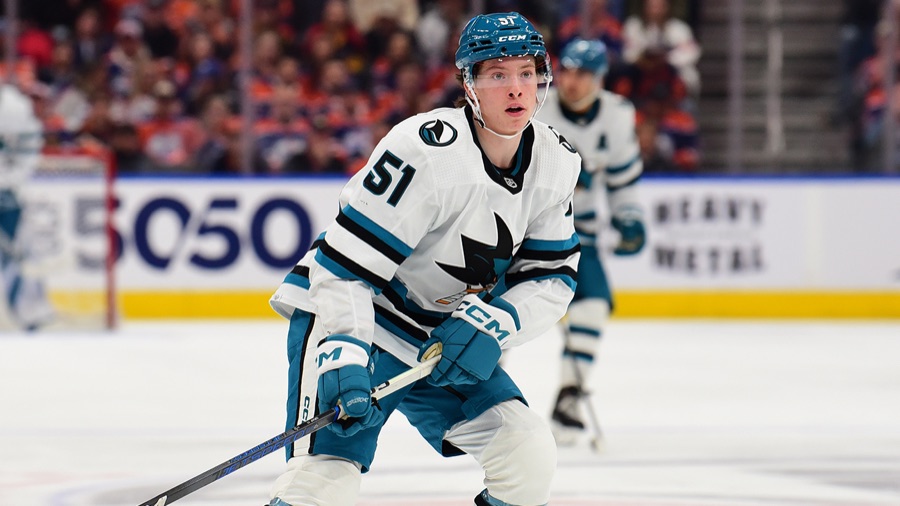
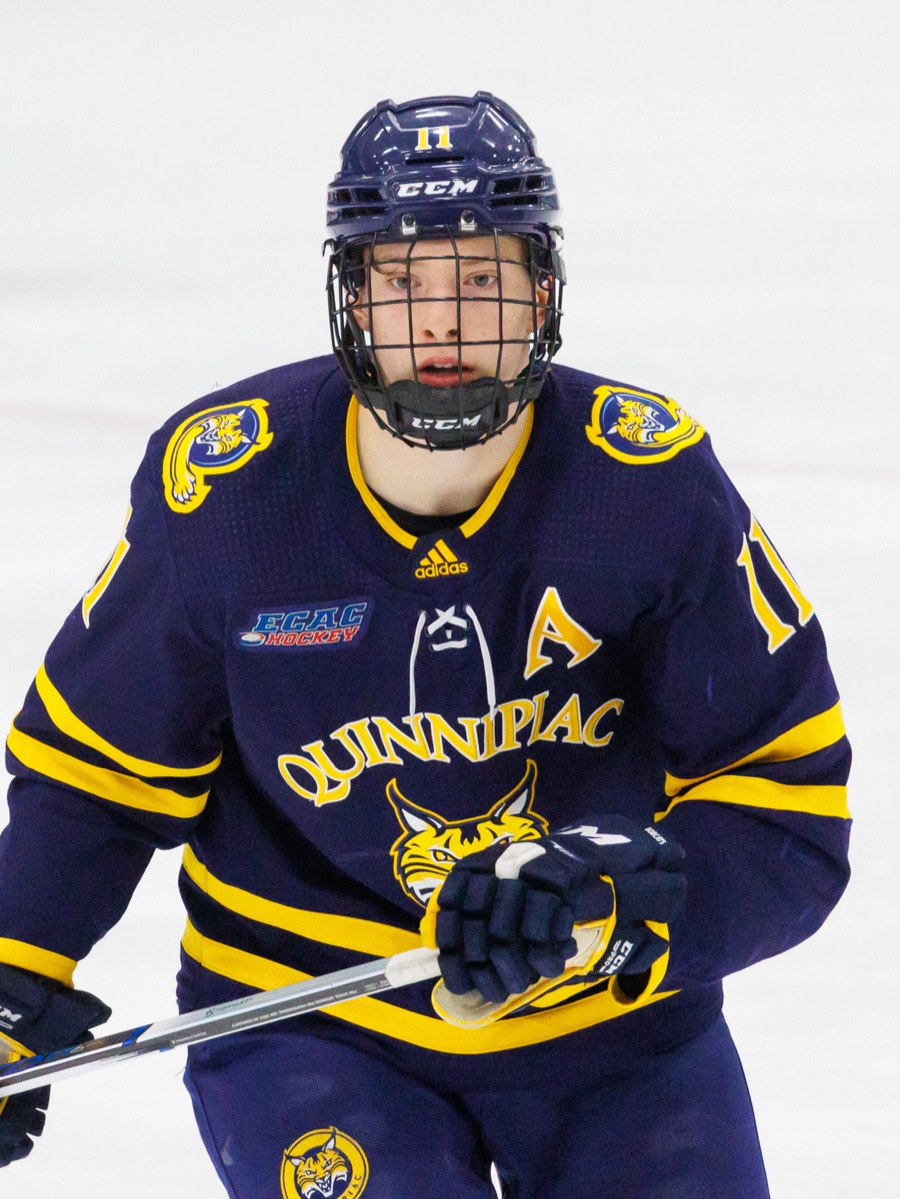
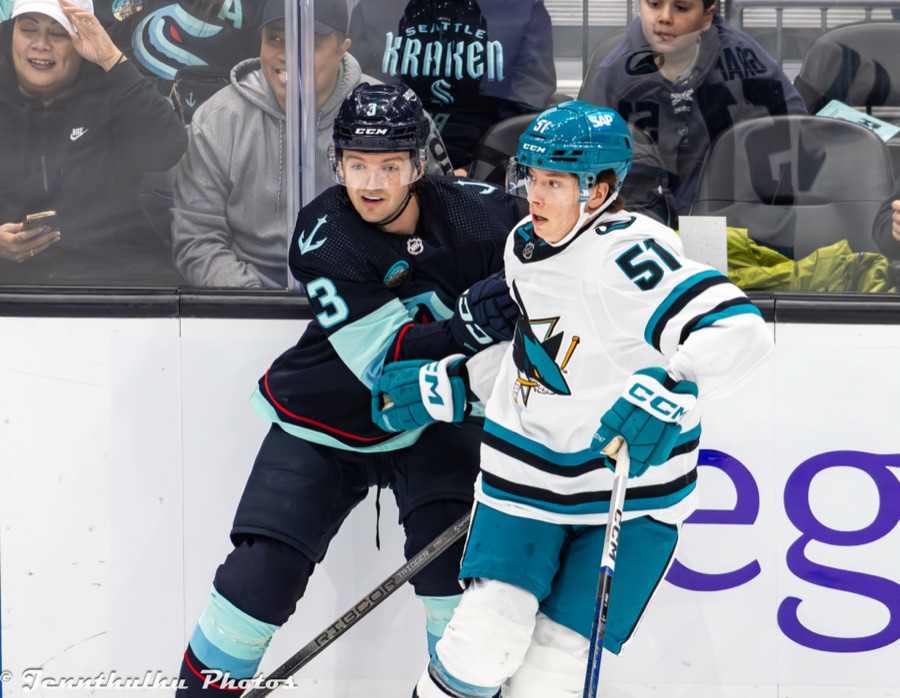
Graf went undrafted, signed out of Quinnipiac on April 4, 2024 at 21, and has spent his entire professional career in one organization. He is 23 now. He played 81 games last season and put up 21 goals and 25 assists at a plus-6, finishing third on the Sharks in goals and sixth in points. It was his first 20-goal season and his best in nearly every category the club bothered to list. His career now reads 121 games, 26 goals, 33 assists.
Mike Grier led his public reasoning with the unglamorous part. "Collin was a big part of our team's improvement this past season, being an effective penalty killer for us and his versatility in the lineup was extremely valuable," the general manager said in the club's release. Which is true, and it is the part of Graf's game the market prices last and San Jose knows best. This site's component work in June had him at 196 shorthanded minutes, tied for the best suppression rate on the team. The Sharks were not guessing about him.
Grier kept going, and the rest is worth printing because it cuts against the reading you are about to get from me. He credited the work ethic, said Graf's game "took another stride last year," called him an important person in a young group, and finished: "We're happy we are able to keep him a Shark for the next several seasons." That is not a general manager hedging. That is a general manager describing a player he likes a great deal.
It is also a general manager calling three years "the next several seasons," which is the most generous available translation of the number he actually signed.
So they paid him like a player they believe in, and they gave him a term like a player they do not.
In June this site argued for five years at $4.5 million, and half of that call cashed. The price came in $250,000 under. The years came in two short, and the years were the entire argument. What a five-year deal buys is not a discount on the annual rate. It is the deletion of a future negotiation, plus a season of unrestricted free agency at the back that a team gets to keep. Three years buys neither one. It buys 2029.
Consider what changes by then. The leverage San Jose held this month was an expiring entry-level contract and a player with nowhere else to be. That is a one-time asset and it has now been spent. In 2029 Graf arrives at 26, with three more professional seasons behind him, arbitration rights in his pocket, and, if the plan works, a role he did not have when he produced the season that got him paid. Twenty-six is not a man you buy out of his prime cheaply. It is the front of it. He took 38 power-play minutes all of last year. Every version of the Sharks' forward group that anyone has drawn for next season gives him more than that. The whole case for the raise is that his usage is about to go up, and usage going up is the same thing as his next price going up.
Which lands the bill in a summer that was already crowded. The five-year cap projections this site published in June strain in 2029 on their own, before anyone adds a re-signed winger with an arbitration case and three more seasons behind him. San Jose has three years to enjoy a good rate and then has to solve that, having declined the version of this contract that made it unnecessary.
The honest counter is real, and it is the reason the deal is defensible rather than dumb. The Sharks have exactly one season of this from Graf. Twenty-one goals is a fine total and it is also one year of one, and single seasons of finishing are the least repeatable thing a forward does, whatever the rest of the profile says about him. Undrafted wingers coming off a career year are precisely the population where five-year term deals become the thing a general manager gets asked about in 2031. (Every front office has one of those on the books. Some have two, and they do not enjoy discussing either.) Three years at $4.25 million is a contract that trades easily if the season sags. Five would not have been.
So this is a hedge, priced honestly and dated conservatively, and my read is that the date is where it costs them. I will put a number on that: Graf finishes 2026-27 with at least 50 points, and when he signs his next contract it carries a cap hit above $6.5 million. The first is scoreable in April. The second is the one I actually care about, and San Jose scheduled the meeting itself.
Contract terms per the San Jose Sharks' club release, July 31, 2026, cross-checked against CapWages (three years, $12,750,000, $4,250,000 cap hit, signed July 31) and CBS Sports. Counting statistics, the team rankings, the undrafted status, the April 4, 2024 signing out of Quinnipiac, his age and the Grier quotation are all from that release, quoted here at its full length rather than in part. CapWages carries the expired entry-level deal at a $941,667 cap hit and the 2029 arbitration-eligible expiry; note that two payroll pages still display the $942,000 entry-level figure in their page titles, which is the old contract and not this one. Date of birth September 21, 2002. The $104 million upper limit for 2026-27 is the league's announced figure, up $8.5 million from last season. Deployment components (196 shorthanded minutes, 38 power-play minutes) are from this site's June component audit.