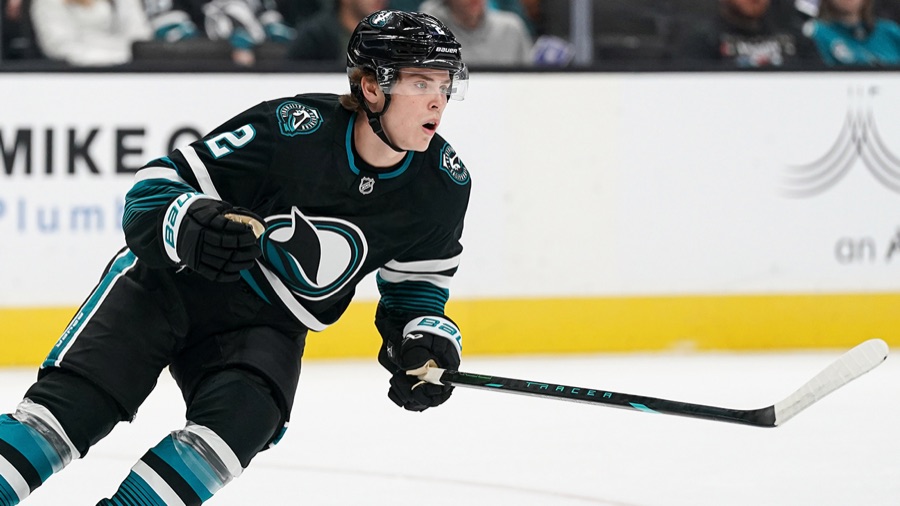
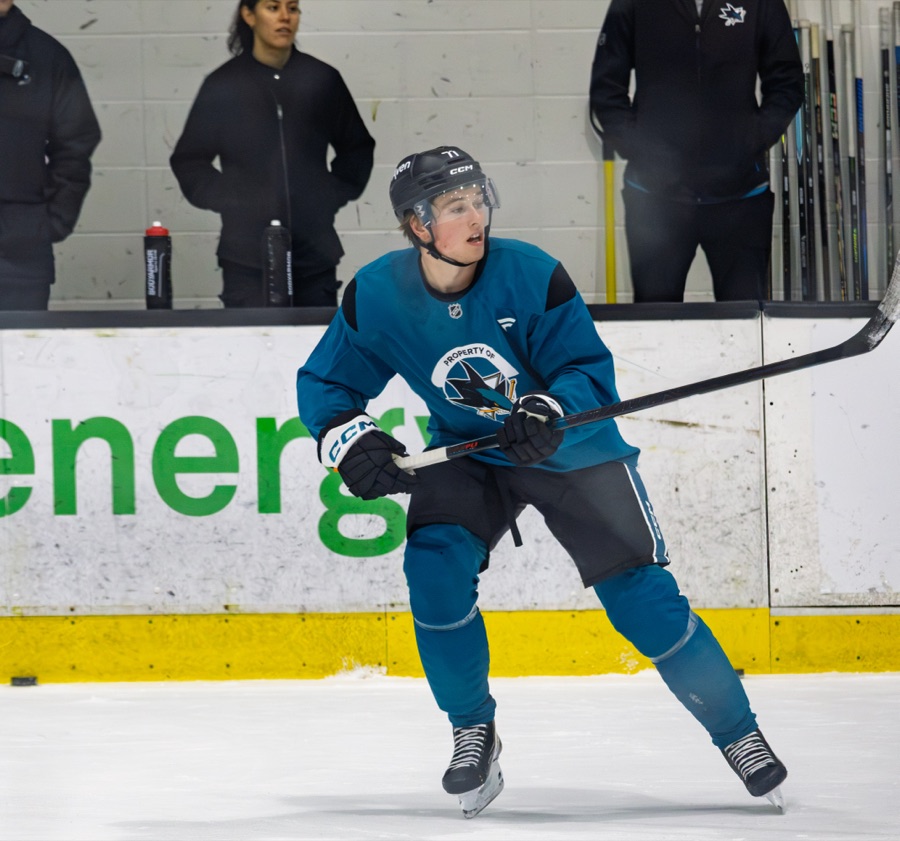
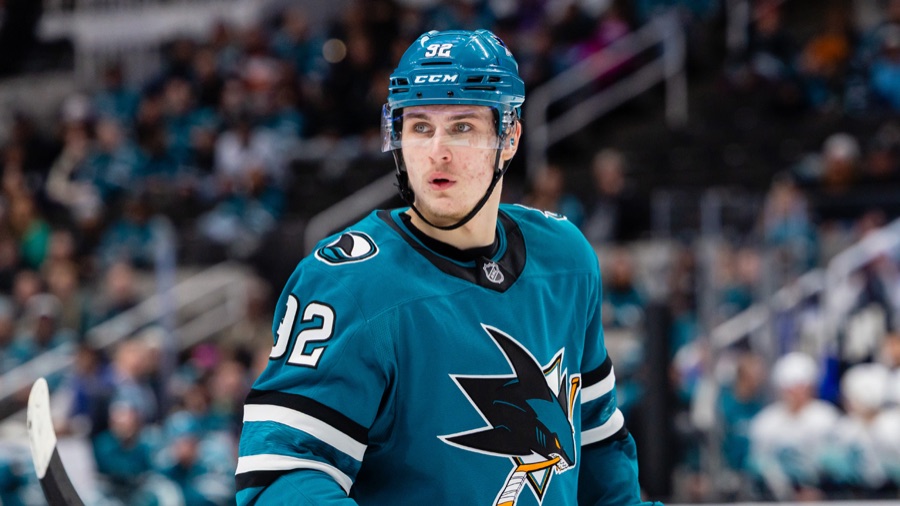
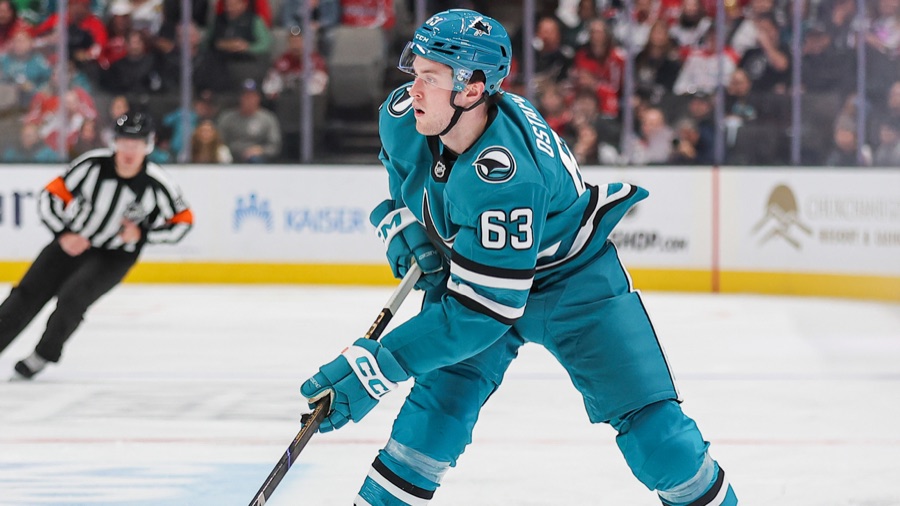
Collin Graf Scored More Shorthanded Than He Did On The Power Play
The Sharks 25, No. 10. San Jose gave Graf twenty-nine seconds a night on the man advantage last season and he still finished third on the roster in goals. Then it paid him four and a half times his old salary, and the deployment source this desk weighs most heavily leaves him off both units again.
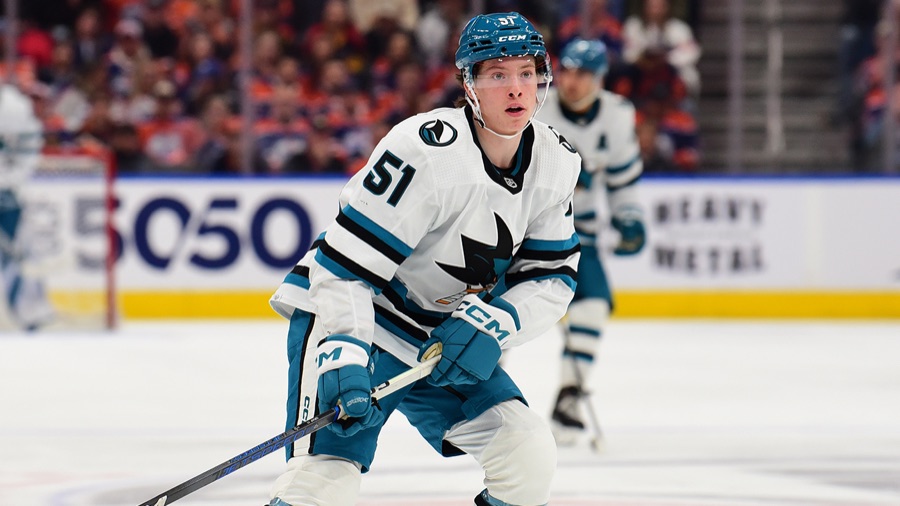
Collin Graf spent 39 minutes and 38 seconds on the power play last season. He dressed for 81 games to get there, which comes out to 29 seconds a night.
He spent 200 minutes and one second killing penalties, more shorthanded ice time than any other San Jose forward took.
He scored 21 goals, third on the roster behind Macklin Celebrini and Will Smith. Two of them came shorthanded. None came on the power play.
On July 31 the Sharks signed him for three years and $12,750,000, a $4,250,000 cap hit through 2028-29. He played last season on $941,667. That is four and a half times the money for a forward this staff has never once used on a power play.
The even-strength number#
Take the roster's point totals and subtract the power-play and shorthanded points out of them. What is left is what each man did at even strength, which is where most of a hockey game is played.
Celebrini is first at 82. Then it is Will Smith at 42 and Collin Graf at 42.
Smith needed 17 power-play points to reach 59. Graf needed one to reach 46. At even strength, on a team that finished 39-35-8, the undrafted right wing from Lincoln, Massachusetts and the fourth overall pick were the same player. That is the argument for the contract, and it is a good one.
Tenth in line#
Nine San Jose forwards took more power-play time than Graf last season. Celebrini at 300:29 and Alexander Wennberg at 267:54 are the top unit and nobody argues it, and Tyler Toffoli, Smith and William Eklund all cleared 226 minutes behind them. Then it falls off a cliff, and three of the four men still ahead of Graf played fewer than half a season.
Philipp Kurashev took 79:13 in 43 games, twice Graf's total in half the appearances. Jeff Skinner took 56:03 in 32 games before leaving the organization. Michael Misa took 52:28 in 45. Graf outscored all three and was tenth in line anyway, for a full year, while finishing third on the club in goals.
He and Ty Dellandrea were also the only San Jose skaters who finished with more shorthanded points than power-play points.
The cheapest upgrade#
San Jose's power play was worse in process than in result. Professor Hockey's own numbers put the Sharks 16th in power-play percentage but 25th in expected goals per sixty on the man advantage. The most efficient chance generator in the building at five-on-five, by individual expected goals per sixty among forwards with a full-season role, was Graf, at 0.84 across 1,054 minutes, from MoneyPuck's season file. Not Celebrini, not Smith, not Eklund. A club that wants goals and has spent its cap space has one free move left and has not made it in two years of holding it.
What is best for the club and what is best for Graf are not the same thing from here, and saying so is not a criticism of anybody. Graf's best case is a unit, 55 points and a much larger contract in 2029. San Jose's best case is that he never gets one, because the reason would be that Mason Marchment, Ivar Stenberg, Michael Misa and Igor Chernyshov are good enough to hold both units without him, while Graf produces 45 to 50 points off even strength and the kill anyway at $4,250,000. That is a better team than the one that needs Graf on the second unit, and a worse next contract for him. Both at once.
The more likely good outcome is smaller: he takes the second-unit net-front job, 21 goals become 25, and the power-play repair comes free out of a forward already paid for.
Worst case#
Seventeen point eight percent shooting on 118 shots has to come down. League average for forwards sits near ten and a half. If Graf lands at eleven or twelve, 21 goals becomes thirteen or fourteen and 46 points becomes the mid-thirties. The shot quality underneath was real, which limits the fall, but the possession half is not fixed: his lines were outshot on attempts at 44 percent and the chance-quality edge is what covered it.
The damage to San Jose is not the $4,250,000. It is what a club reaches for when a player it just paid stops scoring. The fix that presents itself is the power play, and those minutes belong to Misa, Chernyshov and Stenberg, who need them to become the players the next four years depend on. A slumping Graf who gets them anyway costs the Sharks something they cannot buy back.
The arguments against#
Three of them, and the first is the hardest to answer.
One. A full season at 29 seconds a night, while the man scores 21 goals, is not an oversight. Ryan Warsofsky watched Graf outscore every fringe power-play forward on his roster and did not move him, for 81 games. That is a coaching staff saying plainly what it thinks.
Two. Professor Hockey published his opening-night units on August 28 and Graf is on neither. Celebrini, Luca Cagnoni, Smith, Wennberg and Marchment are the first; Misa, Michael Kesselring, Stenberg, Chernyshov and Kiefer Sherwood the second. He flags Toffoli's absence as notable. He does not remark on Graf's, which means Graf did not come up at all.
Three. The kill is real work. Graf led the forwards in shorthanded minutes and scored two goals and an assist doing it, which nobody else on that unit managed. A player can be valuable in the role he already has.
The answer to all three is one number. San Jose did not pay a penalty-killing third-line winger $4,250,000. The house row filed July 31 says Graf reaches 50 points this season, and the entire case for it is that the usage goes up. If it does not, the Sharks bought the season they already had at four and a half times the price.
What to watch#
Power-play time on ice, first two weeks, against a baseline of 29 seconds a game. A minute or more a night means he has a unit and the contract is being used. A string of shifts in the twenties, against a shorthanded rate still near 2:28, means the deployment did not move and only the salary did.
Shots on goal is the second reading, on the same page. Graf took 118 in 81 games, 1.46 a night, thin volume for a player whose value is chance creation. If the shooting percentage regresses and the volume does not rise to meet it, the goal total falls twice.
The stakes#
San Jose has missed the playoffs for seven straight seasons. The last berth was 2018-19.
The Sharks spent this summer buying goals from outside. Marchment costs $6,750,000 a season, Jacob Trouba and Darnell Nurse together $17,500,000. The forward already in the building who created the most per minute played 29 seconds a night when the other team was short.
Tenth is right. Graf is not among the nine most important people to this season. He is the one whose deployment San Jose can change on opening night, at no cost, and learn immediately whether it bought anything.
Yesterday: Michael Kesselring went from seventy power play minutes to two seconds in one season.
Sources: The NHL's own time-on-ice-by-strength database and skater summary for San Jose's 2025-26 season, read September 8, for every deployment, scoring and games-played figure here. MoneyPuck's 2025-26 season file for individual expected goals per sixty. PuckPedia and the club's own July 31 release for the contract term and cap hit. Professor Hockey, August 28, for the projected opening-night power-play units and the power-play process ranks, which are his.