Will Smith's old linemate got eight years on the last day they existed
Ryan Leonard signed for eight years and $84 million on Tuesday night, hours before a new labor deal cut the maximum term to seven. Thirty-three players have taken an eight-year contract since the agreement was struck, twelve of them in the last three months. San Jose did not sign one, and the longest deal it can now put in front of Will Smith is a year shorter than the one it could have offered on Monday.
Ryan Leonard did the thing hockey players mostly avoid, which is explain the paperwork out loud.
"Obviously we're working up against the Sept. 15 at midnight time," he said on Thursday, describing a deadline he had beaten on Tuesday. "But it was really nice to get it done."
What he beat was the calendar. The labor agreement the league and the players signed in the summer of 2025 took effect on Wednesday, September 16, and among the things it changed is the length of a contract. A club could re-sign its own player for eight years. Now it is seven. Another club's free agent could be signed for seven. Now it is six.
So Tuesday was the last day an eight-year contract could be written in the National Hockey League, and it cannot come back before this agreement expires on September 15, 2030. Washington wrote two of them. Leonard got eight years and $84 million, an average of $10.5 million against the cap beginning in 2027-28. Justin Sourdif got eight years and $50.8 million the same day. Ottawa gave Drake Batherson eight years and $86 million, the largest by total value in the history of that franchise. Buffalo had signed Noah Ostlund for eight years and $52.8 million on September 14, which is a substantial amount of money for a 22-year-old with 71 games in the league. Pittsburgh got there in August with Ville Koivunen, eight years and $32 million, on the evidence of 14 points in 42 career games.
Thirty-three players have signed an eight-year contract since the agreement was struck in late June 2025. Twelve of them signed in the last three months.
San Jose's longest contract of the entire summer was five years.
The club's transaction log from the day free agency opened reads Ivar Stenberg at three years, Libor Hajek at one, Macklin Celebrini at five, Collin Graf at three and Ilya Samsonov at one. That is the whole list, in order, and the biggest number in it is a five.
The man in the last year of his deal#
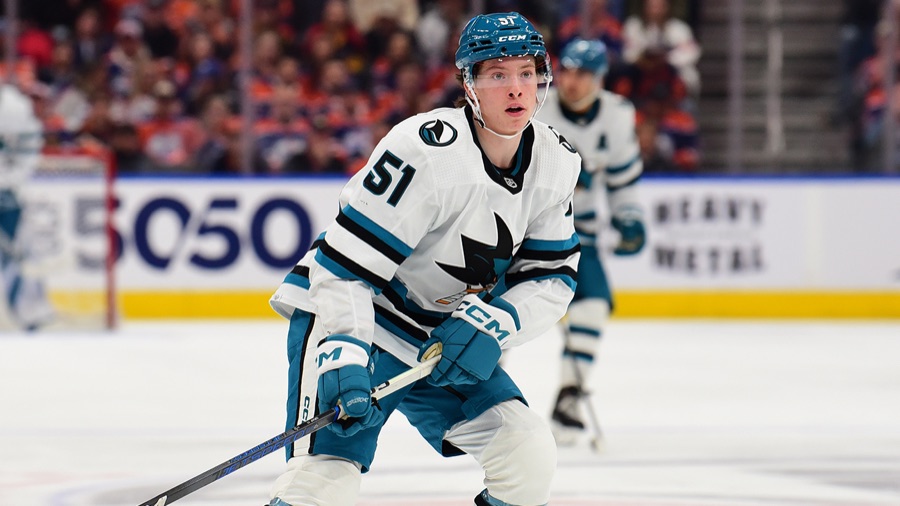
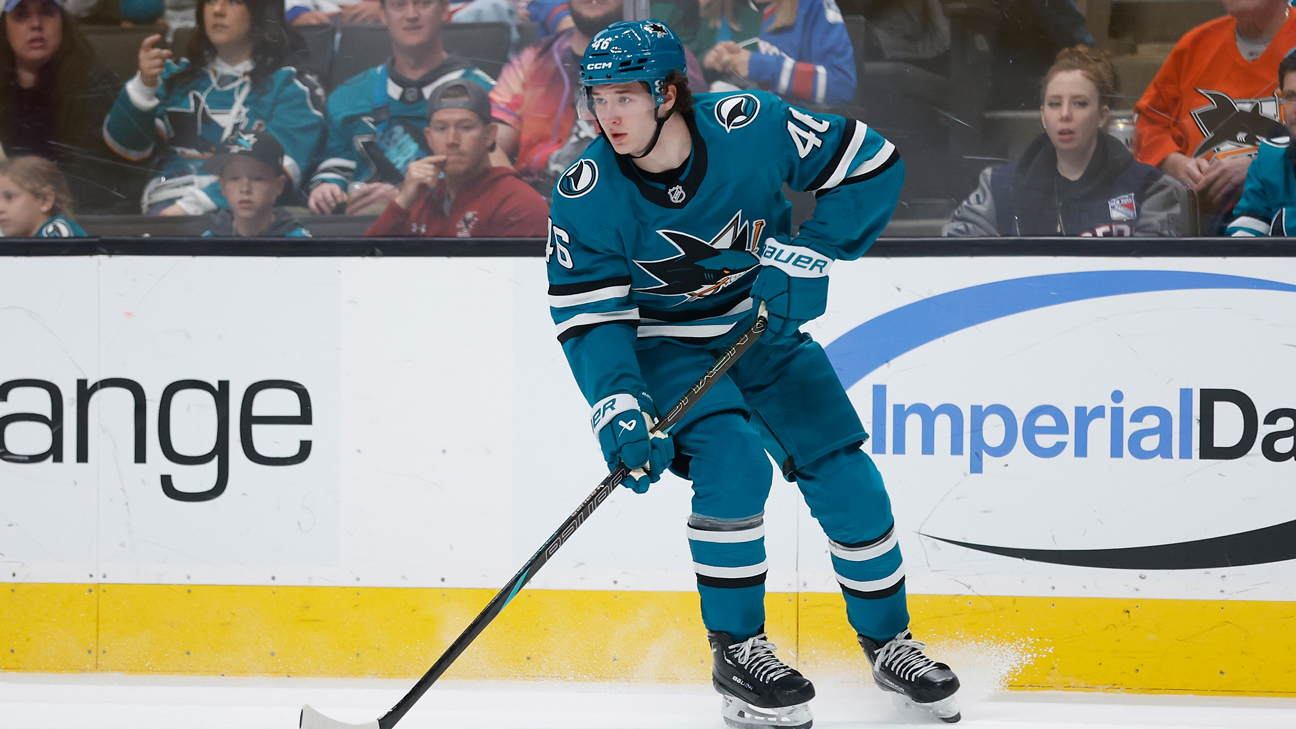
Will Smith went fourth overall in 2023, the highest any Boston College player has been drafted. Leonard went eighth in the same first round, to Washington. They were linemates on the national development program before that and linemates at Boston College after it, which is the sort of detail that means nothing to a cap sheet and a fair amount to everybody else.
Smith is going into the third and final season of an entry-level contract worth $950,000 against the cap. He scored 24 goals and put up 59 points in 69 games last season. He has 104 points in 143 NHL games. He becomes a restricted free agent on July 1, 2027, at 22, with a qualifying offer of $940,500 sitting under him, and he was eligible all summer to sign an extension of any length the rules allowed.
He did not sign one. Neither did the club.
(Nobody is accusing anybody of negligence here. Leonard's own general manager, Chris Patrick, said he was less than optimistic in August and got it done in the last few days. These things go how they go.)
Here is the arithmetic, and it is smaller than it sounds. Smith's first year of unrestricted free agency is 2031. Any extension he signs begins in 2027-28, because he plays this season out on the entry-level deal. An eight-year extension would have run through 2034-35, buying four seasons he would otherwise have been free for. A seven-year extension runs through 2033-34 and buys three.
One season. That is the whole cost of Tuesday night, and it is 2034-35, the year Smith turns 30.
Grier is not pretending it was the plan#
Mike Grier met the media on Thursday, September 17, the first day of camp, and did not dress it up.
"We had some good conversations with Will and his group. And with Smitty himself," he said. "This is just the way it worked out that there wasn't a deal done."
That is a general manager describing a thing that did not happen rather than a thing he chose. He went on: "I told you guys when we met on July 1, I said then it's not the end of the world if we don't get them done. It's all good. It's in a good spot. We had good conversations, and I'm sure we'll continue to have conversations as the year goes on."
Then the sentence that tells you the pace. "I'm always open to listening if they want to have a conversation during the season. There are no plans to talk tomorrow or next week."
Smith was equally relaxed, which is what a 21-year-old in line to be paid a great deal of money in one of the next two summers should be. "I'm not worried about it," he said. "Control what I can control. I'm worried about playing hockey." He added that he had not focused on the extension much over the summer and had left it to his agent and to Grier.
Anyway.
The case that San Jose lost nothing at all#
There is a real argument that Tuesday was somebody else's deadline, and San Jose's own July supplies it.
Macklin Celebrini signed his extension on July 29, when eight years was still legal and available and nobody had to hurry. He signed for five. Five years and $94 million, an $18.8 million cap hit beginning in 2027-28, running through 2031-32. Against a 2031 free agency date, that contract buys exactly one season. Eight would have bought four, and the club's own announcement thanked Celebrini's representatives for "the flexibility they have provided to the team in how we allocate future dollars towards the team being constructed around Macklin."
Flexibility is the word a front office uses when a term came out shorter than the maximum and everybody is content about it. The money was not the obstacle either. A player may sign for 20 percent of the upper limit, which against this season's $104 million is $20.8 million a year, and Grier said he did not think owner Hasso Plattner would have hesitated to pay it if Celebrini had asked. Celebrini signed for $18.8 million.
So the club that just watched the eight-year contract disappear had its first overall pick available at that term, seven weeks ago, with a willing owner, and signed him to five. Nothing on San Jose's books now runs past 2031-32, and the only contract that reaches even that far is Celebrini's.
Meanwhile Montreal put Ivan Demidov on eight years and $9.15 million a season, running 2027-28 through 2034-35, in the first week of July, without waiting for a horn.
Both of those things are true, and which one you find persuasive depends on whether you think San Jose was ever going to write an eight-year deal or simply never got the chance to decide. The record says the club did not write one when it could, and cannot now.
The deadline that actually matters#
It is not September. It is July 1, 2027, when Smith becomes a restricted free agent in a league that has rediscovered the offer sheet. Philadelphia put one in front of Leo Carlsson in July at $18 million a season, Anaheim matched it, and the price of every young forward in the sport moved. The cap goes from $104 million this season to $113.5 million in 2027-28, which is when Celebrini's $18.8 million lands and when whatever Smith signs will land beside it.
Leonard spent Tuesday night watching a clock and said so the moment somebody asked him about it.
Nobody in San Jose is watching one. There are no plans to talk next week.
Called Shots#
Will Smith and San Jose do not agree to a contract extension on or before April 30, 2027. The case against me is decent: the market comparable just printed at $10.5 million and an eight-year term is no longer available to drive the price, Grier has said explicitly that he will listen in season, San Jose has watched a division rival's franchise center get offer-sheeted this summer, and a club that fears July 1 has every reason to move before it. The case for me is that Grier said there are no plans to talk next week, that both sides went out of their way to describe the absence of a deal as fine, and that this front office took until the last week of July to finish Celebrini in a summer when it had nothing else to do. Teams that are relaxed in September are usually still relaxed in February.
Sources: Ryan Leonard's contract terms, quotations and draft position, the September 16 start of the new collective bargaining agreement, its seven-year maximum, and Justin Sourdif's contract are from NHL.com's September 17, 2026 report, read at the original. The term limits and the agreement's September 16, 2026 to September 15, 2030 span are also from NHL.com's own explainer of July 21, 2025. The count of 33 eight-year contracts since late June 2025 and 12 in the last three months, Drake Batherson's and Noah Ostlund's and Ville Koivunen's terms and career games, Chris Patrick's August pessimism, the Carlsson offer sheet and Anaheim's match, and the $104 million and $113.5 million cap figures are from Stephen Whyno's Associated Press report of September 15, 2026. Will Smith's entry-level terms, cap hit, signing date, restricted free agency year, qualifying offer, unrestricted free agency year and birth date, and Macklin Celebrini's and Ivan Demidov's extension terms, covered seasons and free agency years, are from PuckPedia's player and San Jose cap pages, read September 19, 2026. The five San Jose signings since free agency opened, with their terms, are from the club's transaction log on the same site, read the same morning. Smith's and Leonard's draft slots and their shared development-program and Boston College lines are from Boston College Athletics' own release of June 28, 2023. Grier's and Smith's remarks of Thursday, September 17, 2026 were reported by Max Miller at Sharks Hockey Digest. Grier's remarks on the maximum and on the owner, and the club's language about flexibility, are from Sharks Hockey Digest of July 29, 2026 and from the Sharks' own release of the same date.