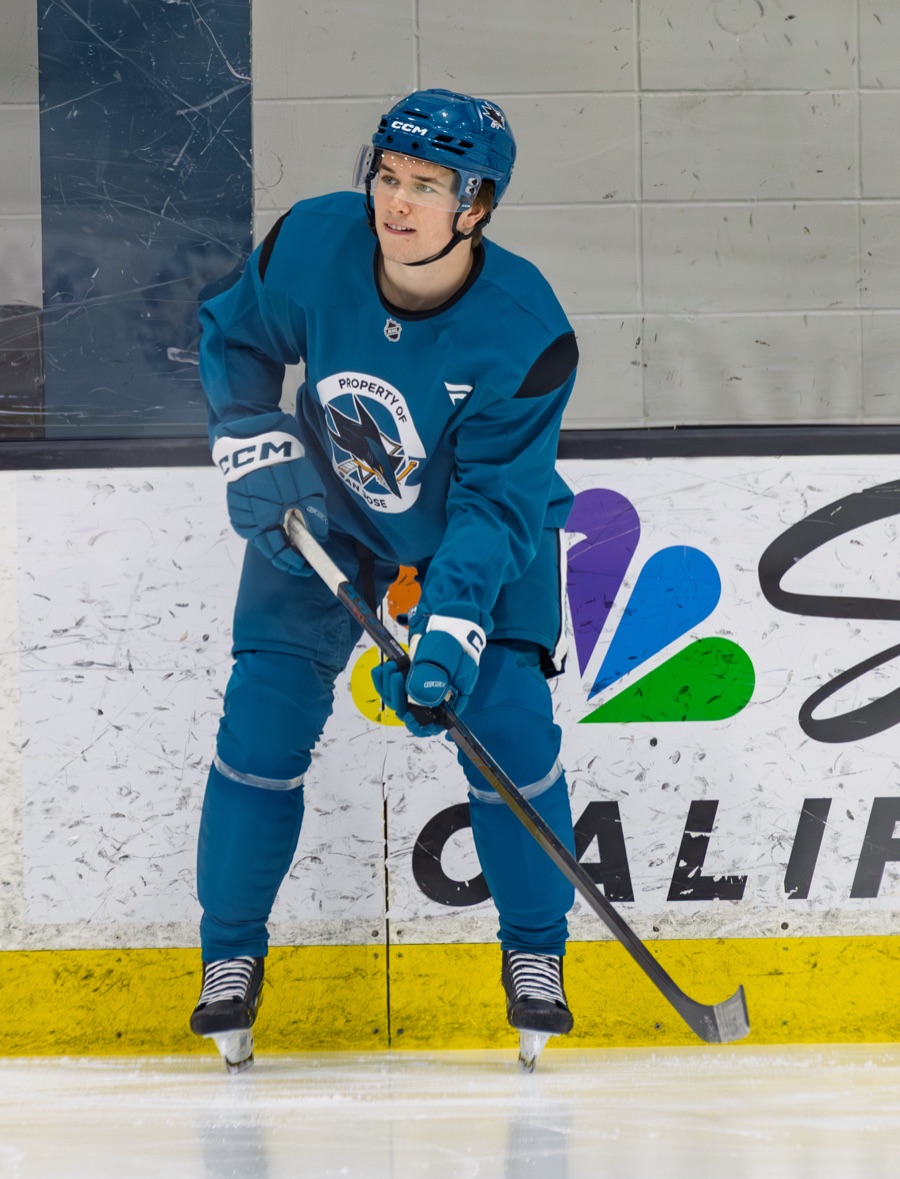
Zack Ostapchuk Got Some Of The Hardest Ice In San Jose And The Puck Stayed Out Of The Net
The Sharks 25, No. 20. Only Ty Dellandrea and Barclay Goodrow began a smaller share of their even-strength shifts in the offensive zone last season, and nobody on the roster allowed goals at a lower rate than Ostapchuk's 2.7 per sixty. He also finished with seven points in 59 games. San Jose just bought four years of a player who has proved one half of his job and none of the other.

Thirteen San Jose forwards dressed at least 40 games last season. By the share of even-strength shifts that began in the offensive zone, Zack Ostapchuk is third from the bottom at 33.8 percent, behind Ty Dellandrea at 30.0 and Barclay Goodrow at 31.5. At true five-on-five it is starker: 34.4 percent offensive, 65.6 percent defensive. About two of every three times a whistle sent him out for a faceoff, he started in his own end.
Rank the same thirteen by goals allowed per sixty at even strength with each man on the ice, and Ostapchuk is at 2.7, level with Collin Graf. Nobody is lower.
That is the case for him, and it is a real one. The job is to take the shifts nobody wants and give the puck back without it going in, and he did that better than any forward on an 86-point team from the third-hardest starting position of the thirteen.
The other end#
The same time-on-ice table has San Jose scoring 1.6 goals per sixty with Ostapchuk on the ice at even strength. That is tied with Dellandrea for third-lowest of the thirteen, ahead of only Goodrow at 1.5 and Ryan Reaves at 1.4. His own line reads four goals and three assists in 59 games, 44 shots, a shooting percentage of 9.1.
The puck stayed out of one net and never went into the other. Hockey Reference's expected plus-minus has him at minus 4.8 against an actual minus 11, and his even-strength shot share was 43.4 percent, 4.8 points below his teammates. He was out-attempted and he survived it.
What San Jose bought#
On June 27 the club signed him for four years and $9.4 million, a $2.35 million cap hit running through 2029-30, the summer he turns 27. Born in May 2003, he is not on a bridge deal. This is the whole restricted window and the door of the unrestricted one.
Professor Hockey, who had projected roughly $1.6 million on two years, said flatly that he would not have signed it: "Would I have signed this contract? Perhaps not." What talked him into calling it fine was a split. Before the Olympic break Ostapchuk's numbers were poor and his wingers were Goodrow and Ryan Reaves. After it, with Adam Gaudette in Reaves's place, the team's five-on-five play climbed to mid-pack, and over the final 27 games, all of which Ostapchuk played, he had by that account the third-highest expected-goal differential of any San Jose forward. That ranking is an outside claim I have not verified.
Take it at face value and the contract is priced off 27 games. Take the 59 and it is priced off a player with seven points.
The faceoffs#
One thing has moved in a straight line. Ostapchuk won 26.8 percent of 41 draws as a 20-year-old in Ottawa, 48.6 percent of 282 the next season, and 51.6 percent of 457 last year. Six San Jose forwards took at least 200 draws; only Dellandrea, at 51.9 percent on 539, was better. Those are the counting stats of a fourth-line center who is good at the parts of the job that do not pay.
Best case#
He plays a full 84-game season for the first time, holds the goals-against rate near 2.7, and the goals-for number climbs off 1.6 toward the 2.4 San Jose managed with Gaudette on the ice. None of that requires him to become a scorer. It requires the line he centers to stop conceding the shot share and winning nothing back, and it requires more than the 8:54 of even-strength time a night he got last season.
Worst case#
The goals-for rate stays where it is, because it was never his to move, and San Jose has a fourth-line center at $2.35 million with three years left and a prospect behind him. Professor Hockey named that risk at signing: Filip Bystedt is closest, Cole McKinney further out, and if either passes him the term becomes dead money on a club paying Macklin Celebrini $18.8 million from 2027-28.
What to watch early#
Not his points. His wingers.
The version of Ostapchuk that justifies four years is the post-break one, and what changed at the break was the man on his wing. DailyFaceoff's projected lines, published July 4 and predating the Celebrini and Graf signings, have a fourth line of Toffoli-Ostapchuk-Dellandrea. Erika Towne's Fear the Fin read at the signing had Goodrow-Ostapchuk-Dellandrea. Neither includes Gaudette.
So the checkable thing in October is the lineup card. If he opens between Goodrow and Dellandrea, San Jose has re-assembled the group whose numbers were bad and is asking a different result of the same parts. The second thing costs nothing: his offensive zone start share, baseline 33.8 percent. Still under 35 in November means the coaching staff has not changed its mind about what he is for, whatever the contract says.
The three arguments against me, and the first one is real#
One. A goals-against rate built on 24 goals in 525 even-strength minutes is a small number. His on-ice save percentage there was 89.4, below average, so the suppression was not goaltending, but a rate that low behind a 43.4 percent shot share is partly the shots being bad ones and partly variance. It will regress and I do not know how far.
Two. Zone starts say where a shift began, not where the play went, and the team-wide version above is even strength rather than five-on-five, so it folds in four-on-four and empty-net shifts. It is a proxy.
Three, and it undercuts my own tell. If the goals-for rate belongs to the wingers, so does some of the goals-against rate, and crediting the center for one while excusing him for the other is having it both ways. A fourth-line number is a line number. Ostapchuk is the constant here only because he is the one signed for four years.
The stakes#
San Jose has missed the playoffs for seven straight seasons, since 2018-19, and finished fifth in the Pacific at 39-35-8 with a minus 41 goal differential. A team there does not reach the postseason on its fourth line, but it can be kept out by one. The four forwards at the bottom of that thirteen-man list were on the ice for goals-for rates between 1.4 and 1.6 per sixty, which is a line losing its shifts quietly.
Ostapchuk is 20th here because the club has already decided he is a fixture and the decision cost four years. He has proved he can be trusted with the hard shifts. What he has not proved is that anything happens on them.
Previously in this series: The Sharks 25, No. 21, Barclay Goodrow.
Sources: Hockey Reference, San Jose Sharks 2025-26 time-on-ice, roster, advanced and skater tables, and the Zack Ostapchuk player page; PuckPedia and CapWages contract pages; Professor Hockey, June 28, 2026; Fear the Fin, Erika Towne, June 29, 2026; DailyFaceoff projected lines, July 4, 2026.