Two Sharks Forwards Played All 82 Games, And Barclay Goodrow Was The Other One
The Sharks 25, No. 21. Goodrow dressed every night last season and spent 1:55 of each one on the penalty kill. San Jose conceded 9.9 goals per sixty minutes with him on the ice shorthanded, the highest rate among the five forwards under contract for this season who killed at least a minute a game, and the club's own improvement plan is written around moving those minutes to somebody else.
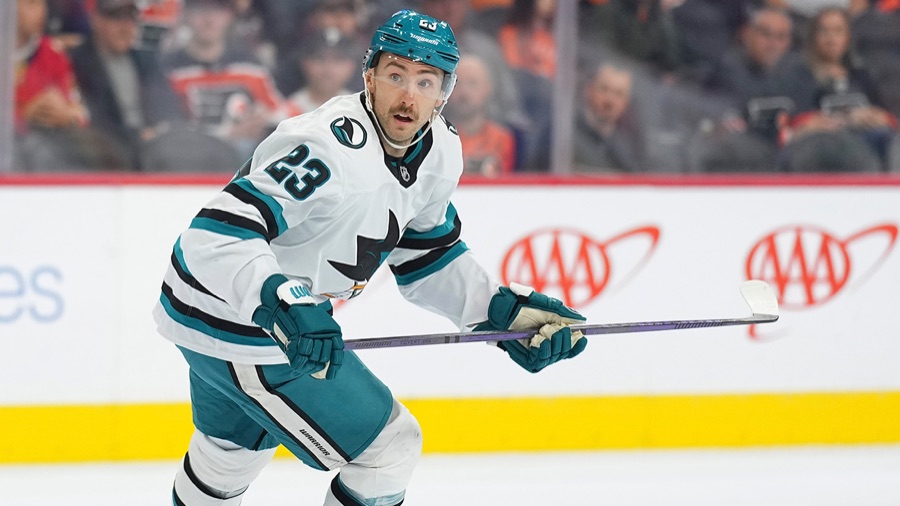
Two San Jose forwards dressed for all 82 games last season. One of them scored 115 points. The other scored 12.
That is not only a joke at Barclay Goodrow's expense. Availability is a real thing a fourth-line forward sells, and he sold every night of it at 32 years old, on a team that finished 39-35-8 and needed bodies. He is an alternate captain, and Erika Towne's Fear the Fin review of his season credits him with 97 playoff games and two Cups, more postseason hockey than most of this dressing room has watched.
The problem is that the thing he was on the ice to do was the thing San Jose did worst.
The job#
Goodrow played 11:20 a night last season, and 1:55 of it came shorthanded. That is 16.9 percent of his ice time spent a man down, second-highest among the ten forwards under contract for 2026-27 who played at least 40 games, behind Ty Dellandrea's 18.5 percent. He took three seconds of power play all season. His even-strength ice time, in the same table, is 9:22 a night, which is fourth-line ice time by any definition.
The penalty kill is not a footnote on his season. It is close to a fifth of it.
The rate#
Take the forwards under contract for this season who averaged at least a minute a game shorthanded last year. There are five of them. Sort them by the goals San Jose allowed per sixty minutes with each man on the ice killing a penalty.
San Jose bled fastest on the kill with Goodrow out there
Goals against per sixty minutes shorthanded, 2025-26, from Hockey Reference's San Jose time-on-ice table. The population is the five forwards under an NHL contract for 2026-27 who averaged at least one minute a game shorthanded last season, with games played and shorthanded ice time per game beside each name. Lower is better. Axis runs from zero to twelve.
Goodrow tops a list nobody wants to top. He also scored no shorthanded goals and assisted on none, so the column that might have paid for the goals against is empty.
The rate and the raw count agree, which is what makes it hard to wave off. Nine point nine goals per sixty across roughly 157 shorthanded minutes works out to about 26 goals. Writing at Fear the Fin on June 16, Towne reported the count directly: 26 goals against with Goodrow on the ice shorthanded, the most on the team, including a team-high 11 from high-danger ice, and none for. Two instruments, one answer.
The unit around him finished at 76.42 percent, 26th of 32, against a league average of 78.87. That is 58 power-play goals allowed on 246 kills.
What he is for#
Towne's review is worth reading against itself. It reaches hard for veteran presence, toughness and playoff pedigree, and it also reports that Evolving-Hockey graded Goodrow the worst forward on the team by goals above replacement, and that among his line combinations with 30 or more minutes together, the best goals-for share any managed was exactly 50 percent. Her own conclusion is the sharpest sentence in it: if the ability to kill penalties goes, there is little else to recommend him.
The toughness is real. He led San Jose with 73 penalty minutes, and Towne has him second on the team in hits behind Ryan Reaves. On a roster this young somebody answers for Macklin Celebrini, and right now that somebody is a 33-year-old forward in the last year of his contract.
Best case#
He plays 55 to 60 games instead of 84, kills penalties on a second unit rather than a first, and the rate comes down because the deployment changed rather than because he did. Professor Hockey, working through the roster on August 12, projected him for 7 points across the new 84-game schedule and put it plainly: it would be coaching malpractice, he said, if Goodrow played all 84. Seven points is a floor nobody would notice, and that is the point. In the best version he is the thirteenth forward who dresses when somebody is hurt, and never again the third-most-used forward on a bottom-seven penalty kill.
Worst case#
The worst case is not that he is bad. It is that he is available. He dressed 82 times last season for a coach entering the final year of his contract, and availability is the quality most likely to survive a losing week. If Ryan Warsofsky reaches for the veteran in October the way he did a year ago, San Jose runs the same kill with the same personnel, finishes bottom-ten again, and the points the special teams were supposed to return to the standings never arrive. Failing that test does not require anyone to play badly. It only requires nobody to change anything.
What to watch early#
One cell in the box score: his shorthanded time on ice, per game, in October.
The baseline is 1:55. Anything at or above it through the first month means the kill was not rebuilt, only re-described. Under about 1:15 means the minutes genuinely moved, most likely to Collin Graf, the only forward of the five who suppressed anything last season at 5.4. The second thing costs nothing to check: whether he dresses at all. DailyFaceoff's projected lines, published July 4 and predating both the Celebrini and Graf signings, have Goodrow and Adam Gaudette as extras rather than in the twelve.
The other side#
One, and it is the one I cannot fully answer. On-ice goals against per sixty shorthanded is a small, noisy number attached heavily to goaltending, and the goaltending behind that kill was Yaroslav Askarov at .883 across 47 games and Alex Nedeljkovic at .896 across 40. A forward does not choose which shots go in. The shot-suppression column is kinder to him than the goals column: his relative shot share while shorthanded was flat at 0.0, which says the kill conceded attempts at its normal rate with him out there and simply lost more of them.
Two. Nothing above says he cannot do the job at a reduced volume. Every argument here is about how much, not whether, and the version of this season where he kills 1:10 a night on the second unit never produces a story at all.
The stakes#
San Jose has not reached the playoffs in seven seasons, since 2018-19. It improved by 34 standings points last year and still finished fifth in the Pacific. The gap left is smaller than the gap already closed, and the cheapest place to find it is a penalty kill that ranked 26th while the power play sat a tenth of a point above league average at 21.18 percent. Special teams are where a fringe team buys points without buying players.
Goodrow is 21st on this list because he is not going to decide a game this season. He may still decide four or five of them, one power play at a time, and the deciding will be done by whoever writes the lineup card rather than by him.
Previously in this series: The Sharks 25, No. 22, Quentin Musty.
Sources: Hockey Reference, San Jose Sharks 2025-26 time-on-ice, roster and advanced tables, and the 2025-26 NHL team table; San Jose Sharks 2025-26 final skater statistics; PuckPedia and CapWages contract pages; Fear the Fin, Erika Towne, June 16, 2026; Professor Hockey, August 12, 2026; DailyFaceoff projected lines, July 4, 2026.