Mason Marchment, and which Mason Marchment
The good half of July 1, a genuine homecoming, and the one question that decides how good.
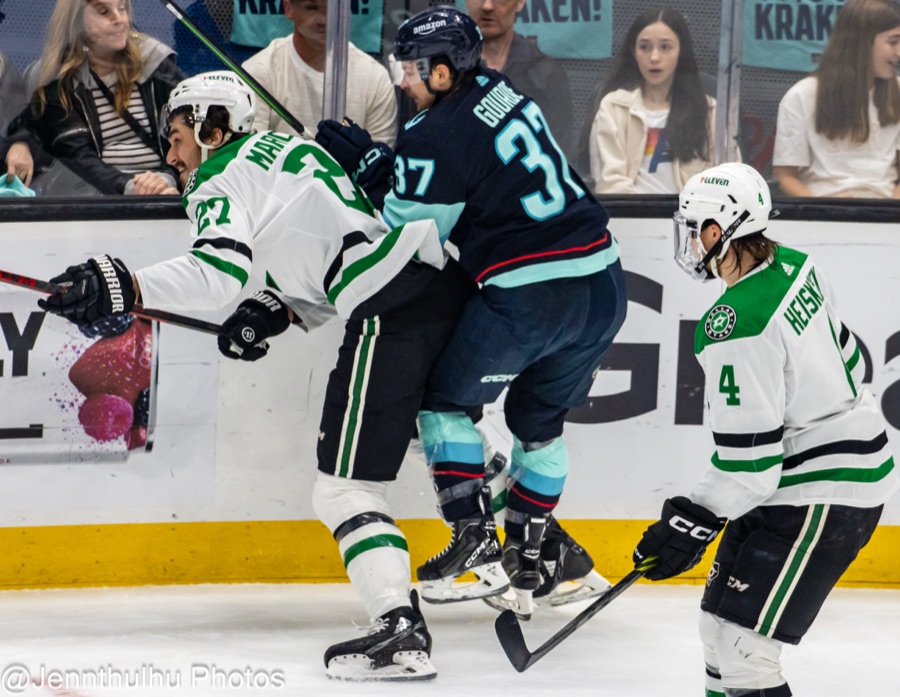
Start with the part that has nothing to do with expected goals. Mason Marchment's late father, Bryan, scouted for the San Jose Sharks from 2008 until he died, suddenly, in July of 2022. Mason grew up a rink rat around that practice facility. On July 1, four years almost to the week after his dad passed, he signed there. You are allowed to feel something about that before we start counting Corsi.
Now the counting. Here is the verdict up front, because that is the house style: this is the good signing of San Jose's July 1, the clean one, the one the models like. The only real question is not whether Marchment is a useful hockey player. It is which Marchment shows up, because there have been two of them, and the answer decides whether this deal is fine or genuinely good.
A 6-foot-5 power winger who scores efficiently at five-on-five, does not need a power play to matter, and brings an edge San Jose's top six genuinely lacked. Signed at fair-to-slightly-positive value, front-loaded, with a fifth year that projects underwater at age 35. The catch: his underlying impact has swung hard by team and role, so the price is really a bet that elite linemates (Celebrini, Misa) bring out the version that thrives rather than the version that just scores. Given where he is landing, that is a good bet. Grade: B+, and it is the mirror image of the Trouba deal in every way that matters.
What they bought#
Five years, at a cap hit that is either $6.75 million (what PuckPedia entered once the actual contract posted) or $7.0 million (what Friedman, CapWages, and Dom Luszczyszyn all reported). My money is on $6.75M being the precise filed figure and $7M being the rounded early number, which would make an already fair deal a hair better. Either way it runs through 2030-31, and either way it is a raise from the four-year, $18 million ($4.5M) deal he just finished in Dallas, which the rocketing cap makes look reasonable rather than reckless.
For context on the market: Dom Luszczyszyn, whose model I keep leaning on because it is the good one, valued Marchment at $7.5 million and called him "the best winger available... arguably the most valuable winger on the market." AFP Analytics had him lower, at $5.7 million. San Jose split the difference and paid a fair price for a real player on a day when fair prices were rare. He graded it a B+. I am not going to be braver than the guy with the model.
What he brings (this part is easy)#
His projection card, which is not shy:
| Metric (2025-26) | Value | Read |
|---|---|---|
| Net rating | +5.8 · 82nd pct | Genuinely good |
| Offense rating | +5.3 · 81st | A projected 26-35-61 line |
| 5-on-5 defense | 84th pct | Two-way, not a passenger |
| Power-play reliance | 20th pct | Does it at 5v5, no PP crutch |
| 2025-26 xGF% / rel | 54.0% / +5.1 | Drove play in Columbus |
| Quality of competition | 30th pct | Lighter minutes (a flag) |
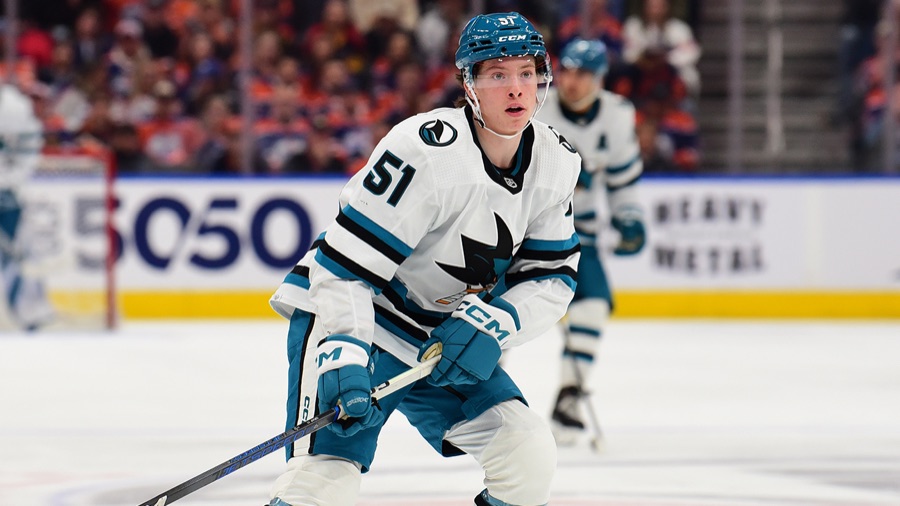
The scouting version, in a sentence: a big, physical, 6-foot-5 winger who scores 20-plus goals when it goes well, finishes efficiently, kills nobody on the power play because he does his damage at even strength, and defends well enough that you never hide him. Eric Stephens put it plainly: the edge is "an element that is much-needed in San Jose's top six," and Marchment can "do the heavy lifting to thrive next to either Macklin Celebrini or Michael Misa." That is a top-six winger, full stop. San Jose's top six was skilled and slightly soft. He is skill you do not have to protect.
The catch: there are two Mason Marchments#
Here is the thing the "best winger available" headline glides past, and the reason I did the digging. Marchment's individual scoring has been steady for years. His impact on the run of play has not. It swings, hard, with his team and his role:
- Florida (2021-22): elite. A plus-11.1 relative expected-goals share. One of the best support scorers in the league, on a great team.
- Dallas (2022-24): a scorer who did not drive. He put up 22 goals and 53 points in 2023-24, and his relative expected goals was minus 2.2. The year before, minus 4.4. Real production, negative play-driving. That is the version that worries you.
- Columbus (2025-26): elite again. Plus 5.1 relative, a 67-point pace, the stretch that earned this contract, in 39 games.
So the model's shiny plus-5.8 is real, but it leans on a hot 39-game Columbus sample and blends over a career that has genuinely been up and down. The honest read is that Marchment is a very good complementary scorer whose ceiling depends on his environment. Put him on a strong team in a real role and he looks like Florida and Columbus. Ask him to carry water on a middling group and you can get Dallas.
And this is exactly why I still land on the optimistic side: San Jose is the good-environment case, not the bad one. He is walking into a top six with Celebrini and Misa, the kind of elite center play that turned him into a plus-11 monster in Florida. The deal is a bet that context brings out the better Marchment, and the context San Jose is handing him is the good kind. That is a much smarter bet than the one they made on the other guy that afternoon.
The honest debits#
- The fifth year. He is 31. The model projects his net rating sliding from +5.8 to roughly break-even by 2030-31, a fifth year that grades slightly underwater at age 35. This is a front-loaded deal: you are buying three very good years, a fair fourth, and eating a soft fifth. Fine, as long as everyone says it out loud now.
- Lighter minutes. His quality of competition graded 30th percentile, so some of the pretty rate stats came against second and third lines. Real, and worth a small haircut on the projection.
- The sample. The number that sold everyone was 39 games in Columbus. Great games. Still 39.
One honest boundary on the research, since I did the same for Trouba: the one layer I could not pull is his All Three Zones microstat card, the transition-and-entries tracking that was so damning for Trouba. Corey Sznajder's cards are subscriber-gated, and I will not use your login to get behind the paywall. If you can paste Marchment's the way you did Trouba's, I will run it and we will know whether his zone entries and forechecking match the pretty outcome numbers. My strong suspicion, given a 6-5 forechecker who drives play on good teams, is that they hold up. But suspicion is not the card.
The bet, stated plainly#
San Jose is wagering that:
- Celebrini or Misa on his wing produces the Florida-and-Columbus Marchment, not the Dallas one (the context strongly favors it).
- Three or four good years up front are worth carrying a soft fifth (they are, at this price).
- A climbing cap turns $6.75 to $7 million into a middle-six salary by the back half (near-certain, ceiling headed past $150M).
A fair-value signing of a real top-six winger who fills an actual hole (size and finish and edge), whose one honest risk is environmental and whose new environment is the good kind. Front-loaded, with eyes open on the fifth year. This is the deal you make. Grade: B+, and if Celebrini's center play does to Marchment what Barkov's did, it ages into an A and nobody remembers the quibble about 39 games.
So, back to where we started. His father spent 14 years finding players for this team and did not get to see this one walk in the door.
If you are going to sign a homecoming, this is the way to do it: not on the story, but on a fair number for a good player who happens to have the story too. The math and the moment agreed for once. Enjoy that. It does not happen much.
Sources: Dom Luszczyszyn (The Athletic) grade and projection card, Hockey Stat Cards, PuckPedia and CapWages contract and career data, Eric Stephens (The Athletic) on the fit. Impact figures are 2025-26 regular season unless noted. All Three Zones microstat card pending (subscriber-gated). Full workup logged in the repo.