Kesselring deep dive, the NHL Edge layer: elite tools confirmed, and one correction
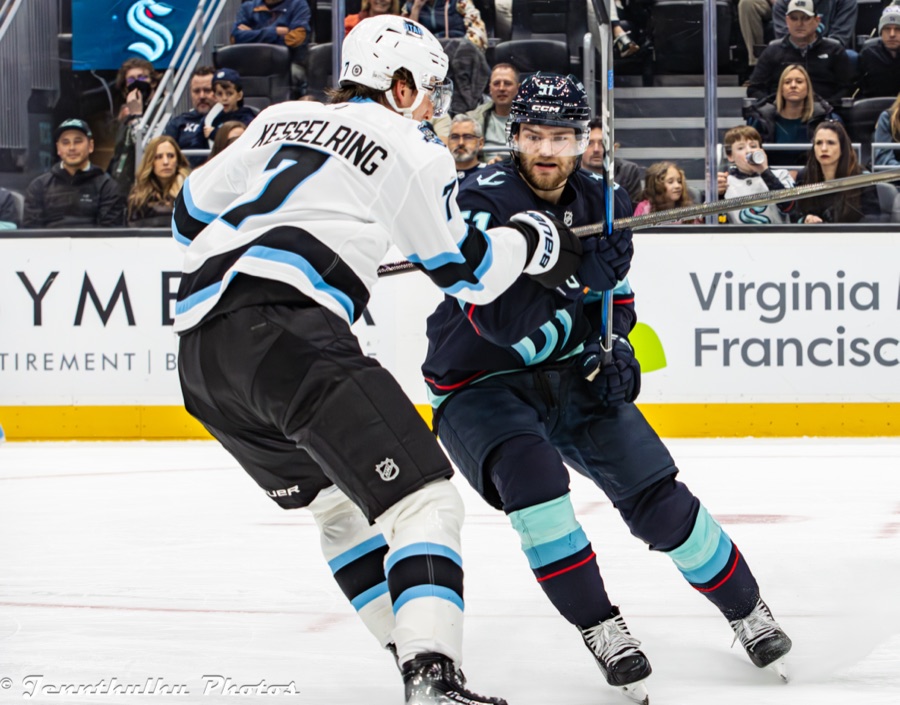
The NHL Edge card for Kesselring's best year (2024-25, Utah) is the most important data in the whole file, because it measures the two things an ankle injury hides but cannot erase: how fast he skates and how hard he shoots. Both come back at the 99th and 97th percentiles. This is the addendum to the deep dive, plus one correction I owe you.
The correction first#
The deep dive said Kesselring has the "second-hardest shot in the league behind Tage Thompson," echoing the Athletic feature. NHL Edge's official 2024-25 data says that skips a name. The top three hardest shots among all skaters: Tage Thompson 106.0, Gustav Forsling 105.05, then Kesselring at 103.77. So he is the 3rd-hardest shooter in the NHL, and 2nd-hardest among defensemen (behind Forsling). Still 99th percentile, still a cannon. Just not quite the Fairburn framing, and the Nashville-81-vs-84 rule says I flag it rather than let it ride.
The skating is the revelation#
| Edge metric (2024-25) | Kesselring | Position avg | Pctile |
|---|---|---|---|
| Speed bursts over 20 MPH | 115 | 29.4 | 97th |
| Max skating speed | 22.29 MPH | 21.59 | 75th |
| Skating distance | 220.7 mi | 135.9 | 81st |
| Hardest shot | 103.77 MPH | 89.69 | 99th |
| Shots on goal | 150 | 65.4 | 92nd |
Look at the top row. 115 bursts over 20 MPH against a positional average of 29.4 is nearly four times the league norm, and it lands at the 97th percentile. For a 6-foot-5 defenseman, that is not "good skater for his size," it is a genuinely elite high-speed engine, full stop. Add 81st-percentile mileage (he covers ground) and a 75th-percentile top gear, and the scouting cliche that he "skates well" is doing a lot of quiet work. He is fast, and he is fast often.
The shot total is a lie in the good direction too#
He put 150 pucks on net (92nd percentile, more than double the positional average) and buried 7. That is a 4.7 percent clip, below the 5.5 percent average, so the goal total is a slightly-unlucky return on huge volume, not a sign of a weak shot. The shot itself is a 103.77 MPH point bomb, and 23 of his attempts came in the 90-to-100 MPH band (96th percentile). The takeaway for San Jose is the power play: this is a real point-shot weapon whose 7-goal line actively hides the threat, on a Sharks unit that the PK autopsy's twin (the power-play blueprint) identified as needing exactly a point shot. The offense in Utah flowed through his 22 assists (6th among all NHL defensemen in five-on-five primary assists). The volume plus the velocity is the point.
Why this is the decisive evidence#
Skating speed and shot velocity are the most repeatable, least luck-dependent traits a defenseman owns. They do not evaporate in a contract year. What a high-ankle sprain does, specifically, is steal a skater's edges, his bursts, his top gear, the exact things this card says are his elite calling cards. So the bounce-back bet gets simpler and safer the closer you look: it is not "can a player rebuild a skill set," it is "do a 97th-percentile skating engine and a 99th-percentile shot come back once the ankle is healed." Tools that elite, at that size, on a player that young, bought at the bottom of an injury year for a pick slide and roughly $3M. Every layer of this file has pointed the same direction, and the tracking data points hardest of all. The zone usage even backs it: balanced, transition-heavy, not sheltered. Pair him with Dickinson, point that cannon at the net on PP2, and let the wheels come back.
Source: NHL Edge official tracking, Kesselring 2024-25 regular season. The shot-ranking correction (3rd overall / 2nd among D, behind Thompson and Forsling) supersedes the "2nd behind Thompson" line in the deep-dive email; the full Edge breakdown is logged in docs/2026-offseason/clippings/2026-06-17_TRADE_Kesselring-for-No20-pick-swap.md. The deep-dive email's substance is otherwise unchanged; this only adds the tracking layer and fixes the one ranking.