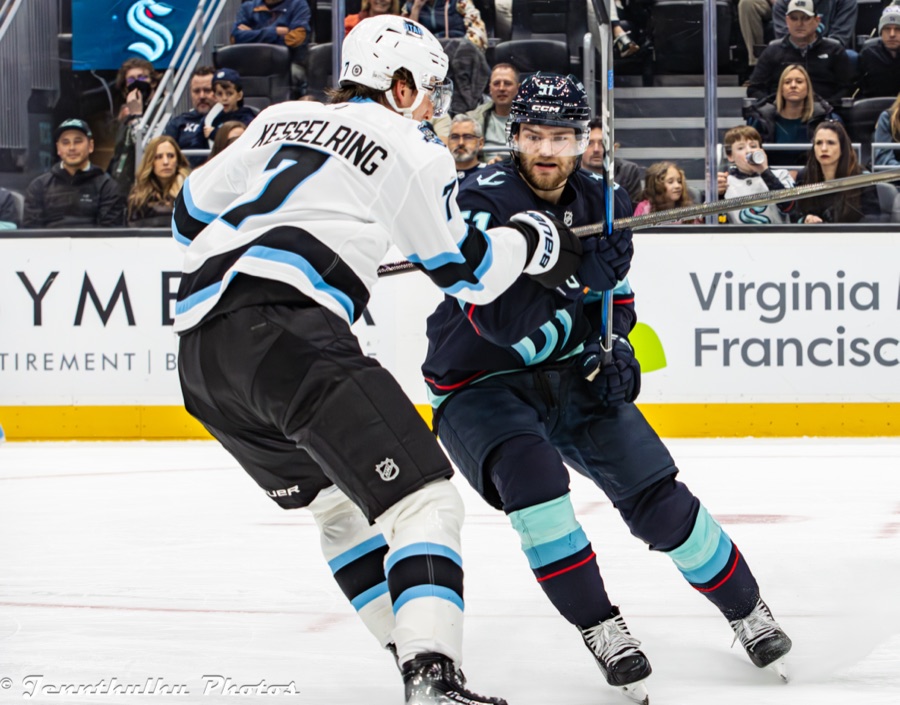
Kesselring's power-play efficiency in Utah: a functional PP2 with a PP1 weapon attached
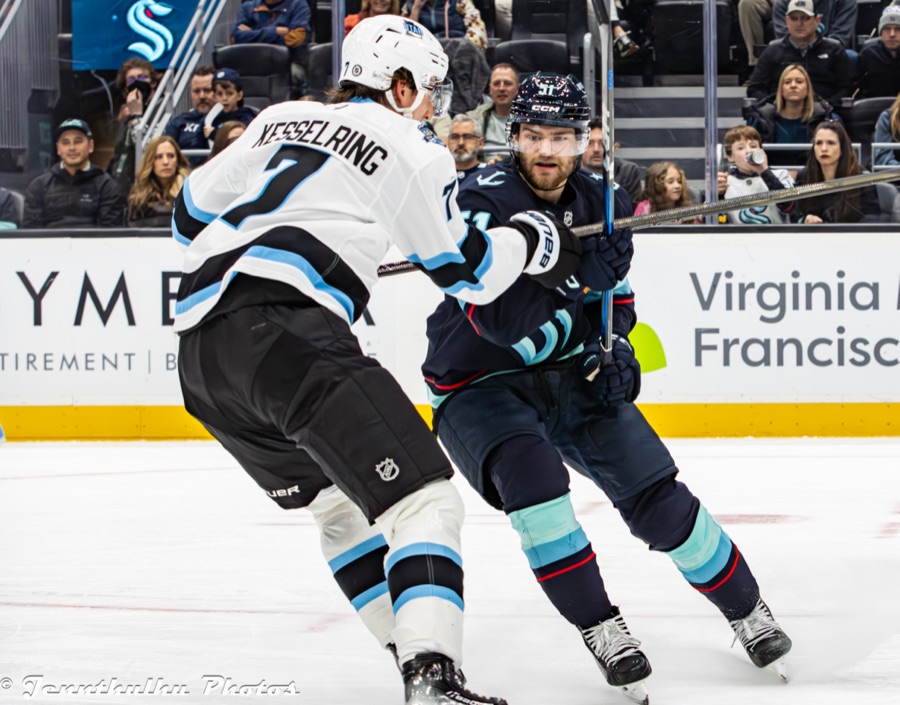
The right narrow question is not "can he run a power play," but "what did his second-unit power-play role actually produce." Here is the verified answer from MoneyPuck's 5-on-4 splits for 2024-25, and the headline is that the role was small but the efficiency was real.
The PP2 line, 2024-25 Utah (5-on-4)#
| Measure | Kesselring | Read |
|---|---|---|
| Power-play TOI | 69 min (about 0:50/game) | A true second-unit/spot role, not a quarterback's workload |
| On-ice xGF/60 | 6.33 | A functional, roughly league-average PP rate |
| On-ice goals (xG) | 4 goals on 7.29 xG | The unit converted at expectation in his minutes |
| His individual PP points | 3 (1 G, 2 primary assists) | ~2.6 points/60, a solid second-unit rate |
Is 6.33 good?#
For context, a strong NHL power-play unit runs 8-to-9 expected goals per 60, league average sits around 6.5-to-7, and the Sharks' own top unit last year ran 7-to-9 with Toffoli leading at 9.29. So Kesselring's 6.33 is not a PP1-elite number, and it was never meant to be: it is a second-unit rate, generated with second-unit linemates, in fifty seconds a night. Judged as what it actually was, a PP2 contribution, 6.33 xGF/60 is a perfectly functional, roughly-league-average result, and the unit scored four real goals on 7.29 expected in his minutes, so it converted to plan rather than living on luck. The honest caveat: 69 minutes is a small sample, so the precise figure has wide error bars. Treat it as "competent second unit," not a precise ranking.
Why this matters more for San Jose than the number suggests#
The key is that Utah never gave him the keys. He posted a functional 6.33 on the second unit in spot minutes despite carrying the third-hardest shot in the entire NHL (103.77 MPH) and a 92nd-percentile shot volume. That is a point-shot weapon sitting on PP2, under-deployed. The Sharks' power-play problem last year was diagnosed precisely as a missing point shot, the Klingberg-quarterback hole on a unit that already generated chances at 7-to-9 but could not convert. Kesselring is a credible answer to that, at minimum as a PP2 quarterback who can actually fire it through, and with genuine PP1 upside if the bounce-back lands and the staff points that cannon at the net. His distribution backs it too: he was sixth among all NHL defensemen in five-on-five primary assists, so the playmaking is real, not just the shot. Pair the Utah PP2 efficiency with the elite shot and the under-utilization, and the realistic projection in San Jose is an upgrade on the man advantage, not just at even strength.
Power-play splits from MoneyPuck 5-on-4 data, Kesselring 2024-25 (Utah): 69.1 PP minutes, 7.29 on-ice xGF, 4 on-ice goals, 6.33 xGF/60, 3 individual PP points (1 G, 2 primary assists), 0.88 individual PP xG. League/Sharks PP context per the value board and the power-play blueprint (Sharks unit 7-9 xGF/60, Toffoli 9.29). The 103.77 MPH shot (3rd in NHL, 99th percentile) per NHL Edge. Small-sample caveat noted; figures are descriptive of a limited second-unit role.