Eklund at $5.6M: the bargain nobody's talking about (because the scoreboard keeps lying about him)

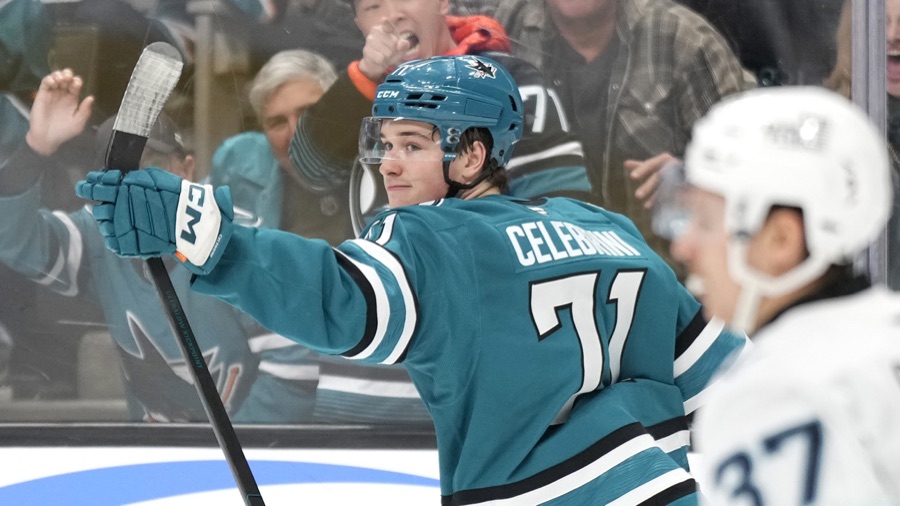
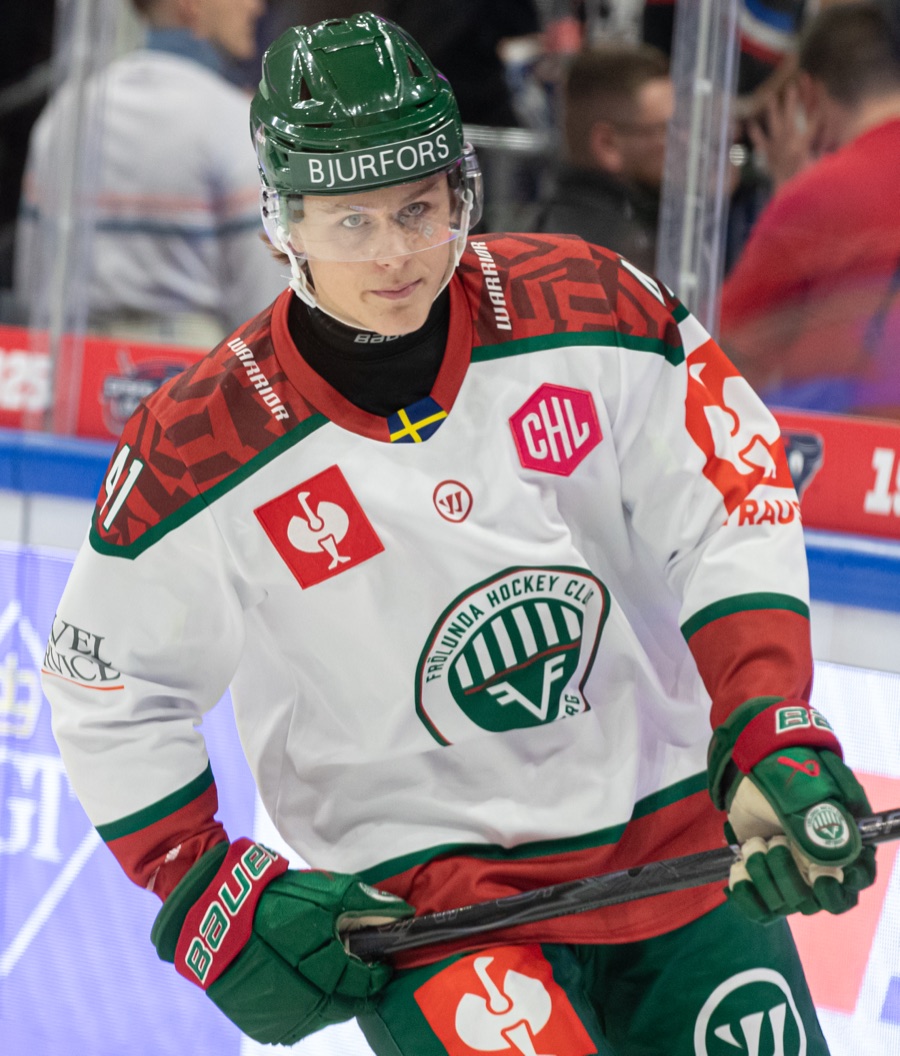
Nobody threw a parade when Eklund signed his three-year, $5.6M extension last July, and nobody is throwing one now, because he just posted a 53-point season with a minus-31 and the building spent the year watching Celebrini hang 115. Fine. But the extension kicks in this October, so this is exactly the right moment to ask the question the way a front office would: what does $5.6M buy on the open market, and what did Eklund actually do for it? The answer is the most underpriced contract on the roster, with one honest asterisk I will get to.
1. The market says this deal is $2M light#
Price the comparable: a 23-year-old top-six winger coming off seasons of 45, 58, and 53 points, signing the contract that bridges his early prime. The recent market band for exactly that player runs $7M to $7.75M a year, on long term. Matt Knies got six years at $7.75M. Seth Jarvis, the closest stylistic comp (tough-minutes two-way winger who scores), got eight at $7.42M. JJ Peterka got five at $7.7M. Eklund signed for $5.6M, and only for three years, and the term is the sneaky part: it walks him to restricted free agency at 26, not unrestricted. The Sharks pay below-market now and still hold his rights at the other end. On a cap that goes from $104M to $113.5M and keeps climbing, his cap share shrinks every season the deal runs. Even if you think Eklund is just okay, this is the structure you want every mid-tier contract to have.
2. The job he did: the hardest forward minutes on the team#
Here is the part that never shows up in a points column. PuckIQ's WoodMoney splits every even-strength shift by the quality of the opponent. Look at who ate the elite-competition minutes among Sharks forwards:
| Forward | vs Elite (share of EV time) | Role |
|---|---|---|
| Wennberg | 41.7% | Veteran checking center, 31 |
| Eklund | 40.2% | Scoring winger, 23 |
| Celebrini | 35.5% | Franchise center, 19 |
The only Shark forward who saw more elite competition than Eklund was the 31-year-old checking-line specialist whose entire job is matchups. Among the scoring forwards, nobody faced a harder diet, not even Celebrini. And Eklund did not just survive it: his shot-attempt share relative to teammates was positive against elite competition (+2.1), and when he got a shift against depth lines he flat-out caved them in (56.3% Corsi, +10.5 relative, the look of a top-six player against bottom-six opponents). Three different models (PuckIQ relative, PuckIQ dangerous-Fenwick, MoneyPuck relative xG) all land on the same read: the Sharks were better with Eklund on the ice than off it, against the toughest assignments a winger can draw.
3. So why does everyone shrug? The scoreboard lied to him twice#
| Signal | Number | Reading |
|---|---|---|
| Plus-minus | -31 | The ugly headline |
| Expected on-ice goal differential | about -1 | The actual hockey was even |
| PDO (on-ice luck index) | 95.7 | Goaltending cratered behind him, .839 on-ice save percentage |
| His own finishing | 15 goals on ~22 expected | Underfinished by about 7 goals, career-low 8.5% shooting |
Read that table as one sentence: Eklund played even hockey against the hardest competition, and then the goaltending behind him and the puck off his own stick both betrayed him at once. A 30-goal gap between his expected and actual on-ice differential is a full season of variance, almost none of it within his control. And his own 8.5% shooting is the lowest of his career on a chance profile that says he should have scored about 22. Run him back with league-average goaltending on his shifts and league-average finishing on his own chances and the same exact season reads: 60-plus points, even plus-minus, "wow, what a contract." That player and the minus-31 player are the same player.
4. The honest asterisk#
The contrarian case has one thing it must concede: the production arc is consolidation, not liftoff. 0.56 points per game at 21, 0.75 at 22, 0.68 at 23. His goal scoring collapsed in the second half (4 in his last 39) and his shot volume dropped 30%, and while the variance math says his true finishing level sits right at his career norm, a $7.5M winger he is not, yet. If you price his results, $5.6M is merely fair. The bargain case is a bet on his process: the play-driving, the matchup load, the age. Every analytic model votes process. The scoreboard votes results. I am with the models, but it is a bet, not a settled fact, and the year the bet pays off is the year the goaltending behind him stops running four points below league average.
The verdict#
A 23-year-old who drives play against the other team's best, takes the matchup burden off Celebrini's line, and produces top-six offense through the worst on-ice luck on the roster, at $1.5M-to-$2M below his market band, on a term that hands his age-26 rights back to the team. This is also exactly why the plan puts him on Misa's wing instead of Celebrini's (his play-driving is worth most next to the younger center) and exactly why "do not trade Eklund for Simon Nemec" stays in the do-not list in bold. Teams spend years hunting for the contract the Sharks already have. The only thing Eklund is missing is the bounce, and bounces regress. Pay attention next March when everyone suddenly discovers him.
Counting line (78 GP, 15-38-53) verified across MoneyPuck and the in-repo review (Hockey-Reference/PuckPedia sourced). Competition data: PuckIQ WoodMoney. Process metrics: MoneyPuck (individual xG 22.15, relative on-ice xG positive) and the PDO/expected-differential work in docs/players/Eklund_2025-26_Review_Brisbee.md, which this builds on. Market comps (Knies, Jarvis, Peterka) cited as the recent second-contract band for comparable wingers. Contract terms per state/cap.md (3 years, $5.6M, starts 2026-27, RFA July 2029).