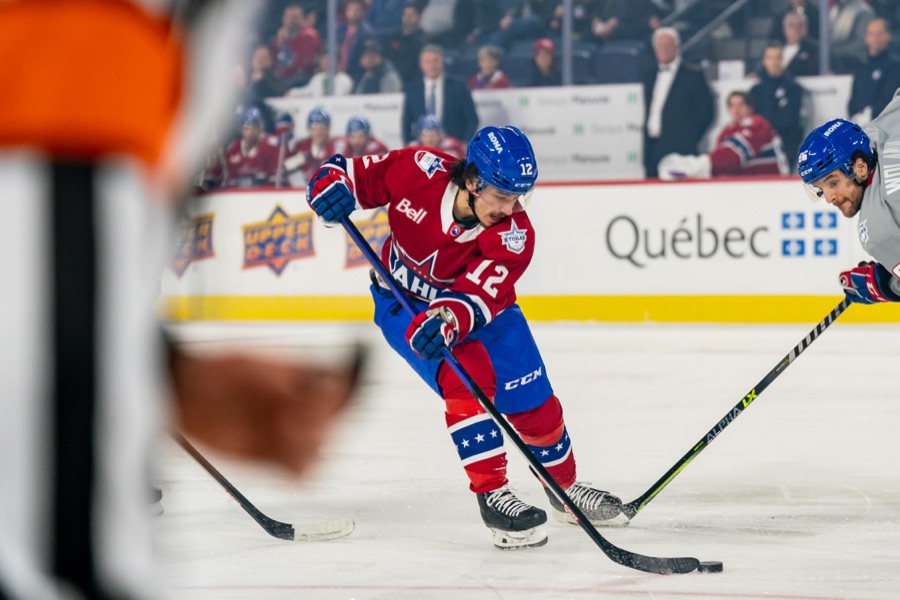
The salary floor after Eklund: $21M the Sharks are required to spend, not free to spend

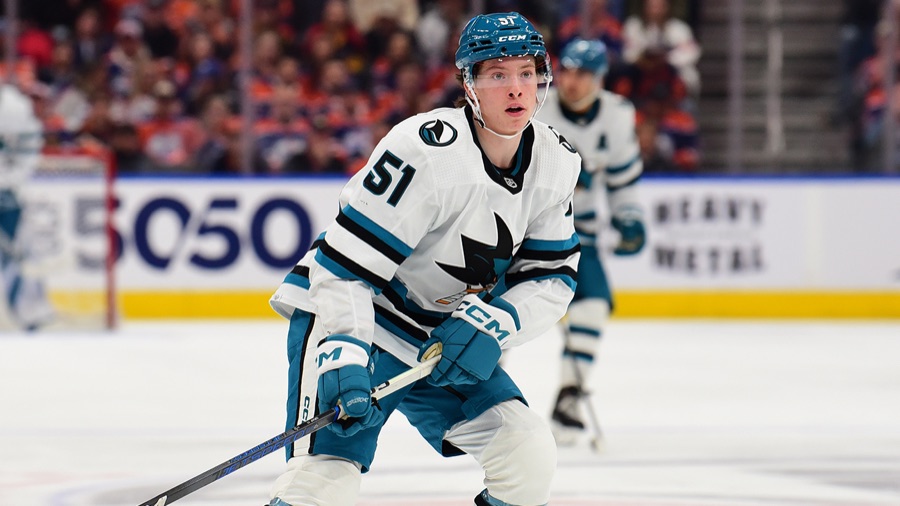
Here is the thing nobody says out loud about a rebuilding team sitting on a pile of "cap space." That space is not a luxury. It is a bill. The Sharks do not get to decide whether to spend this summer. They are required to. And the William Eklund trade, which everyone filed under "creates flexibility," did the opposite of saving money: it enlarged the bill by $5.6M.
Let me walk through why, because the floor changes how you should read every move Mike Grier makes between now and October.
The one-line version: The 2026-27 floor is $76.9M. The Sharks have about $55.9M committed toward it. That is a hole of roughly $21M they must fill, not space they may use. Trading Eklund took the hole from $15.4M to $21.0M. A floor team that trades a $5.6M player has not saved $5.6M. It has promised to spend it somewhere else.
First, the actual numbers (verified)#
The NHL and NHLPA set the 2026-27 payroll range on May 6, 2026. These are firm, not projections, and I cross-checked the floor against five sources (PuckPedia, Sportsnet, The Hockey News, theScore, and Friedman's relay of the league memo). They agree:
| Marker | 2026-27 | 2025-26 |
|---|---|---|
| Ceiling (upper limit) | $104.0M | $95.5M |
| Midpoint | $90.4M | $83.0M |
| Floor (lower limit) | $76.9M | $70.6M |
| Max individual salary | $20.8M | $19.1M |
The floor jumped $6.3M in one summer, from $70.6M to $76.9M. That matters: even a team that did nothing would have to spend more this year than last just to stand still against a rising minimum. The Sharks are not standing still. They subtracted from their commitments.
Where the Sharks actually sit toward the floor#
This is where the public cap pages will mislead you, so read carefully. CapWages currently shows San Jose with a $47.96M cap hit and $56.0M in "space." That space number is the ceiling-side view, and it quietly parks Logan Couture's $8M on long-term injured reserve, because he is not going to play.
The floor does not let you do that. A player you are paying counts toward your minimum-spend whether he laces them up or not. That is the entire point of the floor: you cannot duck it by stashing salary on IR. So Couture's $8M, the buyouts, and the retained salary all count toward the $76.9M. Add Couture back and the Sharks are not at $47.96M against the floor. They are at roughly $55.9M.
| What counts toward the floor today | Cap |
|---|---|
| Signed NHL roster, the 15 players who will actually play (Toffoli, Wennberg, Sherwood, Orlov, Nedeljkovic, the ELC core, the rest) | $42.2M |
| Couture (will not play, counts anyway) | $8.0M |
| Buyouts: Vlasic + Jones (final year) | $2.83M |
| Retained: Karlsson + Hertl | $2.89M |
| Total committed toward the floor | $55.9M |
| The floor | $76.9M |
| Required spend to clear it | $21.0M |
Notice the quiet gift inside that table. Almost $13.7M of the Sharks' floor obligation is already met by money paid to nobody who plays: Couture, two buyouts, two retained contracts. Dead and dormant money does the floor's heavy lifting for a rebuilding team, which is exactly why teams in this spot can carry it without flinching. They still need real bodies, but $13.7M of the minimum is satisfied by ghosts.
The Eklund reframe: a floor team cannot "save" money#
Here is the part that flips the usual narrative. When a cap-ceiling team trades a useful player, it banks the space. When a floor team does it, it just hands itself a bigger shopping list, because the floor does not move. The dollars Eklund used to occupy are now dollars somebody else has to occupy.
| Committed toward floor | Gap to $76.9M | |
|---|---|---|
| Before the Eklund trade | $61.5M | $15.4M |
| After the Eklund trade | $55.9M | $21.0M |
| The change | minus $5.6M | plus $5.6M to spend |
So when you read that the Eklund deal "freed up $5.6M," translate it. It did not free anything. It committed Grier to redeploying that $5.6M, plus the rest of the gap, on the open market. Which is the only reading of the trade that makes sense: you do not move a 23-year-old top-six winger off a floor team to pocket savings that do not exist. You do it because you believe you can turn that money, plus the No. 9 pick you got back, into something better than Eklund. The trade is, in cap terms, a declaration that Grier is going shopping. His "we're at the right spot to add a big piece" comments this week are not a coincidence. The floor and his mouth are saying the same thing.
How they actually get to $76.9M#
The good news, and the reason the floor is not a problem here: the required spend points at the exact hole the hockey plan already points at. The Sharks have to add roughly $21M and roughly six to eight bodies, and the most glaring need on the roster is the entire right side of the defense (Klingberg, Leddy, Ferraro, and Desharnais are all walking as UFAs). The floor is not forcing a wasteful signing. It is forcing the signing they needed anyway.
A plausible path, with the restricted free agents as the first layer. The AAVs in the Est. cap column are my projections, not signed numbers:
| Step | Type | Est. cap | Running |
|---|---|---|---|
| Starting point (post-Eklund) | committed | - | $55.9M |
| Re-sign Kesselring | RFA | $3.0M | $58.9M |
| Re-sign Mukhamadullin | RFA | $1.75M | $60.7M |
| Re-sign Graf | RFA | $2.25M | $62.9M |
| Re-sign Ostapchuk | RFA | $1.0M | $63.9M |
| Still short of the floor | needs $13.0M | ||
| The market spend: the top-four RHD + depth | UFA / trade | $13.0M+ | $76.9M+ |
The lesson of that table: even after the Sharks do all the natural housekeeping, re-signing every meaningful RFA, they are still roughly $13M short of the floor with bodies still to add. That $13M is real, open-market money, and the obvious place to put it is the right-shot defenseman the entire offseason plan has been built around, plus a depth forward or two. The floor is a forcing function that happens to be aimed at the bullseye.
The menu, and the one move I would watch for#
Floor teams have four ways to get there, and they are not equally smart:
- Re-sign your own and buy what you need. The honest path. Covered above.
- Absorb a bad contract for assets. The rebuild classic, and the one I would actually watch for. The Sharks have one open retention slot and just proved they will do this (the Carey Price cap-acquisition last September). With $21M of floor room, San Jose is the league's most natural "we will take your overpaid veteran, you attach a pick or a prospect" partner. You reach the floor and get paid in futures to do it. That is the move that turns a spending requirement into an asset-accumulation tool.
- Short-term overpays. One-year "prove-it" deals at inflated AAVs. Fine in a pinch, forgettable.
- Let the bonuses ride. The ELC performance bonuses on Celebrini, Smith, and Misa count toward the floor if hit. Minor, but real.
Stop reading the Sharks' $56M as freedom. The binding number is the floor, $76.9M, and they sit about $21M below it, a gap the Eklund trade widened by exactly his $5.6M. That money is going to be spent. The only question is on whom. The smart version: re-sign the RFAs, spend the leftover $13M or so on the right-shot defenseman the plan already wants, and use the open retention slot to absorb a contract or two for picks. The floor is not San Jose's constraint this summer. It is San Jose's instruction to go get the player they were going to chase anyway, with the league's permission to do it loudly.
Numbers: 2026-27 payroll range from the NHL/NHLPA May 6, 2026 announcement (floor $76.9M, midpoint $90.4M, ceiling $104.0M, max salary $20.8M), cross-verified across PuckPedia, Sportsnet, The Hockey News, theScore, and Friedman. The 2025-26 max salary ($19.1M) and both midpoints are the standard CBA derivations (max salary is 20% of the upper limit; midpoint is the upper limit divided by 1.15). Sharks commitments from the repo cap file, reconciled against CapWages (their displayed $47.96M cap hit plus Couture's $8M, which counts toward the floor, equals the roughly $55.9M used here). RFA AAVs are my projections, not signed figures.