The war chest, the bill it's saved for, and the one bet that's free: three questions, one answer
Three questions, and they turn out to be one. What is actually in the drawer (the asset bank). What the drawer has to be saved for (the 2027 crunch). And the one swing that needs none of it (the Chernyshov bet). Read them together and they tell a single story: the Sharks are wealthier than the standings suggest, that wealth has a date stamped on it, and the most important decision of next season is the one that does not touch the wealth at all. Eleven days from the draft, here is the whole picture.
I. The asset bank: what's in the drawer#
Start with cash, because it is the part everyone forgets a rebuilding team has. The Sharks enter free agency with roughly $42M in usable cap room, the most in the league or close to it, and they enter the draft with two first-round picks. That is not a teardown's balance sheet. That is a buyer's.
The picks, by year, with the finding that matters:
| Year | What they hold | State |
|---|---|---|
| 2026 | Two firsts (No. 2, No. 20), a second (COL's), and a stack of Day 2-3 picks including extra fourths from the Liljegren deal. ~8 picks. | Loaded |
| 2027 | Own first, own fourth, own sixth, own seventh. No second, no third, no fifth (spent on Sherwood, Hertl, and the Georgiev deal). | Depleted |
| 2028 | Own picks across the board, minus the fifth (Desharnais). | Nearly full |
The 2027 hole is the non-obvious part and it shapes trade capacity directly: the Sharks can deal 2026 and 2028 capital freely, but they have already cashed most of their 2027 middle-round chips, so a "pay with futures" deal this summer should be built out of 2026 and 2028 picks, not 2027. Anyone proposing a 2027-pick-heavy package is reaching into a thin drawer.
The other two ledgers:
- Retention slots: two of three used (Karlsson, Hertl), one open, and the Karlsson slot frees after 2026-27. That single open slot is the entire mechanism behind the chessboard's cap-absorption play (taking on a Vegas cap casualty for a pick). Use it wisely; there is only one.
- Prospect currency: the left-shot defense surplus (Sahlin Wallenius, Mukhamadullin, plus Cagnoni's value) and the forward overflow (Musty, Bystedt, Halttunen, Wetsch, Lund). The pipeline logjam is not just depth; it is the trade chips that turn cap space and picks into a right-shot defenseman.
The drawer, in one line: $42M, two firsts, a loaded 2026 and 2028, a thin 2027, one retention slot, and a logjam of tradeable prospects. Grier can do nearly anything he wants this summer. The only real question is whether he should, which is the next section.
II. The 2027 war plan: what the drawer is saved for#
Here is why the $42M is not a license to spend. It is a bridge to the single most important offseason of the entire rebuild, the summer of 2027, when the bills for the young core all come due at once.
| Summer 2027 | From | To (est.) | Swing |
|---|---|---|---|
| Celebrini (RFA) | $0.975M | ~$17M | +$16M |
| Smith (RFA) | $0.95M | $5-8M (line-dependent) | +$5-7M |
| Askarov (RFA) | $2M | $2M-to-starter money | +$0-6M (performance-gated) |
| Cagnoni (RFA) | ELC | bridge | +$2-3M |
| Orlov (UFA out) | $6.5M | off the books | -$6.5M |
| Goodrow (UFA out) | $3.64M | off the books | -$3.64M |
The arithmetic is survivable but only because of three things lining up. Celebrini and Smith add roughly $21M of new money. Orlov and Goodrow walking returns about $10M. The cap ceiling climbing from ~$104M toward $110-115M adds another $6-10M of headroom. Net it out and the crunch is real but payable, which is the entire point: it is payable only if Grier does not spend the 2026 room on long-term veteran money that is still on the books in 2027. Every four-year contract handed to a 30-year-old this July is a chair removed from the room when Celebrini's $17M needs to sit down. This is the mortgage watch restated as a calendar: the $42M is for short-term deals (Carlson at two-to-three years, the Kesselring-type reclamations) that expire before the bill arrives, not for albatrosses that compete with the kids for cap space.
And the thin-2027-picks finding compounds it. The Sharks cannot easily trade their way out of a 2027 cap problem using 2027 draft capital, because the middle of that draft is already spent. So the 2027 plan has to be solved with cap discipline now, not with a future-pick bailout later. The pick on the whole thing: treat 2026 as a year to add on short term and accumulate, and treat the $42M as Celebrini's escrow, not Grier's allowance.
III. The Chernyshov gamble: the bet that costs nothing#
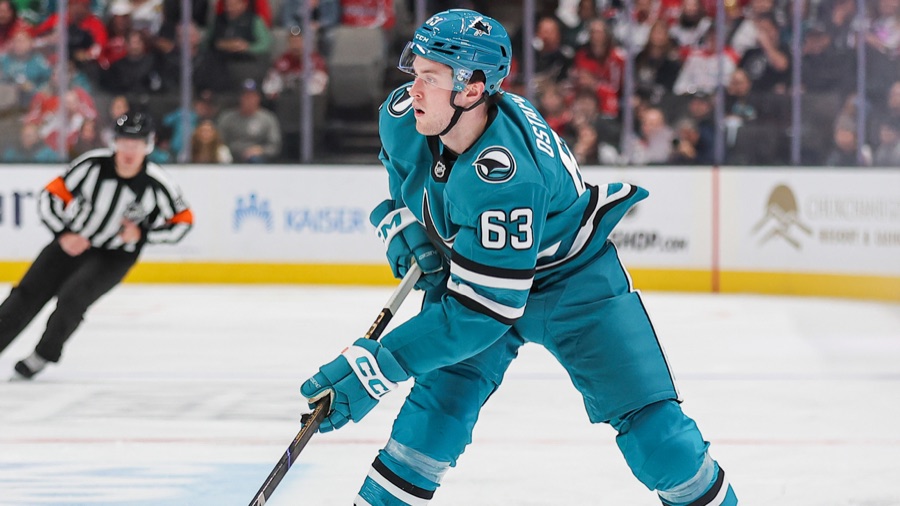
Which brings us to the move that touches none of the above, and might swing the season more than any of it. The projected top line is Chernyshov on the left, Celebrini at center, Smith on the right. It is a trio of entry-level contracts, roughly $2.9M for a unit that should score like a top line, and the whole thing rides on a 20-year-old with 28 NHL games to his name.
| The bull case | The bear case |
|---|---|
| 28 NHL games of 9-10-19, a plus-4.3 CF%Rel in his first look, an AHL Rookie of the Month, a 6-foot-2 right shot who fits the ingredient list next to two playmakers | 28 games is not a sample, the 19.6% shooting will regress hard, and the floor is a 47% expected-goals share through ten games and a line dismantled by Thanksgiving |
The beautiful part is the asymmetry. If the bet works, the Sharks get top-line production for fourth-line money and the $42M stays untouched for the 2027 bills. If it fails, the cost is close to zero: the pre-authorized fix is already written, slide Eklund back to Celebrini's wing, drop Sherwood to drive Misa's second line, and the lineup self-heals. This is the rare high-variance bet with a capped downside, because the insurance policy (Eklund) is already on the roster. The trigger is specific and in the scorecard: a multi-week disappearance against tough matchups, or the line bleeding chances with the kid clearly drowning, and the swap executes. Do not panic at the goal-scoring dip when the 19.6% regresses, that is expected; panic only at the play-driving collapse.
The one answer#
The three questions resolve into one philosophy. The Sharks have a rich drawer ($42M, two firsts, a deep 2026 and 2028). That drawer is not spending money, it is Celebrini's 2027 escrow, and the thin 2027 pick cupboard means the crunch has to be solved with discipline now rather than a future bailout later. So the right offseason spends the wealth on short-term help that expires before the bill, banks the rest, and then wins its biggest swing for free, by betting a cheap 20-year-old on the top line with a veteran insurance policy one slot away. Add on the margins, protect the core money, and let the cheapest bet on the roster carry the upside. That is a contender's plan run by a team that has not made the playoffs in eight years, which is exactly the trick of this particular summer.
Pick inventory reconstructed from the transaction log (the Sherwood, Hertl, Georgiev, Liljegren, and Desharnais pick movements) and the war-room playbook's 2026 holdings; cap room ($42M+), retention slots (2 of 3 used, 1 open, Karlsson frees after 2026-27), and contract figures per state/cap.md; the 2027 RFA timing per the Smith review and the cap model; Chernyshov's line (28 GP, 9-10-19, +4.3 CF%Rel, 19.6% shooting, AHL Rookie of the Month) per the McKeen's table and the Smith review; the Eklund-up swap and the trigger per the forward-lines plan and the season scorecard. Extension estimates are projections; pick movements are verified. Happy to file the asset bank as a standalone living ledger for draft-and-FA week if useful.