Sharks
Sharks franchise desk

How high does Macklin Celebrini go? Higher than we've been saying.
GS
Grab Some PineJun 14, 20264 min read
Every call on this site goes on a public ledger and gets graded. The misses stay up.
How high does Macklin Celebrini go? Higher than we've been saying.

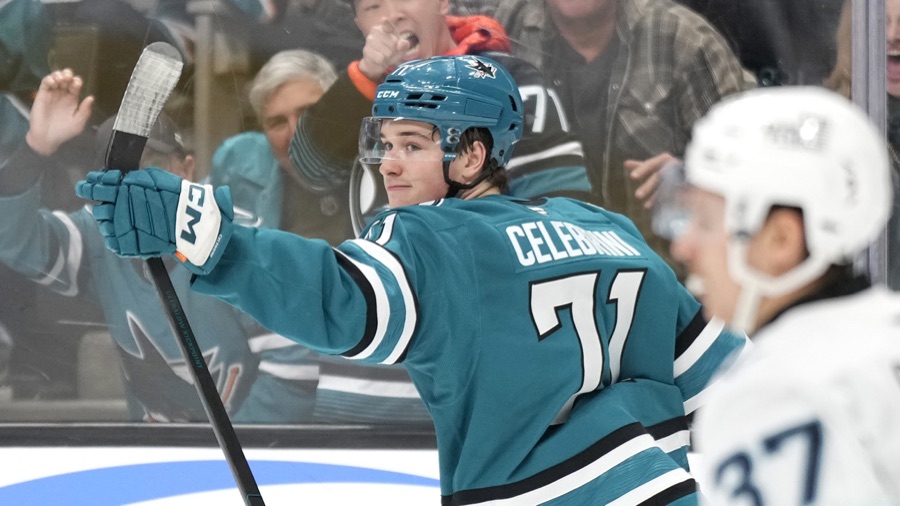
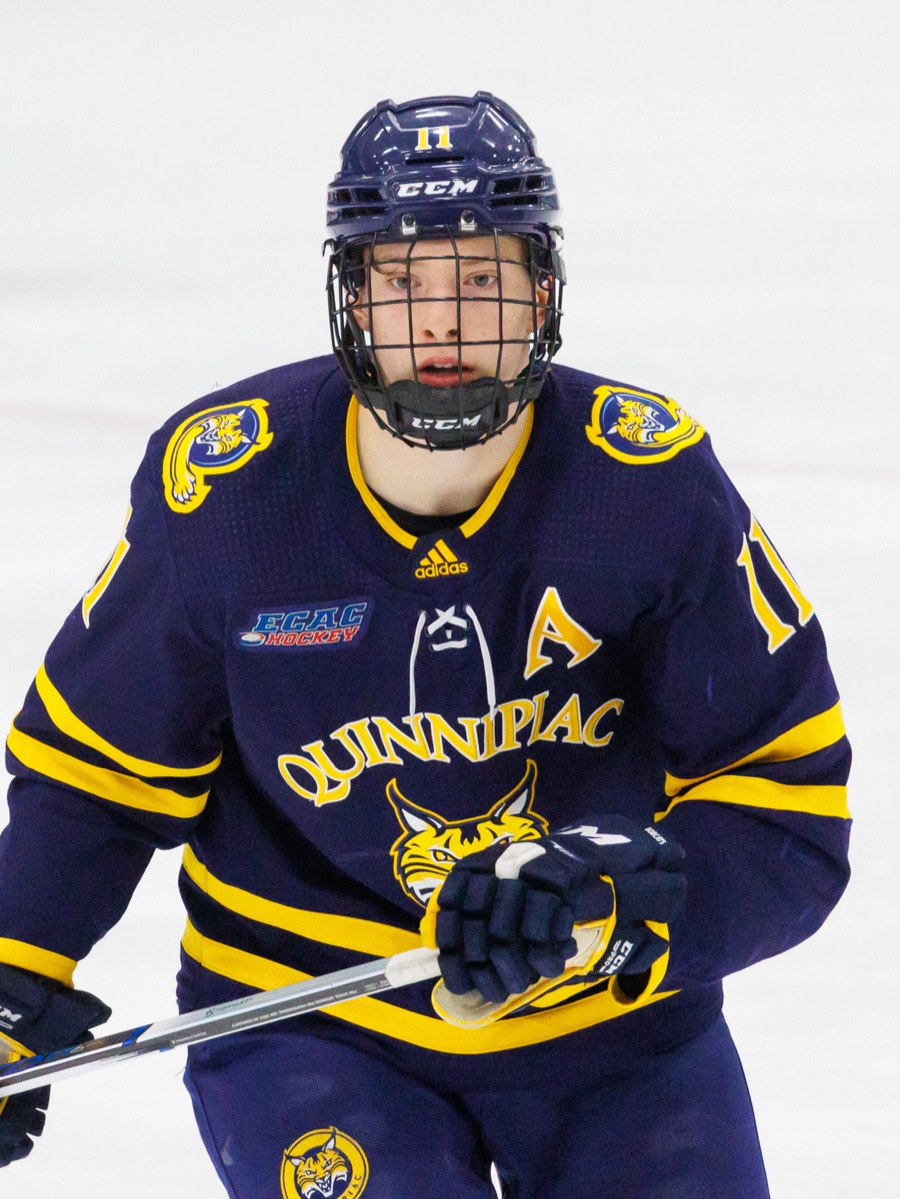
We priced his extension. We never asked the more important question: what tier of player are the Sharks actually building around? We have been writing "franchise cornerstone," which is a safe phrase, and the season he just finished says the safe phrase is too small. At nineteen years old, in his second NHL season, on a team that finished 86 points, Macklin Celebrini scored 45 goals and 70 assists for 115 points. He turned twenty yesterday. That number does not describe a cornerstone. It describes a candidate for best player in the world, and the difference between those two things is the difference between a playoff team and a Cup team.

The leap, in two lines#

SeasonAgeLine+/-
2024-25 (rookie)1870 GP, 25-38-63-31
2025-261982 GP, 45-70-115+8

A 52-point jump. A 1.40-points-per-game pace. And a plus-minus that swung 39 goals in the right direction, which is partly the team improving around him and mostly him becoming a force the other team cannot outscore even when it tries. The rookie -31 on a tanking roster was never the worry it looked like. This is what was underneath it.

What 115 at nineteen actually means#

Production curves are the single best predictor of star outcomes in hockey, and the age-19 scoring line is the most load-bearing data point on the curve. The list of players who have posted 115 points in their teenage season is not a list of "very good first-line centers." It is a roll call of the best to ever play. Sidney Crosby scored 120 in his age-19 season and won the Art Ross and the Hart. Connor McDavid's first scoring title came at a comparable age on 100 points. The teenagers who score at this rate do not become good players who bust; they become the player the league is organized around. Celebrini's 115 sits inside that tiny club, and the club has essentially no busts in it. That is what makes this the safest superstar bet in the sport: not that he might be great, but that the one number most predictive of greatness has already been posted.

The two-way wrinkle that raises the ceiling further#

Pure scorers have a ceiling. Celebrini is not a pure scorer; he is a 200-foot center who backchecks, kills plays, and takes hard minutes, the profile that wins Selke votes alongside Hart votes. That combination, elite scoring plus genuine defensive conscience at center, is the rarest and most valuable shape a hockey player can take. It is the MacKinnon and Crosby template, not the one-end-of-the-ice template. A player who can win you a game 4-3 by scoring twice and a game 2-1 by smothering the other team's best line is not a cornerstone you build a playoff team around. He is the engine you build a Cup team around.

The verdict, and the bet we're holding#

The read

The realistic peak is a perennial Art Ross contender, a Hart-and-Selke-caliber two-way No. 1 center, and a live "best player in the world" argument by his mid-twenties. That is the bet. It is not a cornerstone bet.

This reframes everything downstream. The contention clock does not just have its franchise center slot filled; it has it filled by a player whose ceiling is the ceiling, which is why the goaltending and the Star Forward questions are the only ones that gate a Cup, because the most important position is not just solved, it is potentially elite-of-elite. It also reframes the extension: the roughly $17 million the pricing work landed on is not a generous number for a great player, it is the bargain rate for a possible best-player-in-the-world, the same way McDavid's and Crosby's first extensions look like steals in hindsight. The one honest caveat is that 115 is one season, and one season is not a guarantee of sustained Art Ross contention; the team context and the rookie line are real. But the age-19 production curve is the most predictive instrument we have, and it just printed a number with no busts in its history. The Sharks are not hoping Celebrini becomes a superstar. They are watching one arrive, on schedule, a year early.

Celebrini's lines (45-70-115 in 2025-26, +8; 25-38-63 rookie, -31; born June 13, 2006) verified from the NHL official API (player landing, June 14, 2026), internally consistent with his 178-point, 152-game career totals. The Crosby age-19 (120, Art Ross/Hart) and McDavid first-scoring-title comps are historical record. The extension price per the Celebrini pricing email and Professor Hockey's ~$17M / 8-year read. The peak projection is a forecast; the 115 is fact.
Filed under Sharks

More in The Player Files

The whole thread →
Roster crunch

Nobody Has A Seat For Collin Graf

The Sharks qualified Collin Graf and then spent the summer signing forwards. A month later he is the last RFA standing, and the delay says more about the depth chart than about the money.

Grab Some PineJul 22, 20264 min read
Nobody Has A Seat For Collin Graf
Player Evaluation

Jacob Trouba and the reputation premium

What $33 million actually bought, what it didn't, and whether he can still kill a penalty.

Grab Some PineJul 1, 20268 min read
Jacob Trouba and the reputation premium
Player Evaluation

Mason Marchment, and which Mason Marchment

The good half of July 1, a genuine homecoming, and the one question that decides how good.

Grab Some PineJul 1, 20266 min read
Mason Marchment, and which Mason Marchment

More on Macklin Celebrini

His page →
Season preview

Collin Graf Scored More Shorthanded Than He Did On The Power Play

Collin Graf spent 39 minutes and 38 seconds on the power play across 81 games last season, tenth among San Jose forwards, and 200 minutes killing penalties, which was first. He scored 21 goals anyway and finished with 42 even-strength points, tied with Will Smith for second on the team behind Macklin Celebrini. San Jose then signed him for three years and $12,750,000. The open house row on him says he reaches 50 points, and the entire case for that is usage the club has never given him.

Dom CahillSep 8, 20265 min read
Collin Graf Scored More Shorthanded Than He Did On The Power Play
Season preview

Of Alexander Wennberg's Twenty And A Half Minutes A Night, Five And A Half Came On Special Teams

Alexander Wennberg scored 55 points in 80 games last season and averaged 20:27 a night. Three minutes twenty of that was power play, second on the whole roster behind Macklin Celebrini, and two minutes eight was penalty kill. The demotion every projection has him taking is an even-strength demotion, and both published power-play projections keep him on the first unit. The number that threatens the 55 is a 19.4 percent shooting rate against a career mark of 11.4 across 869 games.

Dom CahillSep 4, 20265 min read
Of Alexander Wennberg's Twenty And A Half Minutes A Night, Five And A Half Came On Special Teams
The extension

Macklin Celebrini Explained His Own Contract By Talking About Everybody Else's

Macklin Celebrini's first media availability since his five-year, $94 million extension. He explained the number, the timing and the term, and all three explanations were about San Jose's flexibility rather than his own market. The context underneath them is a June meeting his agent Pat Brisson requested with owner Hasso Plattner and general manager Mike Grier, reported in July, about the direction of the franchise.

Grant LombardAug 28, 20264 min read
Macklin Celebrini Explained His Own Contract By Talking About Everybody Else's

On the record

Called Shots →
OpenJul 29, 2026

Macklin Celebrini's $18.8 million average annual value is NOT the highest in the NHL on July 29, 2027. Scored off any active standard player contract carrying a higher AAV on that date, signed by any player on any club, and counting a signed extension that has not yet taken effect. A hit means at least one such contract exists; a miss means $18.8 million still stands alone at the top.

This follows from the piece's own argument rather than from a hunch about a particular player. The upper limit went from $95.5 million to $104 million to $113.5 million in three seasons, which moves the 20 percent individual ceiling from $19.1 million to $20.8 million to $22.7 million. Records set against a rising cap do not age. The two most recent ones prove it: Kirill Kaprizov's $17 million did not survive a full season, and Leo Carlsson's $18 million lasted about three weeks before Celebrini passed it. Against the call, five-year deals at the ceiling are still rare, most extensions of this size are signed in July and August rather than mid-season, and the specific players who could clear $18.8 million next summer are not yet identifiable, so this is a structural bet and not a roster read. It loses cleanly if the league's next tier of contracts continues to land at 16 to 17 percent of the cap in AAV rather than chasing the raw dollar record. **Added 2026-07-29, same night, from Leo's audit:** the $22.7 million forward ceiling assumes the CBA's 20 percent individual maximum survives the changeover in September. This call resolves on July 29, 2027, which is after that, so a rule change is a live risk to the mechanism the call leans on. It does not invalidate the call, since a higher ceiling and no ceiling both make it easier and only a LOWER cap on individual salary would protect the record. Recorded because a take should carry the assumption it rests on rather than have it discovered at scoring.