The five-year cap math: can they keep everyone? (The Florida-or-Chicago question, answered)
Every young contender eventually faces the same exam. Chicago took it in the mid-2010s and failed it so badly they traded Panarin, Teravainen, and Saad to pay for the team they used to have. Florida took it in the 2020s and passed, and hung two banners. The Sharks sit the exam between July 2027 and July 2030, when six core players come due in three summers. The contention clock says the window is widest 2028-29 through 2031-32. So here is the stress test: the whole wave, year by year, against the rising cap, ending in an actual answer to whether this core is keepable whole.
1. The wave, on the calendar#
| Summer | Deals due | Modeled cost (new money) | Money rolling off |
|---|---|---|---|
| 2027 | Celebrini, Smith, Askarov, Cagnoni | about $25M ($14M + $7.5M + $3.5M bet-year + depth) | about $20M (Couture $8M, Orlov $6.5M, Goodrow $3.6M, Gaudette $2M) |
| 2028 | Misa, Dickinson, Chernyshov, Graf's re-up | about $24M ($9M + $8M + $5.5M + $4.5M, if all hit) | about $19M (Toffoli $6M, Carlson's bridge, Nedeljkovic $3M, Dellandrea) |
| 2029 | Eklund's third contract, Wennberg decision | about $8M for Eklund (up from $5.6M) | Wennberg $6M, Desharnais |
| 2030 | Reid's second contract (if drafted and hits) | $8M-to-$9M for a top-pair RHD | Sherwood's deal in its final year |
Look at the right-hand column, because that is the column that saves the franchise. The veteran money rolls off in almost perfect sequence with the young money arriving. The summer Celebrini's $14M lands, Couture's $8M and Orlov's $6.5M leave. The summer Misa and Dickinson get paid, Toffoli and the Carlson bridge walk out the door. This is not luck; it is the entire reason the blue-line plan insisted on two-year veteran deals. The bridges were always scheduled to collapse exactly when the kids needed the road.
2. The bottom line, year by year#
| Season | Cap (projected) | Core-plus-key-vets commitment (modeled) | State |
|---|---|---|---|
| 2026-27 | $104M | ELC heaven; $25M-plus to spend | Comfortable, by design |
| 2027-28 | $113.5M | Net new commitment about +$12.5M vs cap +$9.5M | Tight but clean |
| 2028-29 (window opens) | about $120M | Wave lands, vets shed; net add near zero, and Reid's ELC arrives as new surplus | Healthiest year of the window |
| 2029-30 | about $127M | Ten core contracts on the books at once | The pinch point |
| 2030-31 | about $133M | Core 10 at roughly $75M-to-$80M, about 58% of cap | Sustainable, with discipline |
The headline number at the bottom: if every single young player hits his projection, the ten-man core (Celebrini, Smith, Misa, Dickinson, Chernyshov, Eklund, Graf, Askarov, Reid, Cagnoni-or-equivalent) costs roughly $75M-to-$80M against a cap around $133M, about 58 percent. Champions routinely carry their top ten at 55-to-65 percent. Professor Hockey's own band for the young core ($50M-to-$70M-plus) lands in the same place. The math closes. Everyone is keepable. Barely, and only if three things stay true.
3. Why this is Florida-shaped and not Chicago-shaped#
The Chicago collapse was not "they paid their stars." It was three specific diseases, and the Sharks have none of them yet:
- Chicago's wave hit a flat cap. The cap moved barely $6M total across the three summers their bills came due, so Kane and Toews at $10.5M each calcified into 28 percent of the ceiling. The Sharks' wave hits a cap rising $7M-to-$9M per year. This is the single biggest difference, and it is worth more than any negotiating trick: the same contracts shrink two percentage points a season just by standing still.
- Chicago carried an albatross. Seabrook's eight years ate the space the kids needed. The Sharks' longest commitment is Sherwood at five years and $5.8M, and the blue-line plan deliberately refused every four-year veteran contract on the market (Nurse, Rielly, Parayko). There is no albatross. Keep it that way.
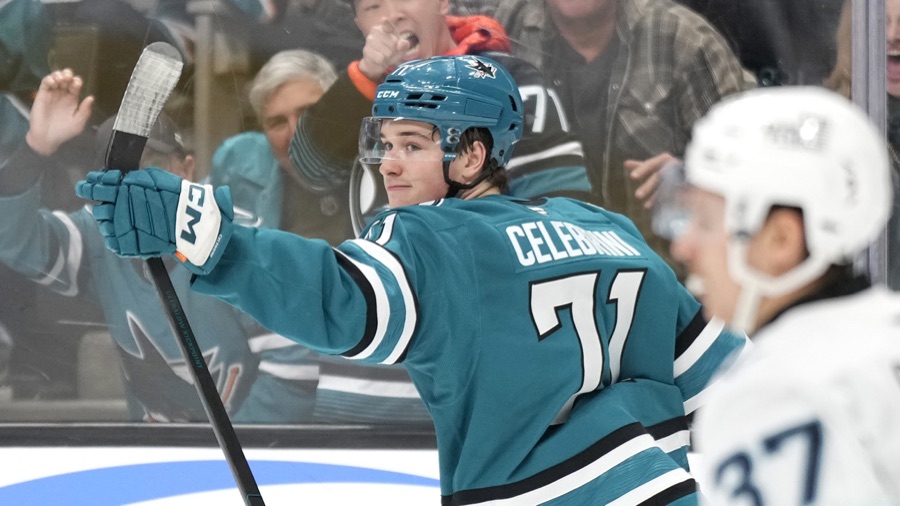
- Chicago paid the past; Florida paid the future. Chicago's money went to what Kane and Toews had been. Florida's went to Barkov-tier players taking slightly-below-market deals in their primes. Which Sharks path gets taken is decided by exactly one negotiation, the first one: Celebrini at the Draisaitl share (11.9 percent) sets the MacKinnon-discount precedent for everyone behind him. Celebrini at 14-plus percent resets every agent's ask. The first domino decides the angle of all of them.
4. The pinch point, and the odd man out#
The stress concentrates in one summer: July 2029. Eklund's third contract comes due (RFA at 26, off a $5.6M bargain, asking $8M-plus) at the exact moment the full wave is finally on the books and before Wennberg-tier money finishes rolling off. If a core piece ever becomes unkeepable, it happens there.
And the odd-man-out logic is already visible: it is whoever becomes redundant, not whoever is worst. The wing is the crowded room (Smith, Eklund, Chernyshov, Graf, with Musty and Halttunen climbing from below on entry-level money). If Musty graduates into a real top-nine scorer by 2029, the Panarin decision arrives: trade the most valuable redundant winger into the strongest market, at full price, before the cap forces a discount. That is not a failure of the model. Done on schedule, it is the model working: Florida moved pieces it loved too, it just always moved them a year early instead of a year late.
The verdict#
Yes, the core is keepable whole. This is Florida-shaped, not Chicago-shaped, for reasons mostly already locked in. The three discipline rules keep it that way.
One: sign Celebrini first, longest, and at the lowest defensible percentage, because his number is everyone's number. Two: never give a non-core veteran more than three years, no matter how good July feels; the entire model runs on the bridges collapsing on schedule. Three: when the July 2029 squeeze comes, move the redundant piece a year early at full value instead of a year late at a discount, and let the kids on entry-level deals (Musty, Halttunen, Reid, eventually Ravensbergen) backfill the way Florida's cheap depth always did. The window the contention clock found (2028-29 through 2031-32) survives the cap math comfortably in years one and two and on discipline in years three and four. The exam is passable. Chicago failed it with more talent than this. Florida passed it with less.
Verified inputs from state/cap.md and docs/offseason-outline.md: current contracts and expiry dates (Eklund $5.6M and Wennberg $6M through 2028-29, Sherwood $5.8M through 2030-31, Toffoli through 2027-28, Orlov/Couture/Goodrow/Gaudette expiring 2027), the $104M to $113.5M cap step, the +$12.5M net 2027-28 commitment, the Askarov-by-July-2027 variance note, and Professor Hockey's $50M-to-$70M-plus young-core band. Modeled, not reported: cap beyond 2027-28 (assumed roughly 6-to-7 percent annual growth to $120M / $127M / $133M), and every extension figure (Celebrini $14M, Smith $7.5M, Misa $9M, Dickinson $8M, Chernyshov $5.5M, Graf $4.5M, Eklund $8M, Reid $8.5M), which assume the players hit their projections; misses make the math easier and the team worse. Companion pieces: the Celebrini pricing email (June 2026) and docs/Sharks_contention-clock_Cup-Checklist-gap-analysis.md.