Michigan had third down at Indiana's 1 and 3, and lost yards both times
Indiana 13, Michigan 6, in overtime. Michigan's defense kept Indiana from scoring in regulation on every drive that began in Indiana territory. Its offense got inside the Indiana 23 five times and came away with two field goals.
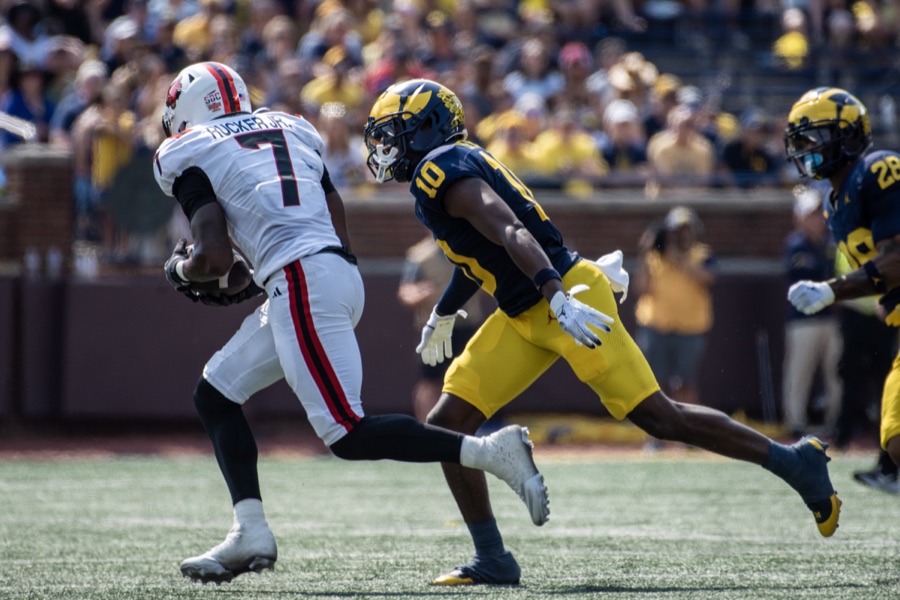
Indiana 13, Michigan 6, in overtime, at Michigan Stadium in front of 111,276. Josh Hoover ran 4 yards for the only touchdown on the second snap of overtime, and Michigan's answering possession ended on a fourth-and-9 incompletion at the Indiana 13. It was Indiana's first win in Ann Arbor since 1967, per the Associated Press. Michigan is 4-3 and 1-3 in the Big Ten, and six of its seven games have been decided by seven points or fewer. Indiana is 7-1. Six things from the afternoon.
1. Why Michigan lost: five trips inside the Indiana 23, and three of them ended in a third-down sack#
Michigan had the ball inside the Indiana 23 on five possessions. It scored two field goals, 29 and 26 yards, and no touchdown.
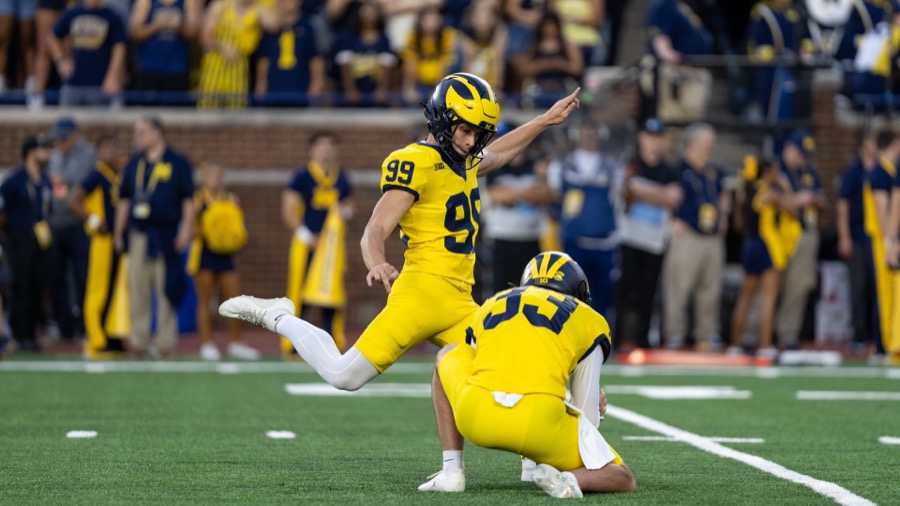
Three of the five ended the same way. With 29 seconds left in the first half, on third-and-3 at the Indiana 23, Rolijah Hardy sacked Tommy Carr for a 12-yard loss, and Trey Butkowski's 53-yard try missed. Michigan opened the third quarter with a 14-play, 61-yard drive that reached the Indiana 1, where on third-and-1 Tobi Osunsanmi sacked Carr for a 13-yard loss, and Butkowski missed from 32. And on the last drive of regulation, 13 plays and 53 yards that took the final 7:32, Michigan had third-and-3 at the Indiana 3 with 32 seconds left. Hardy sacked Carr for a 5-yard loss, and Butkowski tied it from 26 as time expired.
The play at the 1 was a play-action pass intended for Manuel Beigel, the junior offensive lineman Michigan uses as its rhino, according to The Michigan Daily. Indiana's pressure came off the edge. "That was not a good football call at that point in time," Kyle Whittingham said. "I have the ability to overrule anything in the whole program," he added, and called it "a call that Jason wishes he had back because it really was damaging," meaning offensive coordinator Jason Beck.
Michigan was sacked four times and all four came on third down. Butkowski had made all four of his field-goal attempts this season before Saturday, per CollegeFootballData's game logs; he was 2 of 4. The official count of red-zone trips is four, for six points.
2. Indiana's offense scored nothing in regulation on any drive it started itself#
Indiana's six points in regulation came on drives that began at the Michigan 28, after Carr lost a fumble on an option pitch, and the Michigan 21, after Amare Ferrell intercepted him. Indiana gained 24 yards on the first and 5 on the second and kicked field goals from 22 and 34.
Indiana's other nine possessions of regulation all started in its own territory. Seven ended in punts, one in Zeke Berry's interception and one in a missed 56-yard field goal with four seconds left in the half, and none reached the Michigan 37. Indiana finished with 212 yards. It came in averaging 449.3 a game, per Michigan's recap.
Hoover was 8 of 18 for 81 yards. He had completed 108 of 169 passes this season without an interception, and his fewest passing yards in any game had been 145. Berry undercut a route on third-and-5 and returned the ball 37 yards to the Indiana 13, which set up the 29-yard field goal. Indiana's longest gain by yardage all day was Hoover's 21-yard completion to tight end Brock Schott on the first snap of overtime.
Indiana held the ball for 26:16 and converted 4 of 14 third downs.
3. Michigan ran 42 times for 57 yards against boxes its coach called normal#
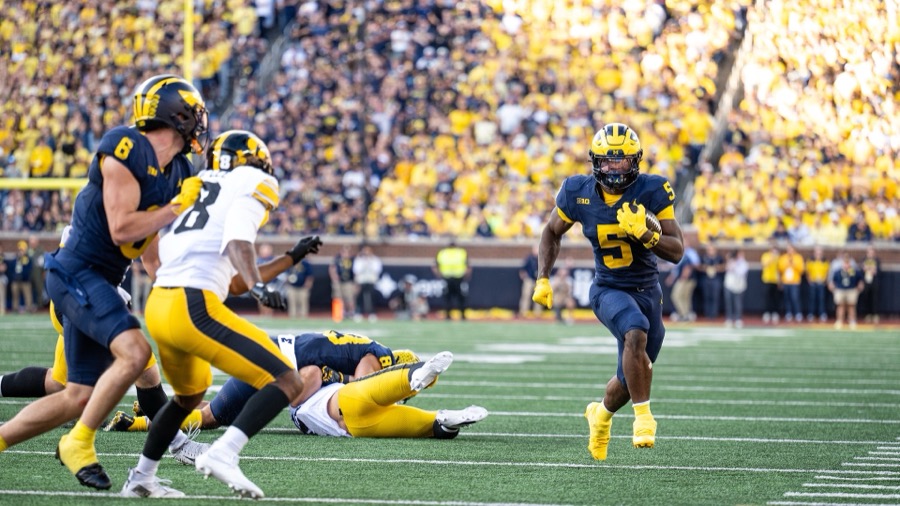
The NCAA counts sacks as runs, so the 42-for-57 line carries the 36 yards Carr lost on four sacks. Without them Michigan ran 38 times for 93, 2.4 a carry. Its running backs carried 26 times for 52 yards: Jordan Marshall 12 for 26, Savion Hiter 10 for 15 and Bryson Kuzdzal 4 for 11. The longest of the 26 went 9 yards.
A week earlier, in the second half against Penn State, Michigan ran 23 times for 174.
Whittingham said Indiana did not crowd the line to do it. They were "not heavy boxes," he said, with "a lot of split safety looks, and we still just couldn't make any hay in the run game." He named the cause as blocking, inside and on the edge: "We didn't block the edge very well."
Indiana came in allowing 2.3 yards a carry with sacks counted, per CollegeFootballData, so Saturday sits close to what it does to everybody, and one game is 42 carries. Rutgers, next, has allowed 150 rushing yards or more to five of its seven opponents. The call here is that Michigan gets to 150 at Rutgers. The other side has precedent: Michigan has finished under 150 in three of its seven games, including 79 at Minnesota, and Rutgers held Maryland to 115.
4. Carr's first start went sideways and short#
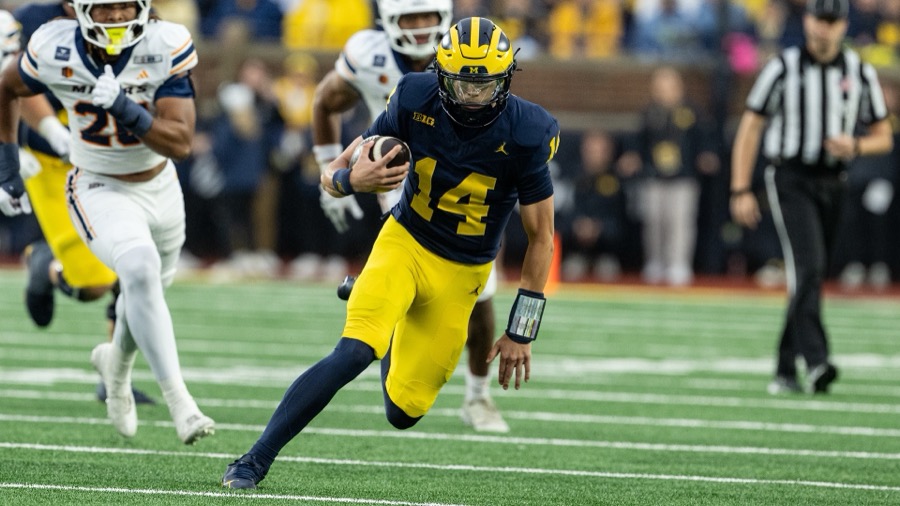
Carr, a true freshman, became the sixth first-year quarterback to start for Michigan, per the postgame notes. He was 20 of 32 for 167 yards with an interception and a lost fumble, and ran 15 times for 6 yards, the four sacks included.
By where the ball was caught in the play-by-play, his 20 completions travelled 112 yards past the line of scrimmage. Thirteen were caught within 6 yards of it. The longest in the air was 18 yards, to Channing Goodwin on the 24-yarder that converted a third-and-10 on the tying drive. Carr threw two passes the stat crew labelled deep, both in the last 48 seconds of the first half: one drew a pass-interference flag and the other fell incomplete.
On the fumble, Whittingham said the staff "ran the option the wrong way. It was incorrectly called," and that the blocking scheme "was not synced up with the play." On the interception, a tipped ball he said went "about 25 ft in the air," he allowed that Carr "did try to force it into some pretty heavy coverage." Carr took both. "Both turnovers, completely on me," he said, per the AP. Whittingham: "It would be absurd to judge him just off this one performance."
Bryce Underwood played one snap, a run for a 1-yard loss in the second quarter.
5. Michigan's defense allowed one touchdown, and it came from the 25 in overtime#
The only touchdown Michigan's defense allowed came after a 21-yard catch from the Michigan 25, where every overtime possession begins. Chris Bracy made a career-high 13 tackles. Berry also broke up a third-down pass in the second quarter, the 25th of his career, per the postgame notes.
The defense also spent the first half defending short fields its offense handed it. Michigan's first-half possessions started at its own 5, 16, 25, 20, 25, 24 and 38; Indiana's two scores started in Michigan territory. Michigan crossed midfield once before halftime. Michigan's defense has allowed 11 touchdowns in seven games, and no opponent has scored more than 14 points in a half, per the notes.
6. Injuries: two starters ruled out on game day, one quarterback playing hurt#
Michigan's game-day report ruled out right tackle Blake Frazier and edge Dom Nichols, both listed as questionable all week, and added tight end Zack Marshall as out, according to The Wolverine's table of the official designations. Safety Rod Moore Jr. and defensive tackle Enow Etta were game-time decisions. Etta played and made two tackles. Michigan's participation release lists Moore among its reserve safeties; the box score's participant list does not include him, and he recorded no statistic.
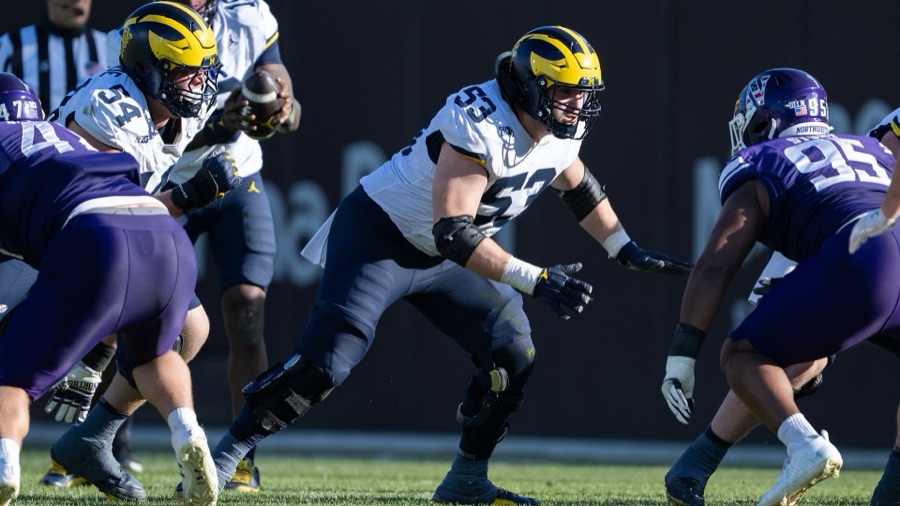
Marky Walbridge, a true freshman, started at right tackle in Frazier's place. Whittingham said he "did a pretty good job there." Benny Patterson III made his first career start at edge. Brady Norton, who missed the Penn State game, started at right guard, and Jake Guarnera started at center. Andrew Sprague, Ace Hamilton and Julius Holly remained out.
Whittingham's full postgame transcript, as published by The Wolverine, contains no update on any player, and the accounts of the game in The Michigan Daily, the AP and On SI name no Michigan player who left it.
On Indiana's side, Curt Cignetti said Hoover was "not 100%" and that the staff discussed playing Grant Wilson, its seventh-year backup, in the second half. "It's been Josh's season," Cignetti said, per the AP. Indiana listed no players on its availability report all week.
Michigan plays at Rutgers on Saturday at 12:30 p.m. Eastern on the Big Ten Network.
Sources: Michigan Athletics' official box score, play-by-play and drive chart, game recap, postgame notes and player participation release for Indiana at Michigan, all dated October 24, 2026; mgoblue.com and iuhoosiers.com roster pages; Kyle Whittingham's postgame press conference transcript as published by The Wolverine (Clayton Sayfie), October 24, 2026; The Wolverine's report of Michigan's final availability designations (Anthony Broome), October 24, 2026; the Associated Press game story, October 24, 2026; The Michigan Daily (Nate Schreck), October 24, 2026; On SI (Trent Knoop), October 24, 2026; CollegeFootballData's 2026 game, team-game and player-game files.