All Three of Michigan's Personal Fouls Landed on Oklahoma's Only Two Scoring Drives
Oklahoma had 11 possessions at Michigan Stadium and scored on two of them. Michigan was flagged for three 15-yard personal fouls all afternoon, and every one of the three came on one of those two drives. On the other nine, Michigan committed no personal foul and Oklahoma scored no points.
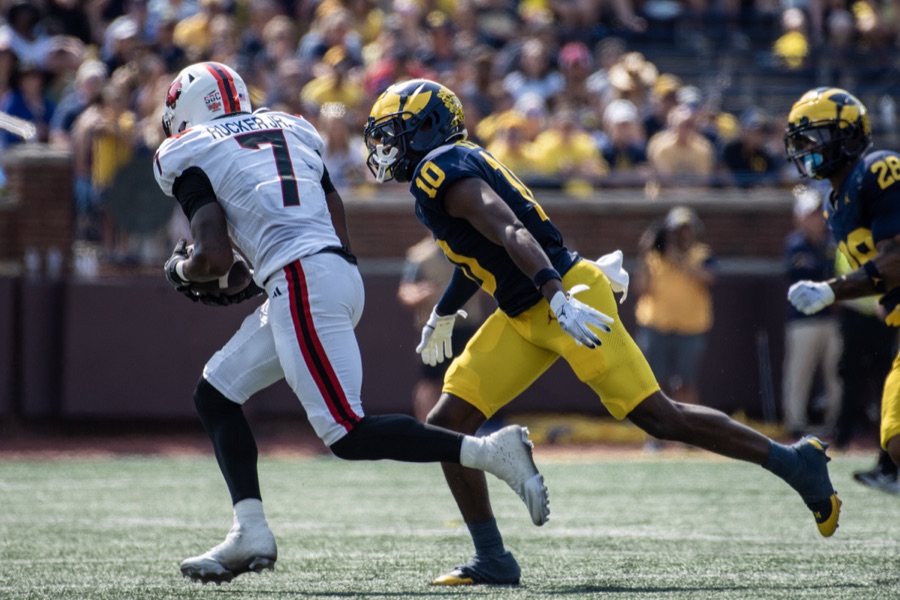
Michigan's defense faced Oklahoma 11 times on Saturday and gave up points twice. The interesting part of a 17-10 win is not the two. It is which two.
Michigan was charged with three 15-yard personal fouls all afternoon. All three landed on the two Oklahoma possessions that produced points, and those three flags supplied 45 of the 173 yards Oklahoma gained on them. On the other nine Oklahoma possessions, Michigan committed no personal foul, and Oklahoma scored nothing on any of them.
Eleven drives is a small sample and a correlation is not a mechanism, so what follows is the mechanism, play by play. In all three cases the flag did not merely add yardage. It converted a down that had already been lost.
The three flags, and what each one actually bought#
Oklahoma's touchdown drive, 90 yards, eight plays, third quarter. Oklahoma started at its own 10 after a punt. On first-and-10 at its own 49, John Mateer completed a 10-yard pass to Trell Harris, out of bounds at the Michigan 41. That play was already a first down before any flag. Shamari Earls was called for a face mask on it, and the 15 yards moved the ball to the Michigan 26. Two snaps later Mateer threw 22 yards to Mackenzie Alleyne for the touchdown.
That is the least dramatic of the three and the most instructive. The foul did not save a drive. Oklahoma had its first down. It converted a first-and-10 at the Michigan 41 into a first-and-10 at the Michigan 26, and a team that has moved from its own 10 to the Michigan 26 in six snaps is in field-goal range with the whole playbook open.
Oklahoma's field-goal drive, 83 yards, eight plays, third into fourth quarter. This one is on the record already, because it is the one the broadcast had time to explain. It is worth the second look for what sits around it.
Oklahoma began at its own 1 after a Cameron Brown punt, and was flagged for a false start before it ever snapped the ball. Lloyd Avant then ran for a yard to the 2. Jyaire Hill was flagged for a personal foul on that run: 15 yards and an automatic first down, from the Oklahoma 2 to the Oklahoma 17. On the next snap Mateer threw 43 yards to Rocky Beers.
Two minutes of game clock later, on the same drive, Michigan had Oklahoma in third-and-6 at the Michigan 36 and Dominic Nichols sacked Mateer for a nine-yard loss. Fourth-and-15, punt, drive over. Nichols was flagged for a face mask on the play he made. The sack came off the board and Oklahoma had first-and-10 at the Michigan 21. Tate Sandell kicked a 34-yard field goal to tie the game.
Where that leaves the argument. Michigan's defense held Oklahoma to 289 yards on 62 plays, 4.66 a snap, forced two turnovers and stopped a fourth-down try at midfield with 3:05 left. It also authored two 15-yard automatic first downs on drives starting at the Oklahoma 1 and the Oklahoma 10, giving away in two plays the field position its own punter had spent the afternoon building.
Oklahoma still had to gain the other 128 yards on those two drives, against the same defense, without help. The 43-yard throw to Beers was a real play against real coverage. So the honest version is not that three flags beat Michigan's defense. It is that Michigan's defense beat Oklahoma on nine possessions out of 11 and lost the two it fouled on, and nobody has to settle causation to notice that is the entire distribution.
The second half was short yardage, and that is the opposite of how it looked#
Michigan threw four forward passes after halftime, and the reading available on Sunday was conservatism: a team sitting on a lead and declining to ask its quarterback to win it. Kyle Whittingham said as much himself. "We understand we've got to throw the ball a lot better," he said. "We can't just sit there and rely on running the ball."
The down-and-distance chart says something the play-call count cannot. Michigan's problem after halftime was not that it kept ending up in third-and-long and hiding. It is that it kept arriving in third-and-short and failing.
Michigan faced six third downs in the first half. They needed 18, 6, 10, 8, 5 and 14 yards, an average of 10.2, and Michigan converted three of the six. It faced seven third downs in the second half. They needed 2, 4, 3, 7, 2, 5 and 4 yards, an average of 3.9, and Michigan converted one of the seven. That is the official four of 13 the box score prints, split by half.
Six of those seven second-half third downs needed 5 yards or fewer. Michigan ran the ball on five of the six and threw once, incomplete. The five runs gained 3, 8, minus 4, 3 and nothing. Only the 8 moved the sticks.
So the four passes are not the finding. A team that converts one of six third-and-shorts does not get to a fifth pass attempt, because its possessions end. Four of Michigan's six second-half drives were three snaps and a punt. Michigan ran 25 offensive snaps in the entire second half of a one-score game against the 11th-ranked team in the country, and 20 of the 25 were runs, and it was not because a coordinator was protecting anything. It was because the offense kept getting to the down it wanted and could not win it.
The one exception is worth its own sentence. On its longest second-half possession, 11 snaps for 33 yards, Michigan went for it on fourth-and-1 at its own 33 with the lead, and Bryce Underwood ran for 3 and the first down. That is the only fourth down Michigan attempted all day and it converted it. The drive died anyway.
Michigan played this football game out of the shotgun, with two exceptions, and both worked#
ESPN's play-by-play carries a formation prefix on most snaps, and CollegeFootballData serves that text unchanged. By that tagging, Michigan ran 58 live scrimmage snaps against Oklahoma and 56 of them carry the shotgun tag. Two do not.
The two are these. The fourth-and-1 conversion at Michigan's own 33 in the third quarter, Underwood for 3. And Jordan Marshall's 1-yard touchdown run from the Oklahoma 1 in the fourth quarter, the play that won the game.
The caveat, and it is a real one. An absent tag is not a positive identification of an under-center snap. Oklahoma has two untagged snaps in the same file and both of them are dropback passes, one of them a sack, which are almost certainly shotgun plays the tagger did not prefix. So the right statement is the narrow one: by ESPN's own tagging, Michigan's offense functioned out of the gun on all but two snaps, and the two carrying no gun tag are both short-yardage runs that gained exactly what they needed.
That is not an argument that Michigan should go under center more, which would be a preference dressed as evidence off a sample of two. It is a description of an offense, and it sits on top of the third-down problem above. Michigan ran three plays all afternoon in what the charting conventions call power situations: third or fourth down needing 2 or fewer, plus goal line. It converted two of the three, and one of those two is the untagged fourth-and-1. The six second-half third downs of 5 yards or fewer all came out of the gun, and they went one for six.
What two games say, and what they do not#
Michigan is 2-0 with a win over a ranked opponent. Its defense was excellent for nine possessions, its offense produced 263 yards, and its own flags built the only two scoring drives the other team managed.
None of the three findings above survives contact with a large sample yet. Eleven drives. Thirteen third downs. Fifty-eight snaps. Three power runs. A team that commits three personal fouls and has all three land on the scoring drives has produced a fact about one Saturday, not a property of itself. Write it down so the third and fourth data points mean something when they arrive.
What is not a sample-size question is the shape. Michigan has played two games, drawn 20 accepted penalties for 170 yards, and converted seven of 23 third downs. Its running backs went 22 carries for 50 yards against Oklahoma while its quarterback went 16 non-sack carries for 96. UTEP on Saturday will not test any of it, because UTEP gained 198 yards and scored nothing against the team Michigan just beat. Minnesota on October 3 is the first road game, and Penn State comes to Ann Arbor two weeks after that. The flags and the third-and-2s are cheap in September. They are the whole game in October.
Sources: CollegeFootballData, read September 14, 2026: the 2026 Michigan schedule file for the result; the week-two play file for every down, distance, formation tag, penalty and drive start used above; the week-two drive file for possession counts and results; the advanced box file for power-success, recomputed by hand against the play file; and the week-one team file for UTEP's yardage against Oklahoma. ESPN's game summary feed, read the same day, for the official team box score, including third-down and fourth-down efficiency, penalties, rushing lines and total yards, and for the Associated Press game story of September 12, 2026, the source of the Kyle Whittingham quotation.