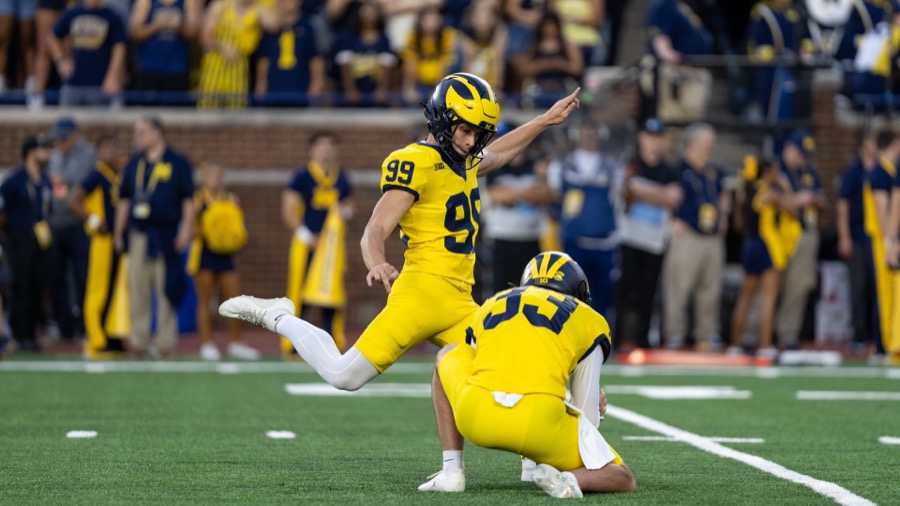
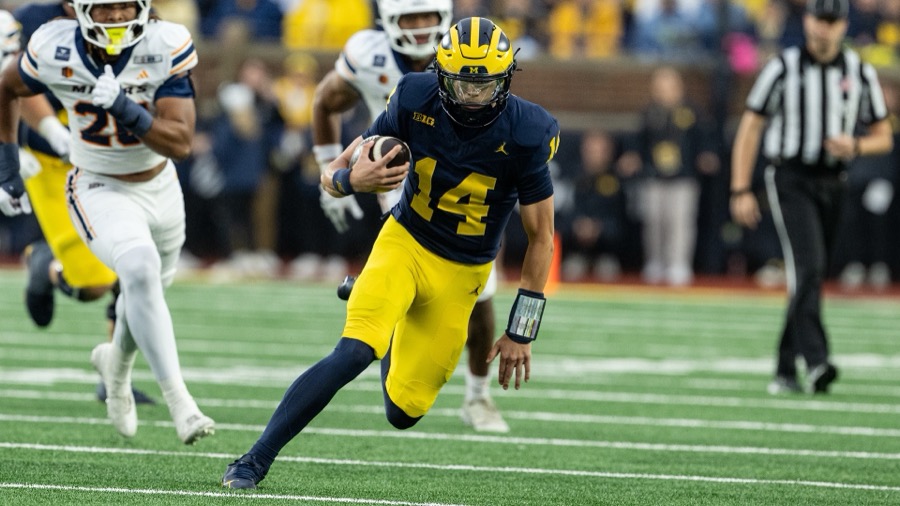
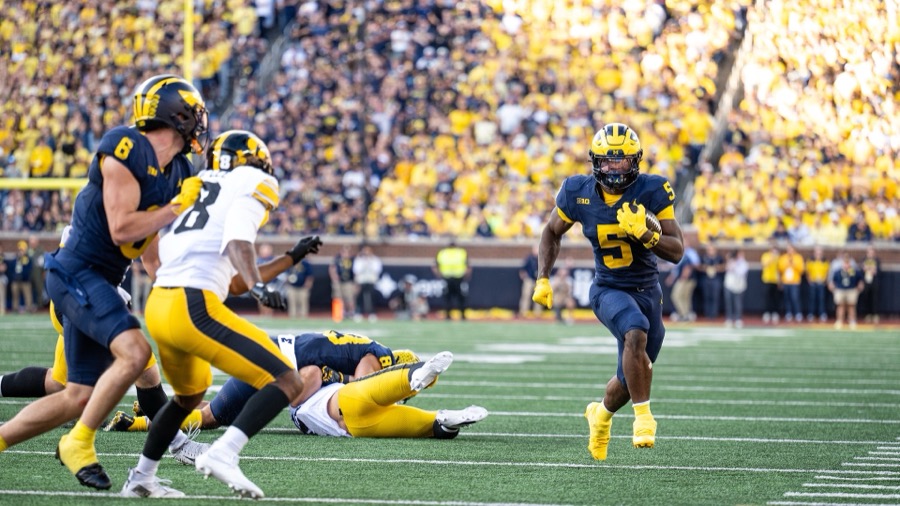
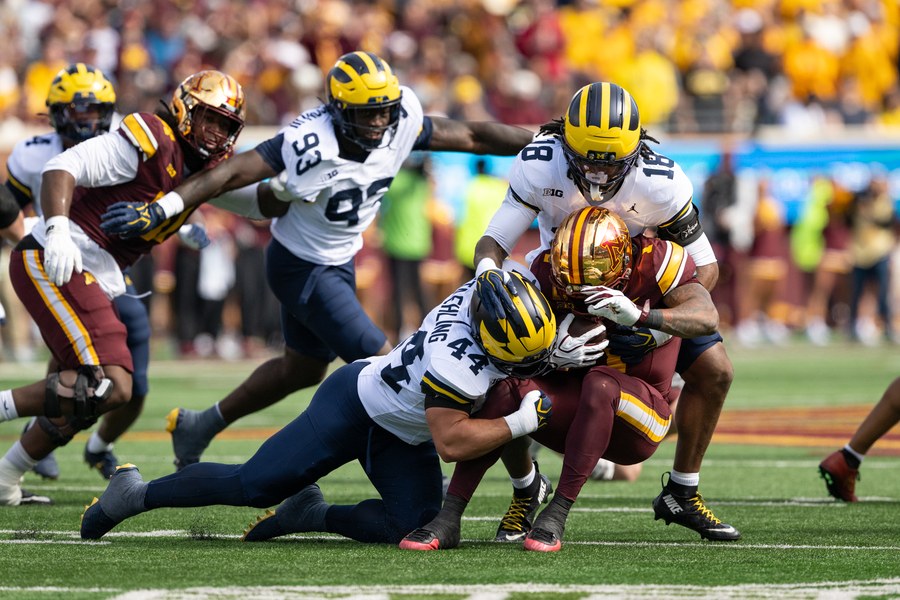
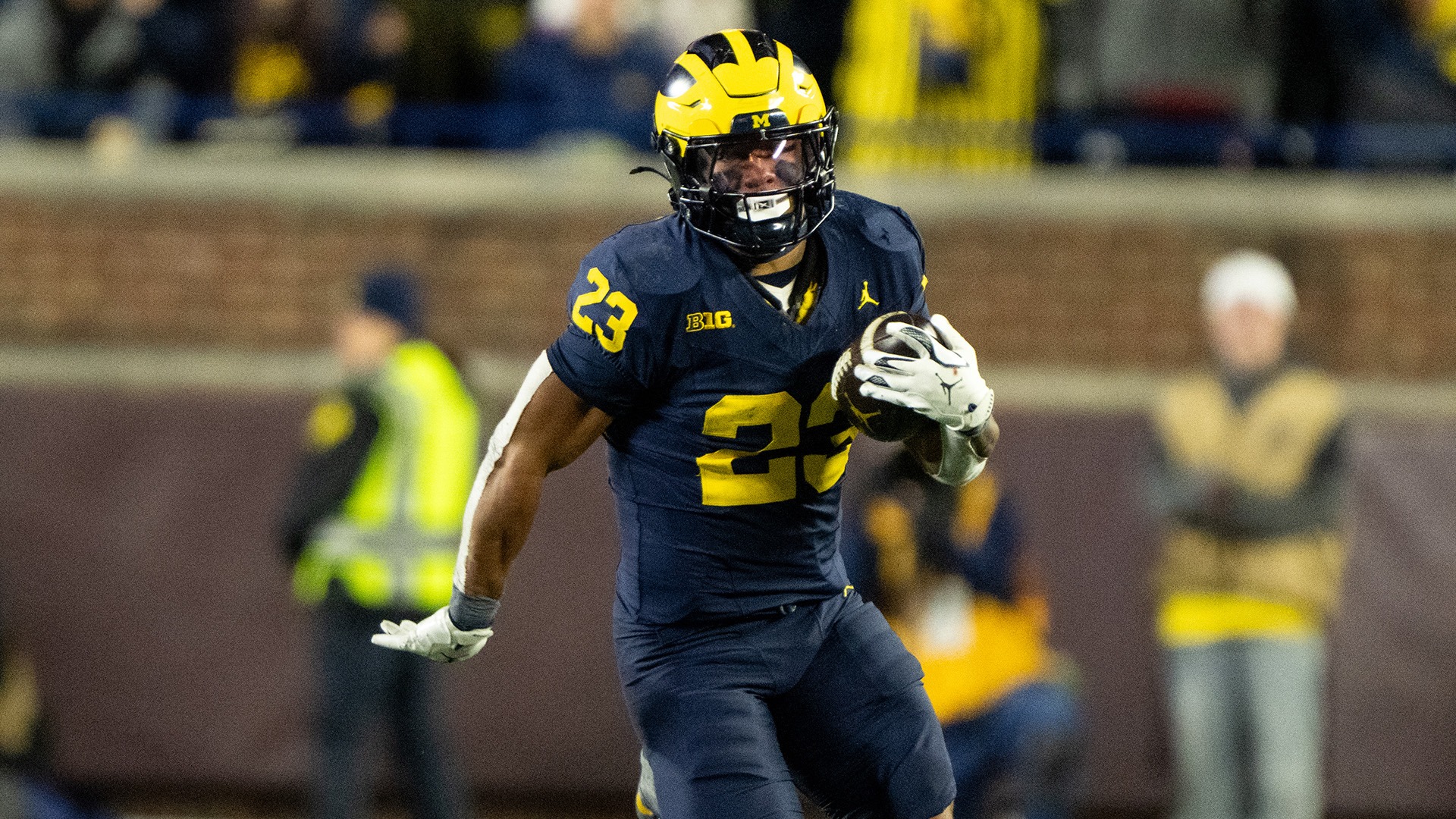
Michigan ran on every short-yardage down inside the 25, until Indiana
In its first six games Michigan faced third or fourth down needing three yards or fewer at or inside an opponent's 25 nine times. It ran all nine and converted seven. Against Indiana it threw on four of six such downs and was sacked on three.
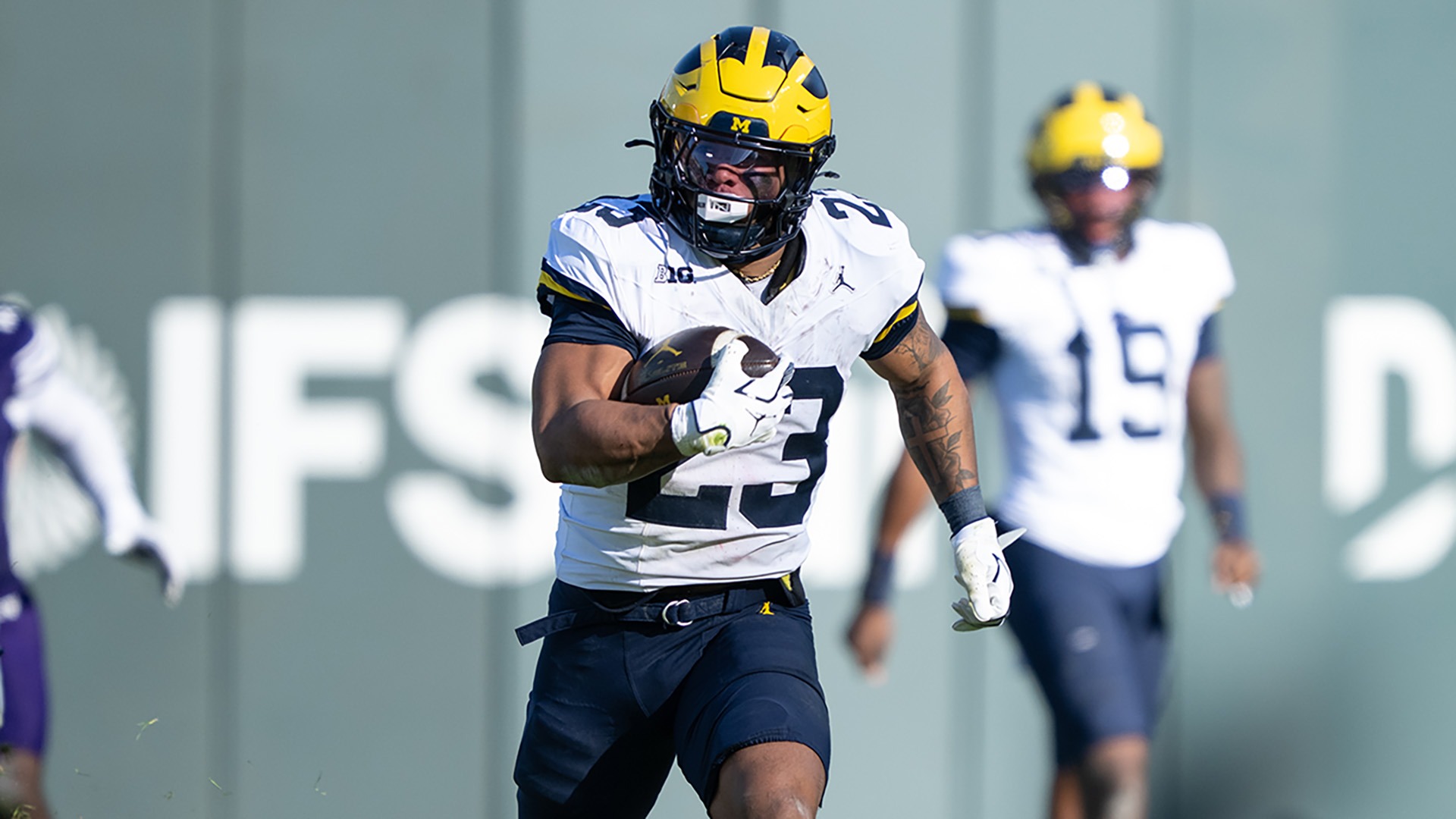
Before Saturday, Michigan handled one situation near the goal line the same way every time. On third or fourth down, needing three yards or fewer, at or inside an opponent's 25, it ran the ball. That situation came up nine times in the first six games. Michigan ran nine times and moved the chains or scored on seven.
Against Indiana the same situation came up six times, and Michigan called a pass on four of them. One converted. On the other three Tommy Carr was sacked, for losses of 12, 13 and 5 yards, and Michigan left those three possessions with a missed field goal, a missed field goal and a tying field goal. It lost 13-6 in overtime.
Kyle Whittingham said after the game that the throw on third-and-1 at the Indiana 1 was "not a good football call." The season shows how far outside Michigan's own habit it sat. Third-and-1 at the 1 was exactly the kind of snap Michigan had run on all nine times.
The nine, by the official play-by-play#
| Game | Down and spot | Call | Result |
|---|---|---|---|
| Western Michigan | 3rd-and-1, WMU 1 | Underwood run | No gain |
| Western Michigan | 4th-and-1, WMU 1 | Underwood run | Touchdown |
| UTEP | 3rd-and-1, UTEP 12 | Hiter run | 5 yards |
| UTEP | 3rd-and-3, UTEP 25 | Marshall run | 4 yards |
| UTEP | 3rd-and-3, UTEP 8 | Hiter run | Touchdown |
| Iowa | 4th-and-1, Iowa 18 | Underwood run | No gain, downs |
| Iowa | 3rd-and-1, Iowa 7 | Hiter run | 2 yards |
| Minnesota | 3rd-and-1, Minn 5 | Marshall run | Touchdown |
| Penn State | 4th-and-1, PSU 25 | Marshall run | 2 yards |
Seven of nine is 78%. Eight of the nine went up the middle by the stat crew's label, and the one that did not, Underwood's run to the right at the Western Michigan 1, was a touchdown until replay put him down short. Three of the carries were Underwood's, none of them from shotgun. The backs took the other six out of shotgun, three for Jordan Marshall and three for Savion Hiter.
The six on Saturday#
| Clock | Down and spot | Call | Result |
|---|---|---|---|
| 0:29, 2nd qtr | 3rd-and-3, IU 23 | Pass | Sacked, minus 12 |
| 10:11, 3rd qtr | 3rd-and-2, IU 13 | Hiter run | 1 yard |
| 9:30, 3rd qtr | 4th-and-1, IU 12 | Marshall run | 2 yards |
| 7:52, 3rd qtr | 3rd-and-1, IU 1 | Pass | Sacked, minus 13 |
| 2:11, 4th qtr | 3rd-and-3, IU 17 | Pass | 7 yards to Buchanan |
| 0:32, 4th qtr | 3rd-and-3, IU 3 | Pass | Sacked, minus 5 |
Two of the four throws came with about half a minute left in a half, when an incompletion stops the clock and a stuffed run costs a timeout. That is a real reason to throw. It is also not the whole story, because Michigan still had a timeout both times and spent one after each sack. The throw at the 1 had no clock reason at all. It came with 7:52 left in the third quarter, Michigan down 6-0, on a drive whose first 12 snaps had gone 74 yards. Marshall had converted a fourth-and-1 three snaps earlier.
Underwood, who carried a third of the nine, took one snap Saturday, a run for a 1-yard loss in the second quarter. Carr carried none of the six.
Indiana did not make the run the wrong bet#
The argument for throwing in short yardage against a good defense is that a good defense stops the run where the field is short. Indiana's record does not say that. In its first seven games, opponents faced third or fourth down needing three yards or fewer 34 times. They ran 20 times and converted 12, which is 60%. They threw 14 times, counting one sack as a throw, and converted seven, which is 50%.
Those are small numbers on both sides, and 20 runs against 14 throws does not settle anything about one call. What they rule out is the idea that Indiana's defense is built to stop exactly the play Michigan stopped calling. Michigan's own short-yardage runs on Saturday went 1 of 2.
The sacks themselves were not a Michigan habit either. Michigan had allowed nine sacks in its first six games, and only one came at or inside an opponent's 25, on second-and-18 at the UTEP 24. On Saturday three came in that zone, all on third down with three yards or fewer to go.
What the season says behind it#
The short-yardage calls cost Michigan points on Saturday. They are not why Michigan's offense has needed so much help to score, and that pattern started before Carr's first start.
Take every possession that began in Michigan's own territory, which is most of them, and set aside the one-snap possessions that end a half. In the first four games Michigan had 36 of those and scored 10 touchdowns. UTEP accounts for five of the 10, so the fairer comparison is the other three games, Western Michigan, Oklahoma and Iowa: 28 possessions, five touchdowns.
In the three games since, at Minnesota and at home against Penn State and Indiana, Michigan has had 27 possessions that began in its own territory. It scored one touchdown on them, the 74-yard drive in the third quarter against Penn State, and that one began right after Chris Bracy intercepted a pass at the Michigan 26. Add Saturday's tying field goal and those 27 possessions produced 10 points.
Michigan's offense scored 34 points in the three games. The other 24 came on possessions that started in the opponent's territory, and all four of those possessions began with a takeaway by Michigan's defense.
This is not one quarterback's problem. Underwood started at Minnesota and against Penn State, and Carr has taken nearly every snap since halftime of the Penn State game. The drop runs straight through the change.
Three games and 27 possessions is a small sample, and SP+ rated one of the three defenses, Indiana's, tied for second nationally before Saturday. Five touchdowns on 28 possessions against Western Michigan, Oklahoma and Iowa is not a high bar either. What the comparison shows is direction. Leaving out UTEP, Michigan's offense finished a long field about once in every six tries in September. In October it has done it once in 27.
What carries to Rutgers, and what does not#
Two things from Saturday should not travel. The short-yardage calls were a break from six games of habit, made in a quarterback's first start, and the coach has already said in public that one of them was wrong. A team that ran nine times out of nine before Saturday is more likely to go back to it than to keep throwing. And the sacks in that zone were new. There was one in six games, then three in an afternoon.
The long-field drought is the part that has three games behind it, under two quarterbacks, and it is the one Rutgers will test. Rutgers has allowed 28 points or more in six of its seven games, and it gave up 42 to Northwestern on Saturday.
The call: Michigan scores at least one offensive touchdown at Rutgers on a possession that begins in its own territory. The other side is real. Michigan scored no touchdown on eight such possessions at Minnesota or on 10 against Indiana, and its one in three weeks needed a takeaway to start it. What makes the call is Rutgers, which has given up points to nearly everyone it has played.
Sources: Michigan Athletics' official box score and play-by-play for Indiana at Michigan, October 24, 2026; CollegeFootballData's 2026 game, drive and play files for Michigan and for Indiana's first seven games, and its game file for Rutgers; Kyle Whittingham's postgame press conference, October 24, 2026, as transcribed by The Wolverine; SP+ via CollegeFootballData, October 21.