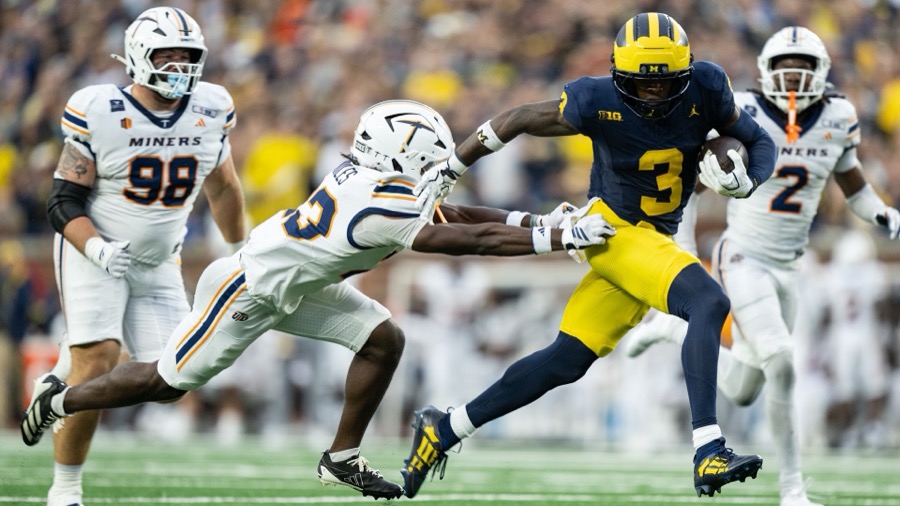
Michigan completed nothing that travelled more than 11 yards in the air, and won
Michigan 21, Penn State 18. By the catch spots in the official play-by-play, Michigan's 10 completions travelled 41 yards in the air between them, and its four throws past 25 yards were two incompletions and two interceptions. The stat crew marked five Penn State throws as deep, and every one went to Chase Sowell.
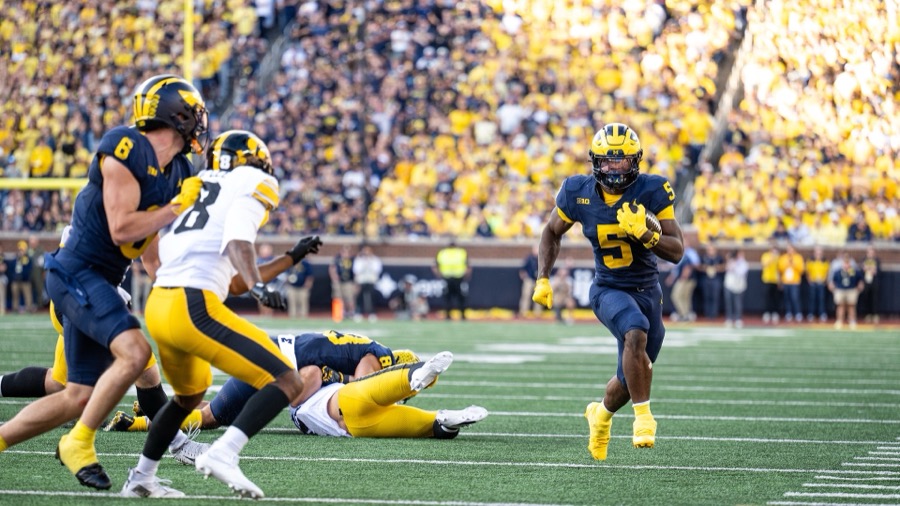
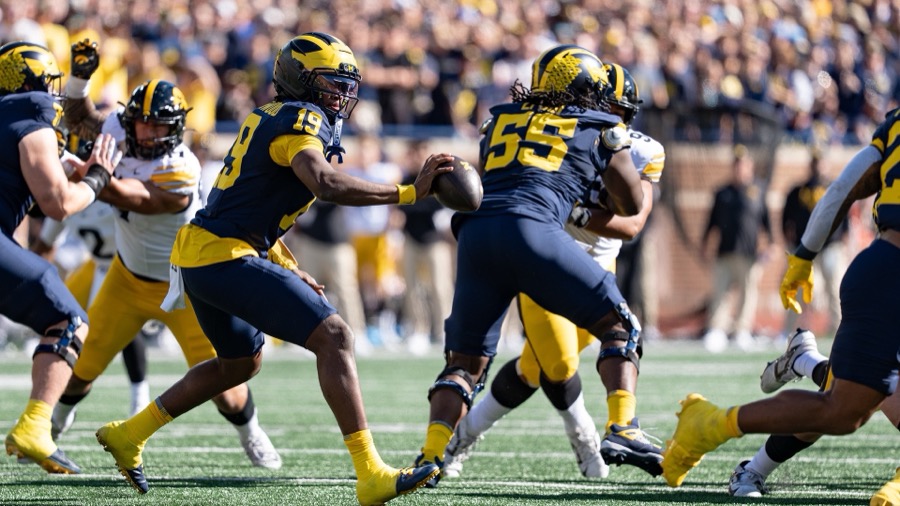
Michigan's two quarterbacks completed 10 passes against Penn State. The stat crew records where every catch is made, and by those spots the longest of the 10 travelled 11 yards past the line of scrimmage. Together they covered 41 yards in the air and 49 after the catch. Michigan threw four passes that went 25 yards or more downfield. Tommy Carr's two fell incomplete. Bryce Underwood's two were intercepted.
Penn State threw deep as well, and when the crew labelled a throw deep, it was always to one man. Five of Rocco Becht's 44 passes carry that label. All five went to Chase Sowell, three were caught for 76 yards, and a sixth, a 27-yard completion to Sowell on third-and-6 late in the first half, was wiped out by an offensive pass interference call on Brett Eskildsen. Of Becht's other 39 throws, 37 were marked short and two were the interceptions, which the crew does not label: Rod Moore Jr. picked off the first 21 yards past the line, Chris Bracy the second 6 yards past it.
That is the shape of the game underneath the quarterback change and the three takeaways. Penn State had a deep passing game and it ran through a single receiver. Michigan did not have a deep passing game at all, and it won by 3 because it did not need one on Saturday. Whether it needs one against Indiana is the question for this week.
The 90 passing yards, throw by throw#
Underwood's five completions were caught 11, 6, 4 and 3 yards past the line and 4 yards behind it, the last a swing to Savion Hiter that gained nothing. Carr's five were caught 10, 9, 3 and 1 yards past the line and 2 behind it. Michigan's longest completion of the day, Carr's 22-yarder to Hogan Hansen on the second touchdown drive, was caught 3 yards past the line at the Michigan 29, and Hansen ran the other 19.
Underwood's first interception came on first-and-10 at the Michigan 36, the snap after a 7-yard run and a Penn State personal foul had moved Michigan from its own 14. The ball was thrown to the Penn State 17, 47 yards downfield, and Zion Tracy picked it off. His second came on first-and-10 at the Penn State 36 with 32 seconds left in the half, thrown 27 yards downfield to the 9, where Josiah Zayas caught it. Carr's two were a first-down throw to JJ Buchanan at the Penn State 5 the snap after Moore's interception, 38 yards downfield and incomplete, the play before Bryson Kuzdzal's 43-yard touchdown run, and a third-and-5 throw to Andrew Marsh 35 yards downfield in the fourth quarter that Zayas broke up.
Three of the four were first-down shots: two came the snap after Michigan had moved the chains, one the snap after a takeaway.
The season says this was not an off day. By the same method across all six official play-by-plays, Michigan's quarterbacks have completed five passes that travelled 20 or more yards in the air: two against Western Michigan, 29 and 47 yards to Buchanan, and three against Iowa, 21 yards to Marsh and 30 and 34 to Buchanan. None against Oklahoma, UTEP, Minnesota or Penn State. The longest completion by air yards was 19 against Oklahoma, 19 against UTEP, 10 at Minnesota and 11 on Saturday. The method has a known coarseness: the crew marks the catch to the yard line, so a pass caught at the line of scrimmage counts as 0 yards in the air.
Sowell was Penn State's deep game, and the only one it had#
The five deep throws, in order: second-and-8 at the Penn State 30 in the second quarter, caught at the Michigan 45 for 26 yards, Jyaire Hill tackling; second-and-10 at the Penn State 35 in the third, caught at the Michigan 40 for 26, Smith Snowden tackling; the next snap, incomplete, thrown to the Michigan 18; first-and-10 at the Penn State 27 with 2:53 left, broken up by Bracy; and first-and-10 at the Michigan 24 with 1:14 left, caught at the goal line for the touchdown.
Sowell's other eight catches were marked short and gained 75 yards. Penn State's other receivers caught 17 passes for 116 yards, all on throws marked short. Three of Michigan's four defensive penalties came on throws to Sowell: Hill's two holding calls and Snowden's pass interference on the last drive.
So Michigan's coverage held the 37 throws marked short to 25 completions and 191 yards, held Penn State to 2.2 a carry and a long run of 9 yards, and gave up 76 yards and a touchdown on five deep throws to a receiver who had been a game-time decision.
The run game changed hands more than it changed direction#
The stat crew marks every run left, middle or right. The label is coarse, but it is the official record, and it says the second half, 23 carries for 174 yards after 12 for 37 behind the same five linemen, was not a new idea.
In the first half, seven of Michigan's 12 runs went left or right, for 8 yards. Five went up the middle for 29. After halftime, excluding Carr's sack and the kneel-down, Michigan ran 21 times: 14 up the middle for 141 yards and seven outside for 36. In its first five games Michigan had run up the middle on 86 of 161 carries, 4.0 yards each. The second half's inside share, 14 of 21, was higher than the season's, and the first half's, five of 12, was lower, and neither is a new idea for this staff. What was new on Saturday was the yardage: 10.1 a carry up the middle after halftime, against 4.0 there in the first five games.
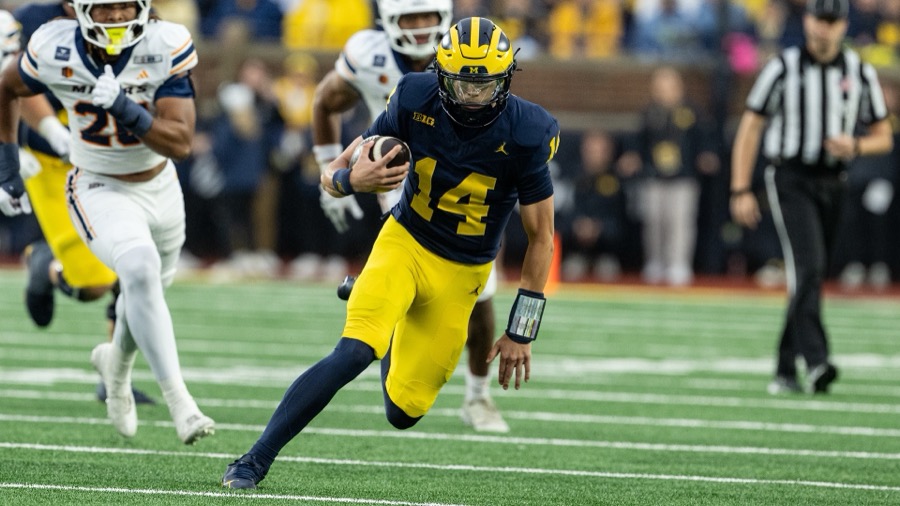
What did change at halftime was who carried. Hiter had two carries for 6 yards before the break. He had nine for 72 after it, including the 41-yarder from the Michigan 7 and an 18-yard run on the second touchdown drive. Jordan Marshall carried six times for 25 yards in the first half and eight for 24 in the second. Across the season Marshall has out-carried Hiter in five of six games, 69 attempts to 57; Iowa is the only game in which Hiter had more. Carr added runs of 4, 22 and 12 yards, and the play-by-play cannot say which were designed.
Three second-half runs went for 43, 41 and 22 yards. The other 18 gained 71, which is 3.9 a carry. That is the shape of 174 yards in a half: a run game that was ordinary on most snaps and found three seams up the middle.
What PFF's grades rank, without the numbers#
PFF's grades for this game are subscriber data, and the values do not appear here. The rankings inside them do, named as PFF's, and a ranking inside PFF's method is a lens on the game rather than a fact about it.
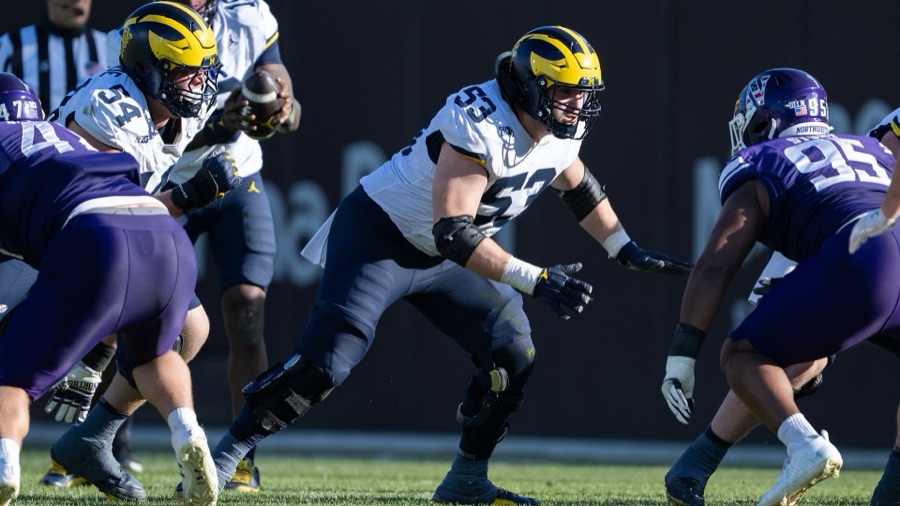
The official box score lists six offensive linemen among Michigan's starters: Evan Link, Nathan Efobi, Jake Guarnera, Avery Gach and Blake Frazier, plus Manuel Beigel as the sixth lineman in the rhino package. Among the five who started at the conventional spots, PFF's run-blocking grades had Gach first, in his first career start at right guard, and Link last. Beigel's run-blocking grade was the highest of any Michigan offensive lineman who played. In pass blocking the order changed: Guarnera, a game-time decision who started anyway, graded first of the five and Efobi last. Among Michigan's pass catchers, PFF's receiving grades had Hansen first.
On defense, PFF's overall grades had Moore as the highest-graded Michigan defender, and he left the game after his interception with 12:19 still to play in the third quarter. Bracy, who had eight tackles, a sack, a forced fumble and an interception in the box score, graded first on the defense in run defense. In coverage, among the eight Michigan defensive backs who recorded a tackle, PFF's grades had Hill last and Snowden third.
What one half says about Indiana, and what it does not#
Indiana, 6-1 after a 19-15 loss to Ohio State, comes to Michigan Stadium on Saturday at noon Eastern on Fox. Kyle Whittingham said Monday that the staff has decided who starts at quarterback and will not say. "We know exactly what we're doing and the plan going forward," he said, according to ESPN. "We're not going to tip our hand to the opponent. But we have a good plan in place." On how much turnovers weigh in the decision, he said "Big impact," and on playing two quarterbacks he reached for the old line, "if you have two quarterbacks, you don't have one," both as reported by Michigan on SI.
The sample is a half: 21 runs and eight dropbacks against a defense that is 0-4 in the Big Ten. The 21 points came from three drives of 43, 74 and 13 yards after takeaways. The question Indiana will ask is whether an offense that has completed five passes of 20 or more air yards in six games, and none in the last two, can score when the field is 75 yards long and nobody hands it the ball.
The call here is that Michigan will not complete one against Indiana either, scored off the catch spots in the official play-by-play. The other side is real: Michigan completed three such passes against Iowa four weeks ago, and Carr threw past 25 yards twice in his half against Penn State, which is a staff willing to call it.
Sources: Michigan Athletics' official box scores and play-by-play for Penn State at Michigan, October 17, 2026, and for Michigan's five earlier 2026 games (Western Michigan, Oklahoma, UTEP, Iowa, Minnesota), including the drive charts, team statistics and starters; Pro Football Focus game grades for Penn State at Michigan, subscriber data, cited as rankings only with no values shown; ESPN (Jake Trotter), October 19, 2026, for Kyle Whittingham's Monday remarks; Michigan on SI (Trent Knoop), October 19, 2026; the Associated Press via Yahoo Sports, October 19, 2026.