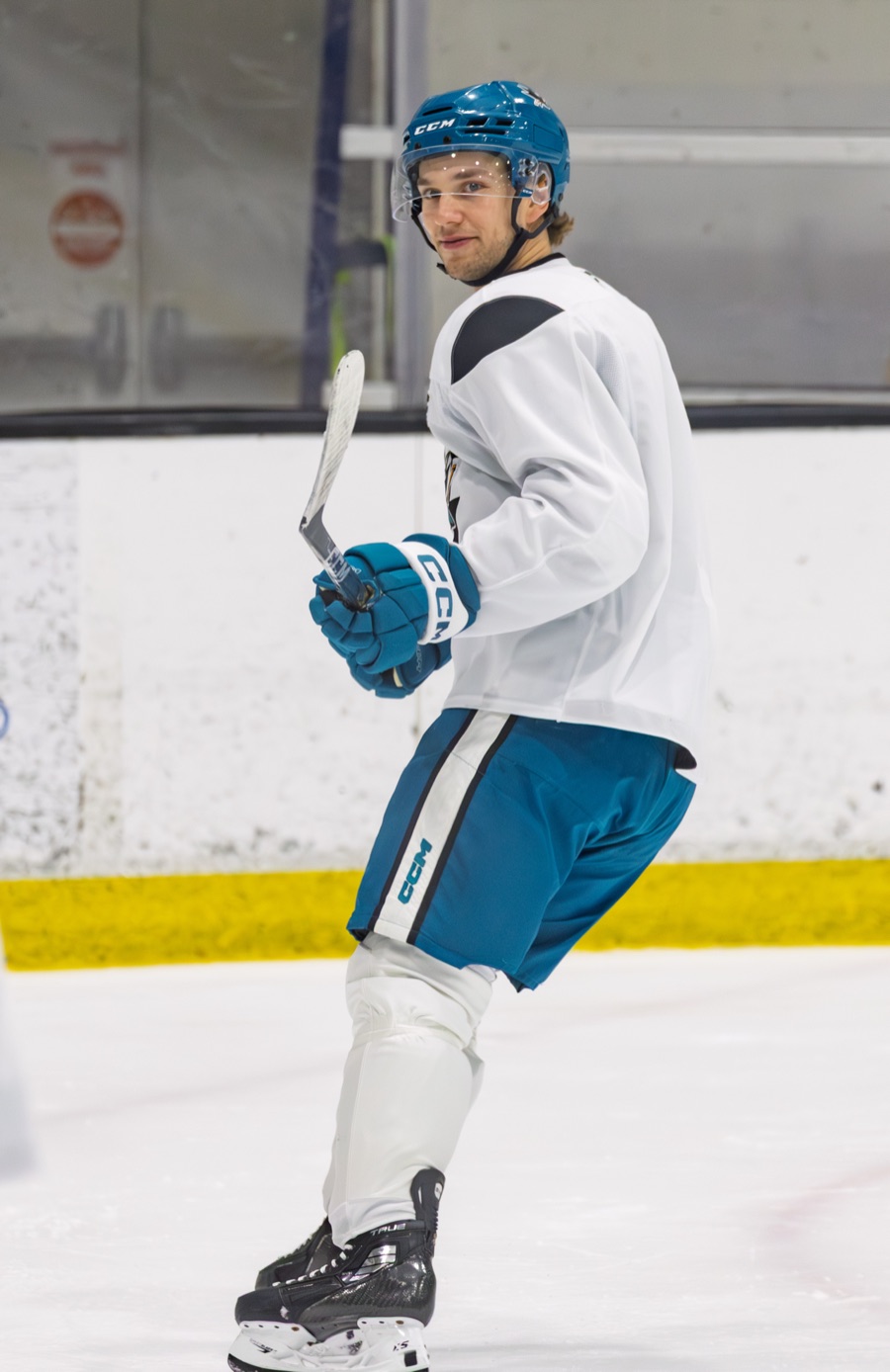
Collin Graf, and the contract you sign before everyone else does the math
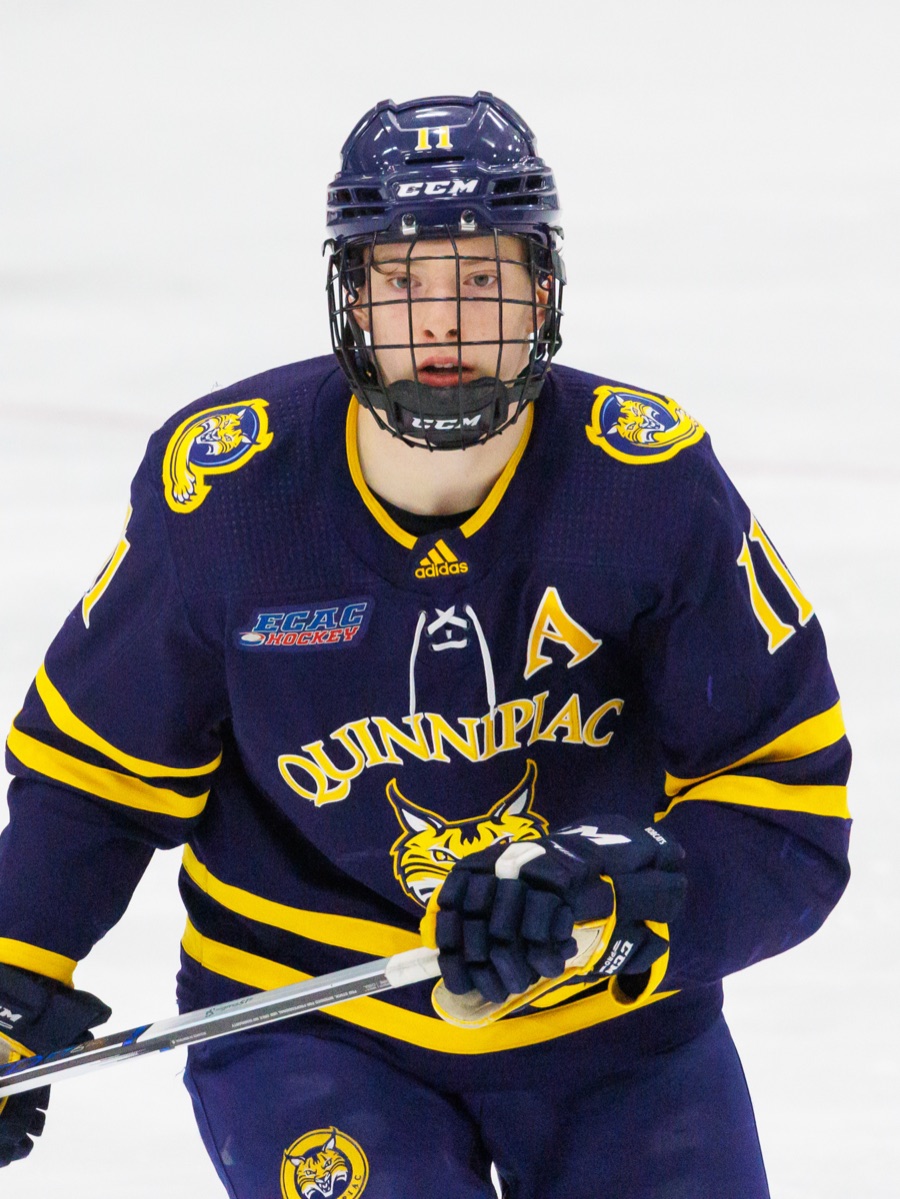
Two summers ago, 224 names got called at the draft over two days, and none of them was Collin Graf, which is how a Quinnipiac junior became a free agent the Sharks signed for nothing on an April afternoon. Two years later the books on him read like a clerical error, and he is sitting on an expiring entry-level contract as a restricted free agent with, and check the fine print on this, no arbitration rights. Which means the Sharks are holding a closing window in their hands: the brief moment where the team has all the leverage and the player has all the value. The Eklund email argued his $5.6M was the quiet bargain of the roster. This is the same lesson, except this time we get to apply it before the contract exists.
1. What the books actually say about him#
| Signal (2025-26, age 23) | Number | Context |
|---|---|---|
| Counting line | 81 GP, 21-25-46, plus-6 | Second-best plus-minus of any forward, on a minus-41 team |
| Individual chance creation | 0.84 ixG/60 at 5v5 | Led every Shark forward with sustained deployment. Not Celebrini. Graf. |
| Penalty kill | 196 minutes at 6.52 xGA/60 | Tied with Desharnais for the best suppression on the team; one of exactly two real killers the autopsy found |
| Power play | 38 minutes all season | The team's best 5v5 chance generator got one PP shift a week |
Read the last two rows together, because they are the whole negotiation. The penalty-kill row says he already does the unglamorous half of a complete winger's job at an elite level. The power-play row says his offensive line was produced with one hand tied behind his back, and the forward plan unties it next year (2RW next to Misa, a PP2 unit slot). His production is more likely to go up than down, which means his price is too, which means the cheapest day to sign Collin Graf for the rest of his twenties is approximately today.
2. Bridge versus term: the two roads, priced#
| Path | Shape | The comp | How it ends |
|---|---|---|---|
| The bridge (league default) | 2 years, $2.25M-to-$2.75M | Will Cuylle: bridged at $3.9M off a 45-point year, broke out, and the Rangers now owe him a tower | Cheap now; re-price him in 2028 off two top-six seasons, with arbitration rights, mid-cap-crunch |
| The term bet (the pick) | 5 years, $4.25M-to-$4.75M | Calgary's Coronato bet: long term at mid-money off a 24-goal season, before the second breakout | Overpay year one by $2M; underpay years three through five by more, and buy his first UFA season |
The bridge is what the league does with undrafted stories, because front offices price pedigree long after the play has outrun it, the exact bias that made him free in 2024. But the math is lopsided. The bridge saves roughly $2M a year for two years. If Graf does on the second line and PP2 what his chance-creation rate says he does, the third contract costs $6.5M-to-$7.5M (the Peterka tier) starting in 2028, the precise summer Misa and Dickinson get paid. The term deal costs an extra $2M now to make that negotiation never happen, locks the cap line through the entire contention window at fourth-line money for second-line output, and buys a UFA year at the end. The five-year cap model already strains in 2029; a Graf bridge adds one more bill to that exact summer. The term deal deletes it.
3. The honest hesitation, and why it loses#
The bear case: one season, an 11-ish percent shooting profile that could sag, and a skill set whose value is partly the kind (defense, killing, finishing other people's chances) that counting stats underrate, meaning maybe the market never prices him up and the bridge costs nothing. It is not crazy. It is also exactly what the eye-rollers said about Eklund's $5.6M, and the answer is the same: you do not get to wait for certainty on players whose underlying numbers lead the team. The 0.84 individual expected goals per 60 is not a percentage; it is volume and location, the most repeatable thing a shooter does. The PK suppression is two hundred minutes, not twenty. The profile is real in the places where profiles stay real.
The verdict#
The pick: five years, $4.5M a season, signed in July while the leverage is all one-directional.
No arbitration rights, an expiring ELC, a role upgrade already written into next year's lineup, and underlying numbers the league has not priced yet because the name on the sweater was never called at a draft. That is the entire Eklund playbook, available one more time, in real time. The market-rate band for what he projects to be is $6.5M-plus by 2028. The cost of certainty today is $4.5M. Teams spend every February hunting for the contract this would become. The Sharks can just write it.
Counting line per docs/Sharks_2025-26_Season_Summary.md (81 GP, 21-25-46, plus-6); components per the value board (docs/Sharks_2025-26_value-board_component-audit.md: 0.84 ixG/60, 6.52 PK xGA/60 over 196 minutes, 38 PP minutes); RFA status and ELC per state/cap.md (no arbitration notation, unlike Kurashev's entry). Comps (Cuylle bridge, Coronato term, Peterka third-contract tier) cited as career-stage shapes, approximate. Role upgrade per the forward-lines plan (2RW, PP2).