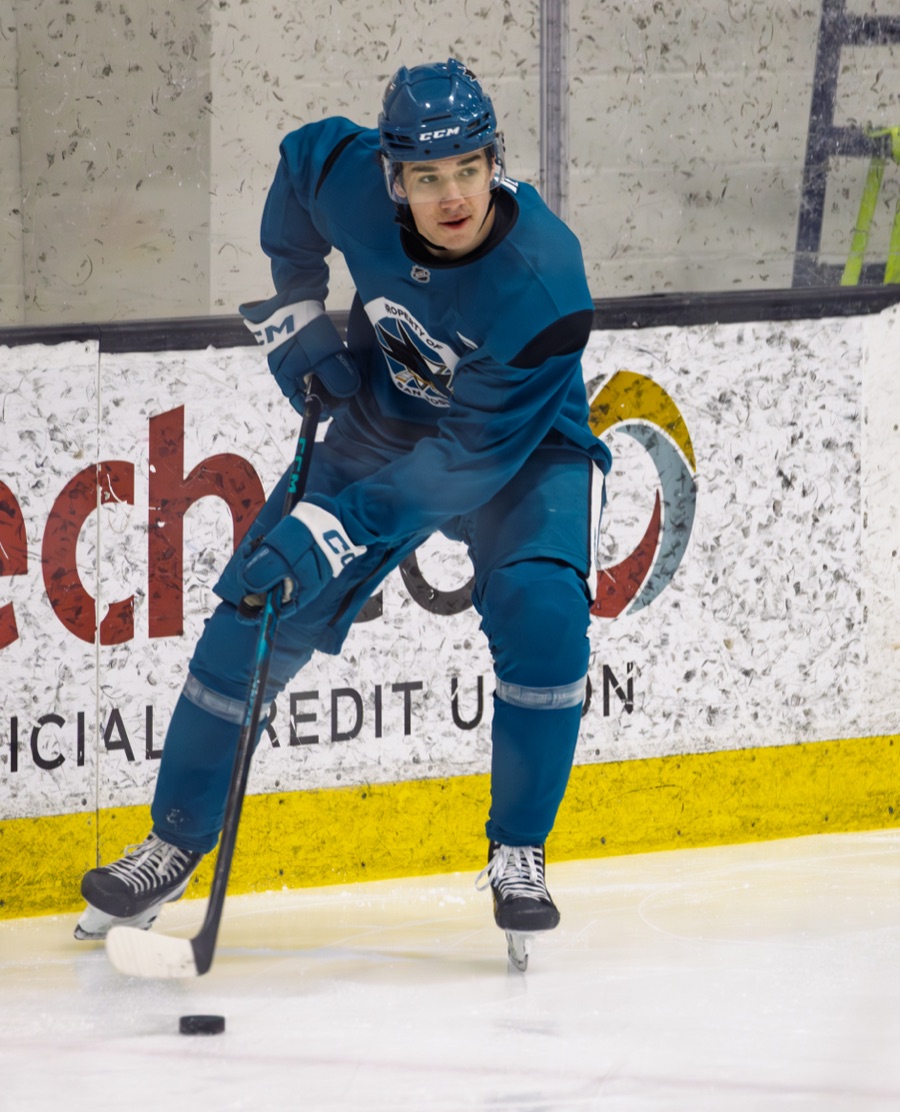
The Ice Time Michael Misa Is Missing Is Mostly Not Even Strength
The Sharks 25, No. 4. San Jose is filling its second-line center job by promotion rather than by signing one, and the man being promoted averaged 12:49 last season. Split those minutes by strength and the distance he has to travel is only three minutes of even-strength work. The other four are power play and penalty kill, which are the minutes a coach hands out rather than a depth chart.
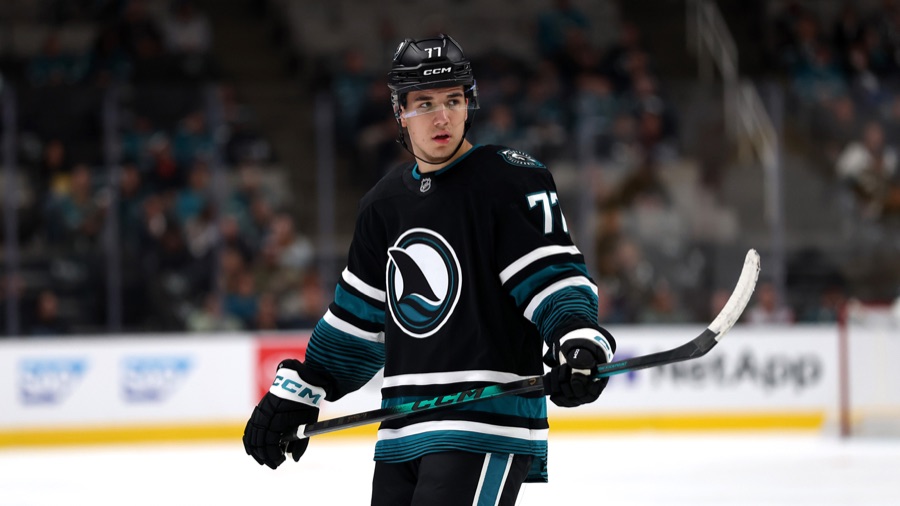
Take the minutes San Jose gave its centers last season and split them by strength. Hockey Reference prints even strength, power play and penalty kill side by side on its time-on-ice table. Put Alexander Wennberg's row next to Michael Misa's and read across it.
At even strength Wennberg averaged 14:57 across 80 games and Misa averaged 11:38 across 45. On the power play it was 3:20 against 1:09. Shorthanded it was 2:08 against a column that reads 0:00.
Wennberg's all-situations average was 20:27 and Misa's 12:49, a gap of 7 minutes and 38 seconds. Only 3:19 of that is even strength. The other 4:19 is special teams.
That is the shape of the promotion San Jose is planning.
Where the gap actually is#
Every projection on file has Misa taking the second-line job. Curtis Pashelka of the Mercury News wrote on September 11 that Celebrini, Wennberg, Misa and Zack Ostapchuk are slated to open as the four centers, and that Misa's 12:49 "will likely increase as a middle-six center in year two." Professor Hockey has Wennberg falling from 55 points to 40, on losing the second-line job to Misa and losing first-unit power play. Both are projections. San Jose has announced no lines.
What the minutes table says is that the even-strength half of that handover is small. Three minutes and nineteen seconds is about one extra shift a period. That column is a proxy for five-on-five rather than a measure of it. Hockey Reference's even strength folds in four-on-four, three-on-three and empty-net shifts, so the true five-on-five gap could sit either side of 3:19. The rest of it, the four minutes and nineteen seconds that make Wennberg a twenty-minute player, sits in two jobs that nobody is promoted into. A coach assigns them.
The centers are all already here#
San Jose spent this summer on the blue line and on a wing. Darnell Nurse at $9,250,000 and Jacob Trouba at $8,250,000 are signed through 2029-30, and Mason Marchment came in at $6,750,000. None of it went to the middle, and all four of the centers Pashelka names were already here last season.
Misa is at $975,000 on the second year of his entry-level deal, a restricted free agent in 2028. Wennberg is at $6,000,000 on the first year of a three-year extension, with a full no-trade clause covering this season and next.
That is what makes this the season's largest lineup bet. If the promotion works, San Jose solved a second-line center job out of its own draft for under a million dollars. If it does not, the club is carrying a $6,000,000 third-line center it cannot move without his permission, and the job is still open.
Best case for San Jose#
Misa takes the special-teams minutes, not only the even-strength ones. He was on for 5.7 goals per 60 of power-play time last season against Wennberg's 7.6, across 1:09 a night, which is about 52 minutes all season and settles nothing. What matters to the club is the redistribution. If Misa can run a power-play unit and kill penalties, Wennberg's $6,000,000 becomes a third-line center who takes defensive-zone draws and plays two minutes on the kill. Across 84 games and 12 back-to-backs that is a useful thing to have rather than an awkward thing to own, and it is what four playable centers looks like on a club seven years out of the playoffs.
Three arguments against that, and the first one is real#
One. Misa won 162 of 354 faceoffs last season, 45.8 percent. Wennberg won 655 of 1,400, 46.8 percent. Neither is good, and the job being handed over is the defensive one. Wennberg started 41.1 percent of his even-strength shifts in the offensive zone; Misa started 48.1 percent. Promoting Misa moves him into his own end, on a draw percentage that was not good enough in easier territory.
Two. He had 28 giveaways against 8 takeaways in 576 minutes. Penalty-kill minutes punish that harder than any other minutes on the ice, and a staff that watched every shift gave him none of them.
Three. Ryan Warsofsky has other penalty killers and used them. Ty Dellandrea averaged 2:37 shorthanded, Wennberg 2:08, Ostapchuk 1:09. Adding kill work to the player you most want producing offense is a defensible thing to decline.
Worst case for San Jose#
Not that Misa is bad. That he gets the title and the five-on-five minutes and nothing else, lands around fifteen minutes a night, and San Jose calls that a second-line center because the depth chart says so. Wennberg keeps the 3:20 of power play and the 2:08 of kill and the points that go with them, and the club reaches January having answered nothing about the middle of its lineup. That is when it would have to buy a center, at the price centers cost at a deadline, with a blue line committed through 2029-30. The damage is not the player. It is a season spent promoting somebody into a job and withholding the hard parts of it.
What to watch in October#
The two smallest columns in the box score, and they take one game to read. Power-play time and shorthanded time. Misa averaged 1:09 on the first last season and did not register a measurable average on the second.
If he is at four minutes a night of combined special teams by the end of October, the handover is real and the all-situations number follows on its own. If the split still looks like last season's, with even strength up and the other two flat, the second-line job is a label, and the ice time will say so before the point totals do.
Then the faceoff percentage. Forty-five point eight is the number to beat, and the defensive zone late in games is where it counts.
The stakes#
Grant Lombard's open call on this site's ledger, filed August 14, has Misa finishing under 60 points. Professor Hockey predicted 60-plus and says he talked himself down from 70. Misa scored 21 points in 45 games, which is 0.47 a game; 60 across 84 games is 0.71. That is the largest rate increase asked of any returning San Jose player this summer, and the ice time it depends on is the thing in dispute.
This desk has its own open call that Wennberg finishes with more power-play points than Misa. Both rows resolve on the same question the season does, which is how Warsofsky splits about seven minutes a night between a 31-year-old with a no-trade clause and a 19-year-old on an entry-level deal.
Previously in this series: No. 5, Sam Dickinson.
Sources: Hockey Reference's 2025-26 San Jose team page, the skater, advanced-stats and time-on-ice tables, read 2026-09-14, for every ice-time split, the zone starts, the faceoff counts, the giveaways and takeaways and the on-ice goal rates. PuckPedia and the club's cap record for contract terms, cap hits and the no-trade clause. Curtis Pashelka, the Mercury News, September 11, 2026, for the projected center group and the ice-time comment. Professor Hockey, August 5 and August 12, 2026, for the Misa and Wennberg point-total predictions. The NHL's 2026-27 schedule for the 84-game season and the back-to-back count.