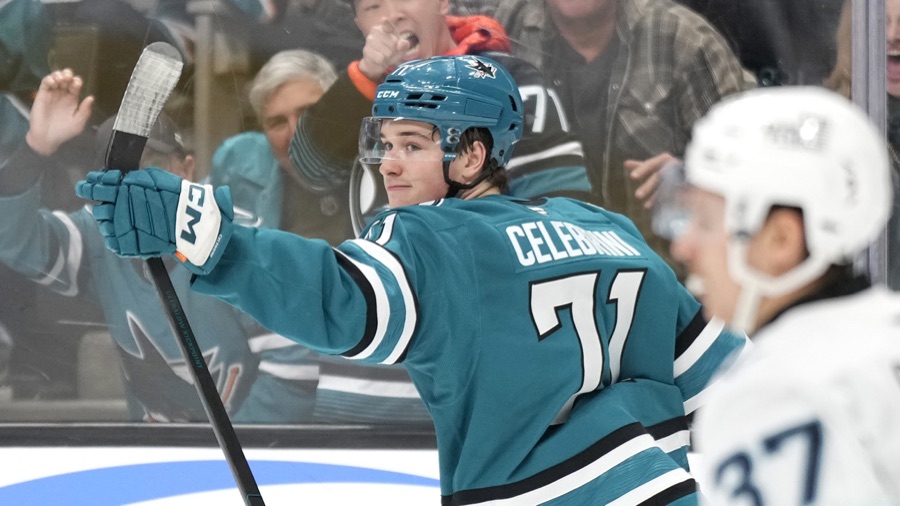
Macklin Celebrini Explained His Own Contract By Talking About Everybody Else's
The 20-year-old sat down for the first time since signing the biggest average annual value in league history, and every answer he gave about the number was an answer about the payroll around it. In June, before any of it was signed, his agent had asked San Jose's owner to sit down and account for where the franchise was going.
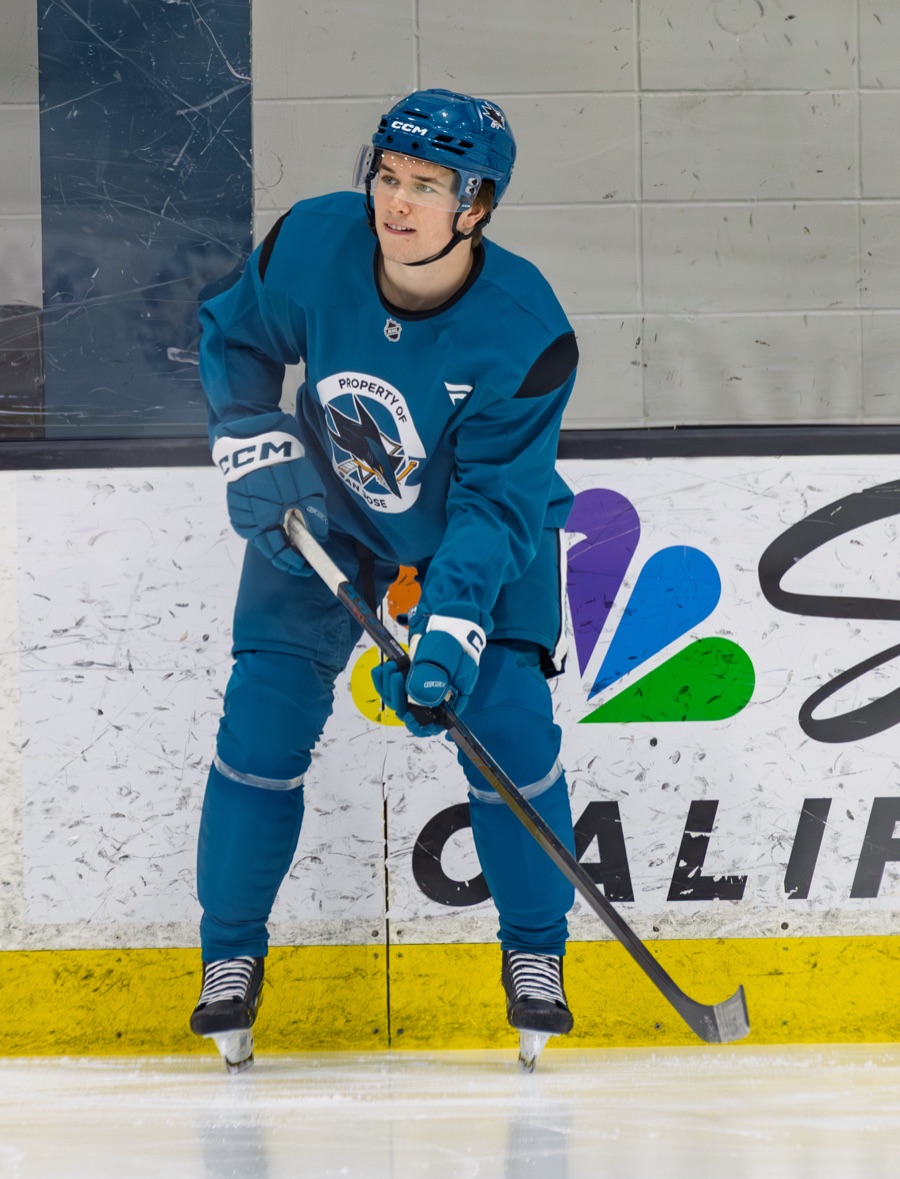
Macklin Celebrini is 20 and has signed for more money per season than anyone in the history of hockey. On Thursday afternoon he sat in front of the local media for the first time since it happened, and what he wanted to talk about was the payroll.
"I wanted to make sure that with where the cap was going, that the number made sense for the team first and foremost, making sure that everyone can get paid and that we're in a good spot to build the way we want to build," he said. "We kind of landed on that number."
That is a sentence about other people. So is the one he gave about the length of the deal.
"Just kind of keeping a little bit more flexibility for everyone. It's not really a bad thing."
The deal is five years and $94 million, an average of $18.8 million a season, signed July 29. It begins in 2027-28, runs through 2031-32, and puts him on the open market in July 2032 at 26. He plays this season on the last year of his entry-level contract, so the largest cap hit in the sport costs San Jose nothing until the season after next.
Here is the number he did not sign for. The collective bargaining agreement caps an individual at 20 percent of the league's upper limit, which is $104 million this season. Twenty percent is $20.8 million a year, or $104 million across five. He signed for $94 million, and the gap is ten million dollars nobody made him leave.
He was under no obligation to sign at all this summer. The extension window simply opened, and he walked through it a year early on purpose.
"It was something I wanted to get done this summer," he said. "I didn't really want to wait until next summer and have it hanging over my head all year."
A player who waits a year and repeats last season negotiates against a bigger ceiling. PuckPedia projects next summer's upper limit at $113.5 million, which puts the individual maximum at $22.7 million a season. That is a projection rather than a set cap, and it is the kind a 115-point 20-year-old gets to take seriously.
He signed anyway. Anyway.
The room in June#
A young man being gracious about money is not usually a story. What makes this one different is what came first.
In June, Celebrini's agent asked to meet the owner.
Pat Brisson, his agent at CAA, requested a sit-down with Hasso Plattner, who owns the Sharks, and Mike Grier, who runs them. The subject was the direction of the franchise and the extension. Celebrini was not in the room.
"I made a special request with a special player like this," Brisson said on July 31, two days after the extension was announced. "I call him a unicorn player. To really go in and meet with ownership and understanding what we're getting into."
He also said the meeting "was part of the negotiations, making sure we do things right." That is an agent describing diligence and an agent describing leverage in one sentence, and Brisson volunteered both readings.
What Thursday supplied was the client's half. Asked about ownership's involvement, he did not file it under somebody else's errand.
"100 percent, it all comes from the top down," he said. "Obviously, Hasso with how excited he is with our team and where we're going and the guys that we have, that means a lot, having his trust as well."
Set that beside the payroll answer and the two lock together. The agent went to hear the plan. The client priced it.
The plan he priced#
The thing he bought is not a finished object. San Jose scored 3.04 goals a game last season, 17th in the league, and gave up 3.54, third-worst. The club has not made the playoffs since 2019. He named the second number himself as the obstacle.
"I think defending, keeping the puck out of our net," he said. "I think we created a lot of offense last year, but letting in goals off mistakes and mental errors hurt us."
Then he put a share of it on himself. "I turned the puck over a lot last year, there's different things that I saw in my game that I wanted to clean up."
(He had 45 goals and 115 points, which broke Joe Thornton's franchise record from 2006-07. He would like you to know about the giveaways.)
Term was the third choice and it went the same way as the other two. This was the last summer a player could sign eight years with his own club, because the new collective bargaining agreement drops the maximum to seven. Eight was on the table and he took five.
"I think five was just the right number," he said. "Just all different factors with where our team is going and having that flexibility."
Every one of those decisions only makes sense if you believe an answer somebody gave in a room in June. Brisson said he wanted to understand what they were getting into. Whatever he was told, his client signed for ten million dollars under the maximum, a year before he had to, on three years less term than the rules allowed. San Jose owns both halves of that now: the plan it described to an agent in the summer, and a 20-year-old who has gone on the record saying he believes it.
Sources. Contract terms, covered seasons, signing date and free agency year verified at Spotrac and CapWages and against the club's own release. Celebrini's quotations, the June meeting, the $20.8 million and $22.7 million individual maximums and the team goal rates from Sheng Peng, NBC Sports Bay Area, August 27, 2026, with the quotations cross-checked against NHL.com's account of the same availability by Max Miller. Brisson quotations from Sheng Peng, San Jose Hockey Now, July 31, 2026. The $104 million upper limit is the league's confirmed figure for 2026-27 and the 20 percent individual maximum is the collective bargaining agreement's; the $113.5 million for 2027-28 is PuckPedia's projection. Franchise points record via NHL.com.