Underwood cleared both bars against Iowa. He did it five times last year.
Against Iowa, Bryce Underwood had his most yards per attempt and his best expected points per dropback in 13 games against Power 4 defenses. His 2025 Big Ten average of 7.5 yards an attempt was a midpoint between five games like this one and four like Ohio State, so the question after Saturday is how often the second kind comes back.
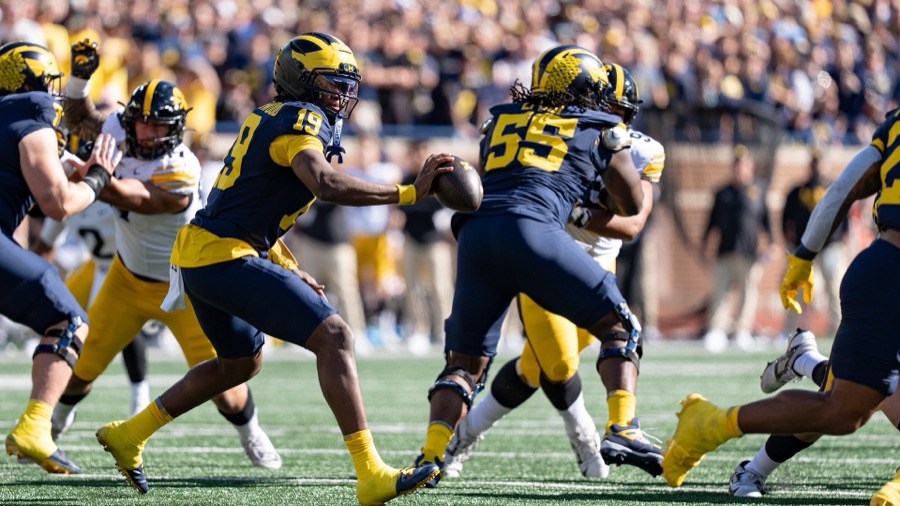
Two numbers were the test for Bryce Underwood against Iowa, and both came from his own freshman season. One was his 2025 Big Ten yards per attempt, 7.5, on 1,601 yards and 213 throws. The other was his 2025 Big Ten success rate, 44.1 percent of 227 dropbacks, where a dropback is a pass attempt or a sack and a successful play gains half the needed yardage on first down, 70 percent of it on second and all of it on third or fourth. Clear both against a Power 4 defense, the reasoning went, and you have the first like-for-like evidence that the passer has moved.
He cleared both. He completed 17 of 28 passes for 276 yards, 9.9 yards an attempt. By the play-by-play, 14 of his 29 dropbacks were successful plays, 48.3 percent.
By the two measures that price a whole throw rather than count it, Saturday was the best game of Underwood's college career against a Power 4 defense. He has played 13 of them across two seasons. None produced more yards per attempt; the closest was 9.6 against Wisconsin last season. None produced more expected points per dropback by CollegeFootballData's model, which values each play by how much it moved a team's scoring outlook: +0.56 against Iowa, ahead of +0.50 against Wisconsin. And Iowa had allowed 4.4 yards an attempt in its first three games, 332 yards on 76 throws by Northern Illinois, Northern Iowa and Iowa State.
It still does not answer the question, and the reason is in where last season's 7.5 came from.
Where 7.5 came from#
Underwood's 2025 Big Ten line is an average of nine games, and the nine split cleanly in two.
In five, against Wisconsin, USC, Washington, Northwestern and Maryland, he cleared both marks: between 8.5 and 9.6 yards an attempt and success rates from 46.2 to 58.6 percent. In the other four, against Nebraska, Michigan State, Purdue and Ohio State, he cleared neither: between 3.5 and 6.6 yards an attempt and success rates from 22.2 to 37.5 percent. Not one of the nine landed between the two groups.
So 7.5 is a midpoint between two kinds of afternoon. Five good ones produced a season sitting exactly on the markers because four bad ones pulled it down, and a single game above both bars is something Underwood did in more than half of his Big Ten games as a freshman.
Measured against those five, Iowa belongs to the group and sits near its bottom on the steadier of the two measures. Success rate does not care how long a completion is, only whether the play did what the down required, and of the five good 2025 games only USC's success rate, 46.2 percent, was lower than Saturday's. Iowa leads the group on yards and on expected points and trails four of the five on down-to-down success.
This season has two Power 4 games, and it has one of each kind. Against Oklahoma on September 12, Underwood averaged 6.5 yards an attempt and 31.6 percent of his dropbacks succeeded. Against Iowa, 9.9 and 48.3. Pool the two and the success rate is 41.7 percent on 48 dropbacks, still under last season's Big Ten mark, while yards per attempt is 8.6 on 45 throws, over it. That is the 2025 shape with the sample cut to two.
Where Saturday's yards came from#
The margin on yards was built by the deep ball, and the deep ball had been missing. Through the first three games the official play-by-play tagged 11 of Underwood's throws as deep, and one was caught. Against Iowa it tagged six, and three were caught for 101 yards: 20 to Andrew Marsh down the right side in the first quarter, 32 to JJ Buchanan down the left in the second, and the 49-yard touchdown to Buchanan down the right that put Michigan ahead 19-14 with 11:59 left.
The two throws to Buchanan account for 81 of the 276 yards. On his other 26 attempts Underwood averaged 7.5 yards, last season's Big Ten figure to the decimal. Taking away any quarterback's two longest throws will flatten his day, so that subtraction proves less than it appears to. What it does show is which throw changed. Everything else Underwood threw against Iowa averaged what his whole 2025 Big Ten season averaged, and the difference was a deep throw that had worked once in 11 tries working three times in six.
The success rate is the harder number to move and it moved less: 14 of 29, about four points above the mark. On 29 dropbacks the ordinary sampling error on a success rate is about nine points either way, so Saturday is consistent with a passer who has improved and with the 2025 passer on one of his good days. One game cannot separate them.
Where the throws failed#
Fifteen of the 29 dropbacks failed. Ten were incompletions, one was the interception at the Iowa 2, one was a 2-yard sack, and three were completions short of what the down required, one of them a 7-yard throw to Marsh on third-and-8 at the Iowa 25 that left Michigan a yard short and set up the fourth-down sneak.
Four of the 10 incompletions were throws to Marsh that Iowa defensive backs broke up, and they are all of his incompletions: he was the target 11 times and caught the other seven for 106 yards. Jaylen Watson broke up three of them in the first half, on second-and-7 at the Iowa 18, on third-and-5 at the 23 before Michigan settled for a 41-yard field goal, and on a deep throw on second-and-2 at the 30. Jacob Wallace broke up the fourth, on third-and-8 from Michigan's 13 with 5:30 left, the incompletion that stopped the clock before Michigan punted the ball to midfield. The play-by-play records Underwood as hurried on two more incompletions, both in the fourth quarter.
A breakup can mean a receiver who was covered or a throw that gave the defender a chance, and the play-by-play does not say which. What it does say is where Iowa put its hands on the ball: four times, all four against Marsh, three of them in the first half and three of them on drives that ended without a touchdown.
The targets stayed narrow. Buchanan or Marsh was the named target on 18 of the 28 attempts, and the two of them caught 12 of the 17 completions for 236 of the 276 yards. Across four games they have been the target on 65 of Underwood's 92 throws.
Protection, and the second half#
Underwood was sacked once in 29 dropbacks, behind the same five starters Michigan used against UTEP, the group with Blake Frazier at right tackle rather than Andrew Sprague. Across four games he has been sacked on 5 of 97 dropbacks, 5.2 percent, against 5.6 percent last season. However much the offensive line has shuffled, it has not shown up in how often he goes down.
The second-half pattern held. Nine of his 17 first-half dropbacks succeeded and 5 of 12 after halftime did, and all five of those came on two drives: the opening possession of the third quarter and the fourth-quarter touchdown drive. Across the season he is now at 54.0 percent before halftime on 63 dropbacks and 41.2 percent after it on 34. His freshman season had the same shape, 45.2 percent on 199 before halftime and 36.5 on 156 after. Two seasons leaning the same way is more than one, and 34 second-half dropbacks this year are still too few to say whether the drop belongs to the passer, the play-calling or the other side's adjustments.
The two open calls#
Jamie Silva's call that Underwood's yards per attempt across Michigan's nine 2026 Big Ten games finishes at 7.52 or lower stands at 9.9 after one game of nine. Grant Lombard's call that his regular-season completion rate beats 60.3 percent stands at 62.0 percent, 57 of 92.
What would settle it#
The 2025 season never gave Underwood more than three straight Big Ten games above both marks: Wisconsin, USC and Washington in October, followed by 5.1 yards an attempt at Michigan State. Iowa is one. Minnesota on Saturday, Penn State on October 17 and Indiana on October 24 would make four, which is a run his freshman season did not have.
If the fourth or fifth Big Ten game this year looks like Oklahoma, the Iowa game goes into the first group with Wisconsin and Maryland, and 2026 becomes the same passer with a better deep ball. Michigan plays at Minnesota at noon Eastern on Saturday.
Sources: Michigan Athletics' official box score and play-by-play for Iowa at Michigan, September 26, 2026; CollegeFootballData's 2025 and 2026 Michigan play-by-play, player box scores and schedule, its 2026 Iowa team game statistics, and its 2026 Michigan and Iowa rosters. Dropbacks, success rates, depth tags and expected points per dropback are computed from the play-by-play, with spikes excluded; each game's attempts reconcile to its box score after removing one duplicated 2025 row (USC) and restoring one 2025 completion the feed files as a fumble recovery (Wisconsin). Expected points are CollegeFootballData's model output.