Five Sharks Prospects Are Enrolled In College, Which Costs Them The Rookie Faceoff San Jose Is Hosting
Keaton Verhoeff, Ryan Lin, Haoxi Wang, Joshua Ravensbergen and Cole McKinney all appear on a Division I roster published for 2026-27. College hockey's own eligibility rules say a student-athlete cannot play in an NHL rookie tournament, and four of the five skated at Tech CU Arena in July.
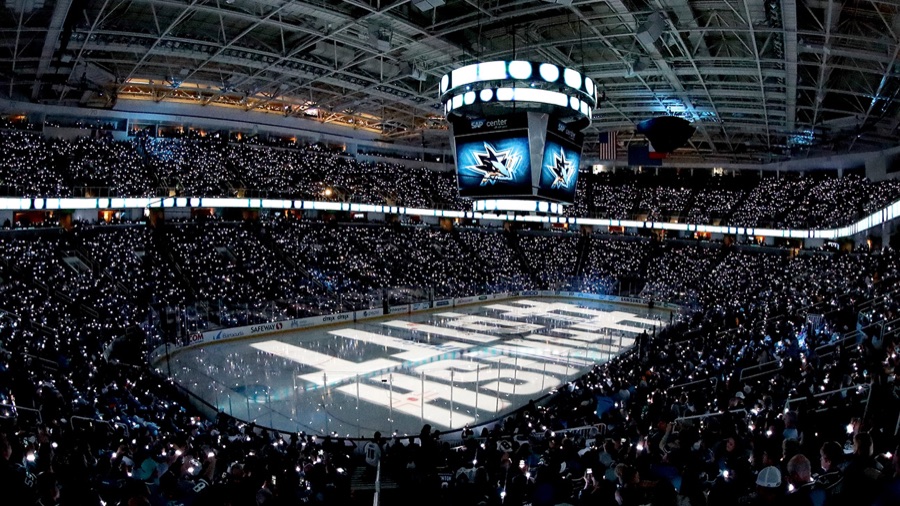
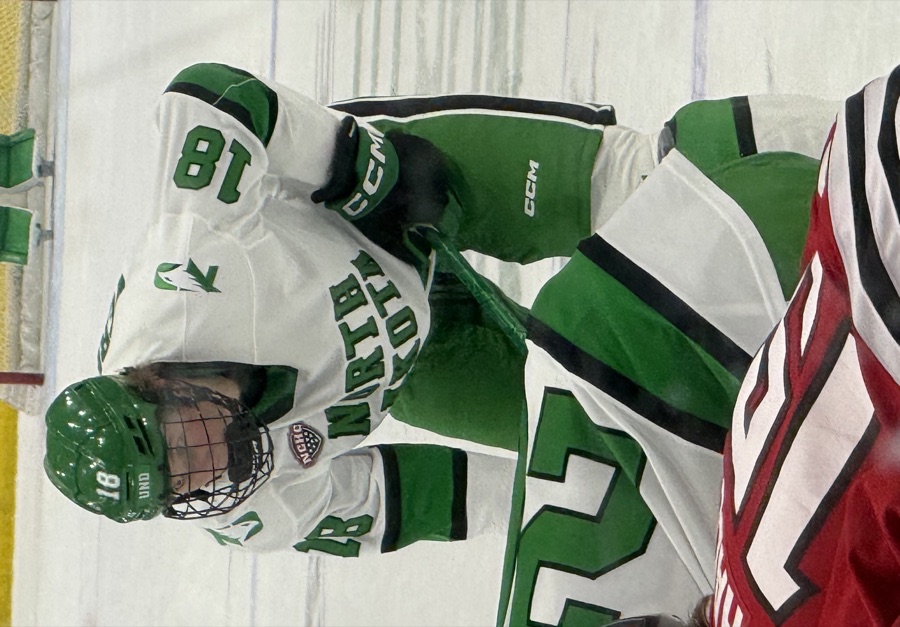
Keaton Verhoeff is at North Dakota. Ryan Lin is at Denver. Joshua Ravensbergen is at Michigan State. Haoxi Wang is at Boston University. Cole McKinney is at Michigan.
All five are San Jose draft picks. All five are on their school's published 2026-27 roster. And none of the five can play in the rookie tournament San Jose is hosting, a six-club event running September 12 to 15 at Tech CU Arena and Sharks Ice in which the Sharks play next Saturday and Sunday, because the rule that decides it is not San Jose's rule.
The sentence that decides it#
College Hockey Inc, the recruiting arm of Division I men's hockey, puts it in one line: "A student-athlete (post enrollment) cannot represent a professional club in any outside competition / games under any circumstances (i.e. a student-athlete cannot participate in NHL Rookie Tournaments.)"
The same document permits nearly everything around it. After enrolling, a player may attend an NHL development camp, a professional camp, a tryout and a practice session run by a professional club, so long as he misses no class to do it. What he may not do at all is dress for that club against another one. The line does not fall between prospect and professional. It falls between a practice and a game.
The control case is on San Jose's own rookie roster. Brady Knowling, the goaltender the Sharks took 127th overall in June, is committed to Boston University and will be at Tech CU Arena next weekend anyway, because he is not enrolled anywhere yet: he plays this season for Saginaw of the Ontario Hockey League and does not reach Boston until 2027-28. A commitment costs a player nothing. Enrollment costs him September.
The five#
| Player | School and class | Arrived from | Drafted |
|---|---|---|---|
| Keaton Verhoeff, D | North Dakota, soph. | Victoria (WHL) | 2026, 9th |
| Ryan Lin, D | Denver, freshman | Vancouver (WHL) | 2026, 21st |
| Haoxi Wang, D | Boston University, fr. | Niagara (OHL) | 2025, 33rd |
| Joshua Ravensbergen, G | Michigan State, fr. | Prince George (WHL) | 2025, 30th |
| Cole McKinney, F | Michigan, soph. | U.S. NTDP | 2025, 53rd |
Every row above was read off the school's own 2026-27 roster page on September 6. A sixth, forward Teddy Mutryn, a third-round pick in 2025, is committed to Boston College and is not on San Jose's rookie roster either. All three defensemen San Jose has drafted inside the top 35 since 2025 are on that list, and so is the goaltender it took at No. 30 in the same stretch.
Four of them were here in July#
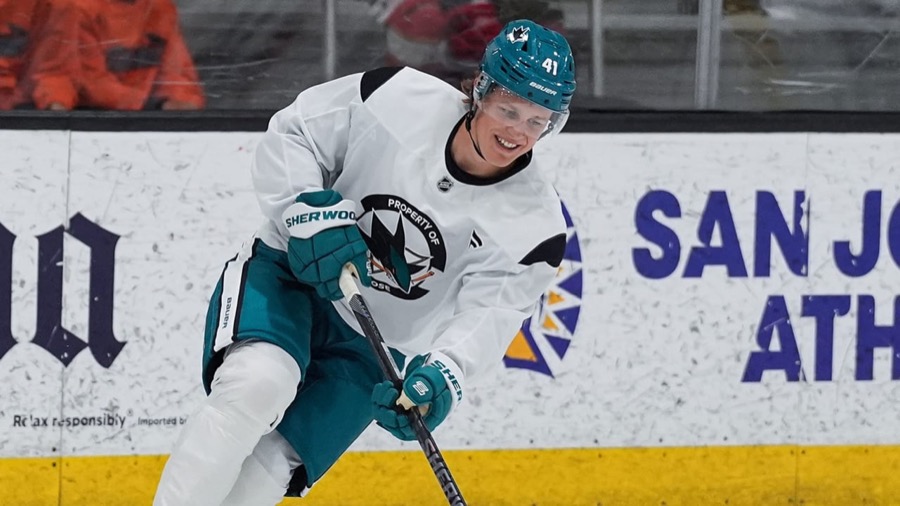
San Jose ran its development camp from June 30 to July 2 at Sharks Ice and finished it with a prospect scrimmage on July 2 at Tech CU Arena, which is the building that hosts the Rookie Faceoff.
Professor Hockey's review of that scrimmage, published the same day, has Verhoeff, Lin, Wang and Ravensbergen all in it, with Verhoeff raw and promising on the thin team and Lin muted but sound in his own zone.
Same rink, same club, ten weeks apart. In July it was San Jose's prospects against each other. In September it is San Jose's prospects against Los Angeles on the Saturday and Utah on the Sunday, and that is the whole difference.
Why it is five this season#
The NCAA Division I Council voted on November 7, 2024 to let players from the three Canadian Hockey League leagues play Division I hockey, effective August 1, 2025. Until then a major-junior player was classified as a professional and could not go to college at all.
Four of the five above came out of major junior: Victoria, Vancouver, Niagara and Prince George. Under the old rule not one of them could have been on a college roster this month. They would have been junior players in September, and junior players go to rookie tournaments.
Which is not a hypothesis, because San Jose has junior players at this one. Jake Gustafson, a sixth-round pick in June, plays for Portland of the WHL and is on the 26-man roster the Sharks announced on September 1. Carson Wetsch, who signed his entry-level contract in May, is on it too.
So the roster shows both halves at once. The junior players are in the building, the college players are not, and a rule change written to open college hockey to the CHL is what moved four Sharks prospects from the first group into the second.
The ceiling on two games#
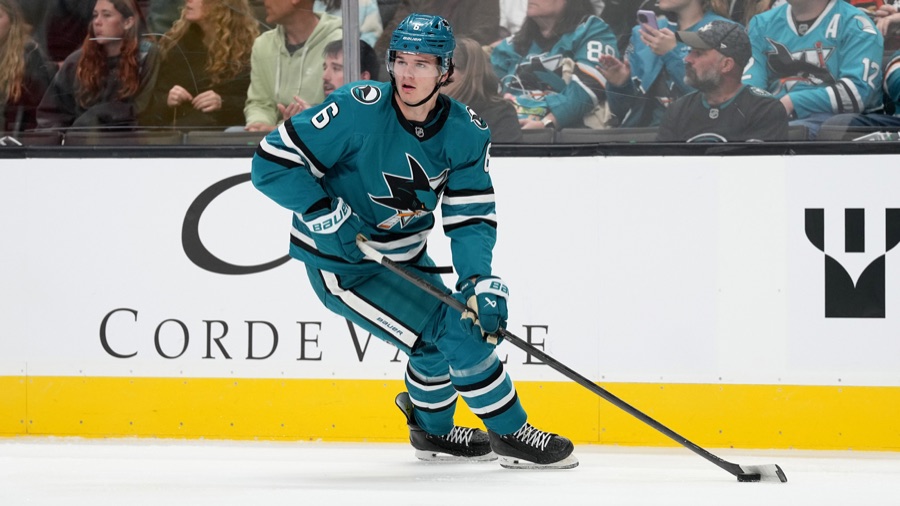
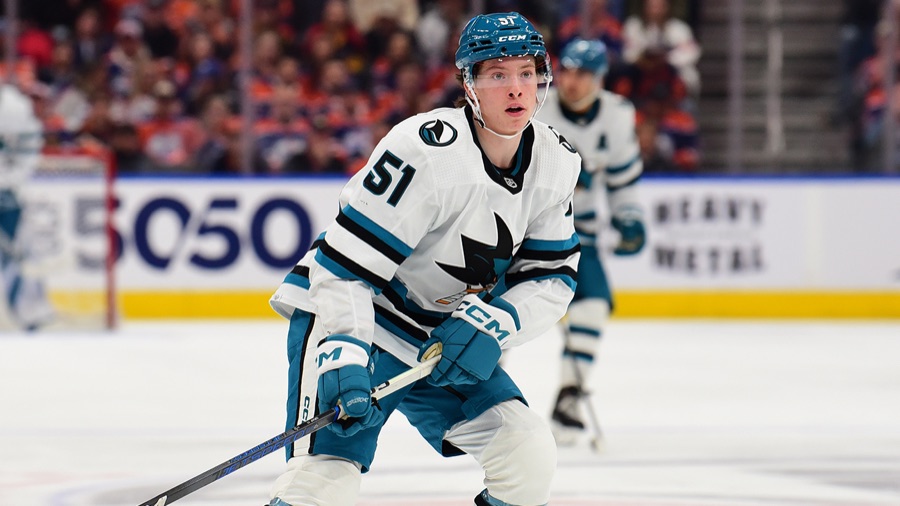
Verhoeff and Lin are both right-shot defensemen, and neither appears in a Sharks sweater against another club until he signs.
The caveat Professor Hockey put on the July scrimmage is the right frame for what they are missing. It was an unserious event, players skating with future teammates after 48 hours together and no real physicality, so no major conclusion followed in either direction. Two September games against other clubs' teenagers are a firmer test and are still two games. Nobody wins a job at Tech CU Arena. What the college rule costs San Jose is smaller than the absence looks, and it is not nothing either: the club finishes this month having watched its two best defense prospects play no minutes at all against outside competition.
Nineteen days#
From the first prospect game on September 12 to the opener against Florida on October 1 is nineteen days, and every roster decision San Jose makes happens inside them.
Two things are worth counting from the men who are there. Eric Pohlkamp, a Hobey Baker finalist on Denver's national title team and entering his first full North American professional season, either takes first-unit power-play minutes in one of the two games or he does not. Cam Lund had 25 points in 37 games before a February injury ended his season, per Curtis Pashelka, and either dresses once or twice. A club that plays a man twice inside 24 hours has stopped worrying about his health.
These five are missing from San Jose's tournament because of nothing the Sharks decided. The NCAA opened college hockey to major junior in 2025, and the same rulebook forbids a college player from playing a game for a professional club. San Jose watches all five this winter on somebody else's rink, in somebody else's sweater, and gets its own look only when they sign.
The Called Shot filed with this one is about the end of that wait, and the case against it is the real one. Professor Hockey read Verhoeff in July as a player whose entry-level contract could come "at the end of his sophomore year," which is this coming spring, and the recent pattern for top-ten college defensemen supports him. Set against that: Pohlkamp, San Jose's last college defenseman, played four years at Denver before signing; the new five-year eligibility model gives a player more runway rather than less; and the Sharks have no opening on the NHL right side while Michael Kesselring and Jacob Trouba are both under contract. The call is that he stays, and it is a lean rather than a conviction.
Sources: College Hockey Inc's eligibility questions, read September 6, 2026, for the rookie-tournament rule and the camp permissions. The published 2026-27 rosters of North Dakota, Denver, Boston University, Michigan State and Michigan, all read September 6. NHL.com, November 7, 2024, for the NCAA Division I Council vote and its August 1, 2025 effective date. Curtis Pashelka, Mercury News, September 1, 2026, for the 26-player roster, the Lund and Pohlkamp notes and the game grid. Professor Hockey, July 2, 2026, for the scrimmage review. Sharks club releases of June 26 and August 17, 2026 for the camp and tournament dates and venues, and the club's Rookie Faceoff release for the September 12 to 15 dates, the six participating clubs, the two rinks and San Jose's two opponents.