Michigan Lost Four Of Five Third-And-Shorts To A Team Averaging 3.3 Yards A Play
Western Michigan ran 67 plays from scrimmage and 66 of them came out of shotgun. It gained 3.3 yards on those snaps and lost nine of its 27 first-down plays to no gain or worse. It still held the ball for 40 minutes and eight seconds, because every time it reached third down needing three yards or fewer it ran, and four of five moved the chains.
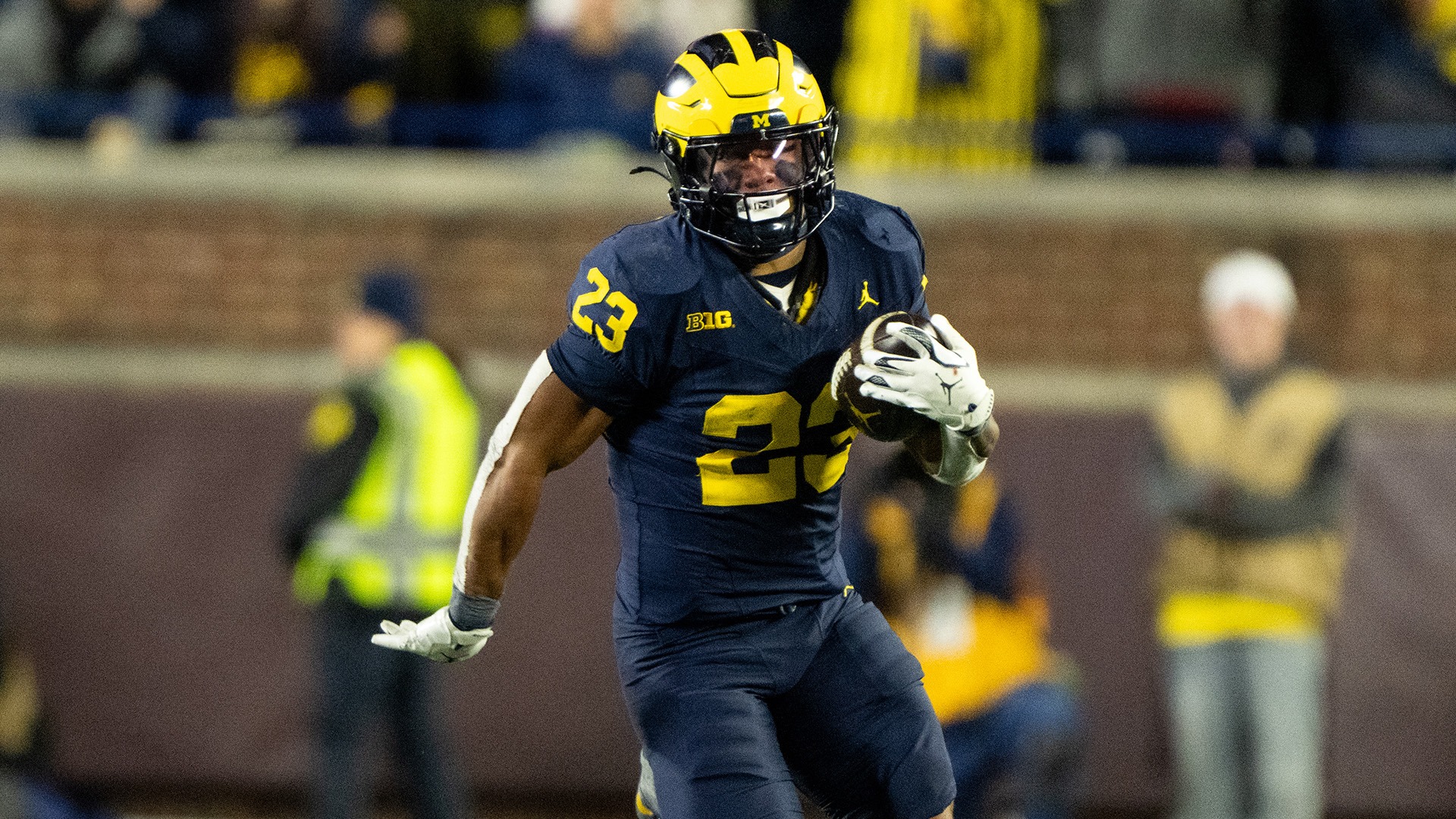
Western Michigan gained 3.3 yards a snap on Saturday night and held the ball for 40 minutes and eight seconds. Those two things do not usually happen to the same team.
The number that reconciles them is five.
Western Michigan reached third down needing three yards or fewer five times. It ran the ball on all five. It converted four. On the other 13 third downs, the ones that needed four yards or more, Michigan allowed four conversions and stopped nine.
That is a defense that was beaten at one down and distance and nowhere else, and the one place it was beaten is the place that decides whether a drive ends. Michigan gave up 12 points on 67 snaps and no touchdowns. It also could not get off the field, and both of those are the same finding read from different ends.
One thing has to sit above all of it. Michigan trailed 12-7 with 35 seconds left and won on the last snap, a 47-yard throw to JJ Buchanan on a down that exists because a replay review put one second back on the clock. Every number below was true while Michigan was losing.
Western Michigan never put a hand under center#
Of the 67 plays Western Michigan ran from scrimmage, 66 are logged out of shotgun in the play-by-play. The single exception is Broc Lowry kneeling down to end the first half.
That is not a spread offense in the sense the formation usually implies. Western Michigan ran the ball on 46 of those 67 snaps, 69%, and it was not good at it: nine of its 27 first-down plays gained nothing or lost yardage, and the offense as a whole averaged 3.3 yards a snap. A team that inefficient on early downs should be punting constantly, and it did punt six times.
What it also did was convert on the down where inefficiency normally kills you.
The quarterback was the short-yardage plan#
Lowry carried 15 times for 35 yards, 2.3 a carry. Jalen Buckley carried 19 times for 62, 3.3. The team managed 132 on 46 attempts. A college rushing line charges a quarterback with the sacks he takes, so Lowry's figure is worse than his designed running was, and it is still not a number that beats anybody. He did not run well on Saturday.
What he did was run at the right moments. Lowry ran on four third downs. Two of them were third-and-1, and both were logged as runs up the middle out of shotgun, and both moved the chains. The third-and-1 that Buckley took, also up the middle out of shotgun, went for exactly the yard it needed.
The reasoning behind that is ordinary football and it is worth saying plainly, because it explains why a bad rushing offense kept converting. A quarterback keeping the ball adds a runner the defense has to account for, which means the blocking has one more man than the front has answers for. Out of shotgun it also gives the runner a head of steam that an under-center sneak does not. It is a numbers play rather than a physical one, and numbers plays do not care that the offense running them averaged 3.3 yards on everything else.
Michigan did not solve it in four quarters. The five short-yardage snaps are a small denominator and nobody should pretend otherwise, but four of five is what happened.
What 13 minutes and 40 seconds is made of#
The drive that swallowed the third quarter is the demonstration. Western Michigan took the ball at its own 8 with 9:05 left in the third and did not give it back until 10:25 remained in the fourth: 20 plays, 71 yards, 13:40 of clock.
Every snap on it came out of shotgun. Two of the third downs on it were third-and-1, and Lowry ran up the middle on both, for three yards and then for five. Take those two plays out and the drive ends inside five minutes with Michigan getting the ball somewhere around midfield instead of at its own 18.
The drive produced three points. Its real output was the clock.
Michigan lined up under center four times, and they were consecutive#
The mirror image of all this sits on Michigan's opening possession.
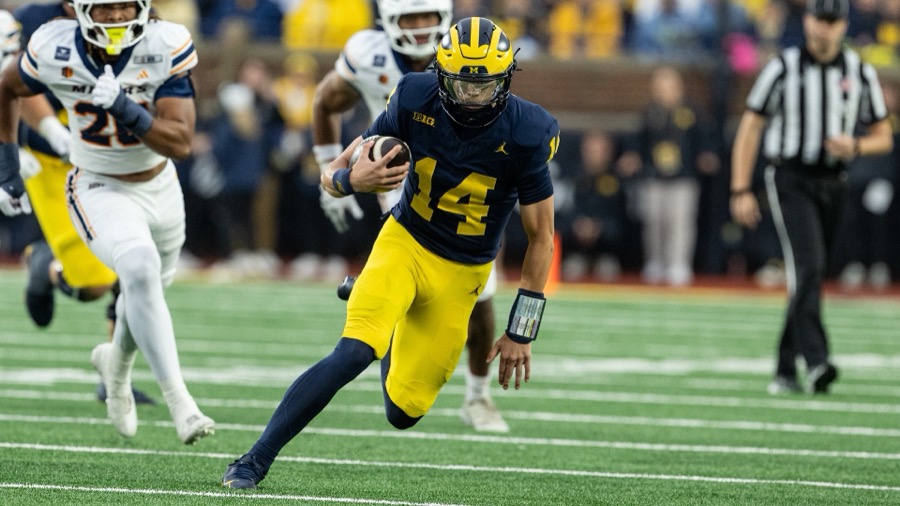
Michigan ran 48 plays from scrimmage and lined up under center on exactly four of them. Those four came in a row: first-and-goal at the Western Michigan 5, second-and-goal at the 4, third-and-goal at the 1, fourth-and-goal at the 1. Jordan Marshall ran the first two, to the 4 and then to the 1. Bryce Underwood ran the second two, stuffed for nothing and then in for the touchdown.
Michigan never lined up under center again. Not on the two possessions it started inside its own 10, not on the fourth-and-goal-style situations it never got back to, not on the drive that won the game.
The formation tags are worth a word on their limits, because a piece leaning this hard on them should say where they come from. They are the play-by-play's own logging, not a charting service and not film study. What makes them credible here is that the exceptions fall exactly where football says they should: Western Michigan's one non-shotgun snap is a kneel-down, and Michigan's four are consecutive goal-line snaps. A tag applied at random does not land that way.
Michigan's offense was the better one, which is not the same as good#
The efficiency comparison runs the other direction from the possession number. Michigan gained 276 yards on 48 snaps, 5.75 a play. Western Michigan gained 221 on 67, 3.30. Michigan gained four yards or more on 13 of its 21 first-down snaps, 62%, against 12 of 27 for Western Michigan, 44%.
An offense that wins first down that decisively and still punts six times is losing somewhere specific, and there are two places.
The first is field position, and the average hides the shape of it. Michigan's 10 possessions started at an average of its own 17. Split by how they began, the four that followed a kickoff averaged the 23, the five that followed a Ryan Millmore punt averaged the 12, and the tenth came at the 20 after a stop on downs. Millmore put Michigan inside its own 10 three times. The best of those five spots, the 27, only exists because a Michigan holding penalty on the return moved the ball back from the 37.
The second is that Michigan went 3 of 10 on third down. An offense starting at its own 12 has to convert three or four times to reach a field goal, and 30% does not do that twice in a row.
The third turnover is a punt#
The box score charges Michigan with three giveaways and a drive chart of Michigan's offensive possessions shows two, the Underwood interception at the 30 and the Underwood fumble at the 31. Both documents are right.
The missing one is Andrew Marsh muffing Millmore's 51-yard punt at Michigan's 28 with 1:28 left in the first quarter, recovered by Braden Steely at the 27. It is a special-teams giveaway, so it lands in the team turnover column and never appears on an offensive drive chart, because Michigan's offense never had the ball.
It is also the only one of the three that cost nothing. Michigan's defense stopped Western Michigan on downs at the 19. The interception and the fumble each produced a field goal, which is six of Western Michigan's 12 points.
What Saturday says about Oklahoma, and what it cannot#
Oklahoma is here at noon on Saturday ranked 10th, and the honest reading of this game for that one is narrow.
The thing that is not narrow is the third-and-short question, because it is the one weakness a better offense will look for first. It rests on five snaps. Five snaps is not a diagnosis. It is a place to look, and if Oklahoma converts on the ground in short yardage in the first quarter, the sample stops being small in the only way that matters.
The thing that probably does not transfer is the possession figure. Western Michigan earned its 40:08 with an offense built to grind and a punter who kept flipping the field. Oklahoma will not average 3.3 yards a snap, and a team that gains more per play generally needs less time to do it.
What Michigan should want from Saturday is simpler than either. It ran 48 plays and out-gained a team that ran 67. It needs to run more of them.
Sources: The official box score of the September 5, 2026 Michigan game, read September 7, 2026 at ESPN and at CBS Sports, for the final score, team plays, net yards, yards per play, rushing lines, third-down conversions, possession time, turnovers and the scoring sequence. CollegeFootballData's play-by-play, drive, game and roster files, read the same day, for formation logging, down and distance, drive starting field position, punt placements and player identification, none of which a box score carries. The two count a team's plays and yards differently, mostly because a box score charges sacks to the rushing column and a play file does not, and where they differ the box score governs here.