Igor Chernyshov and the only real argument in the forward group
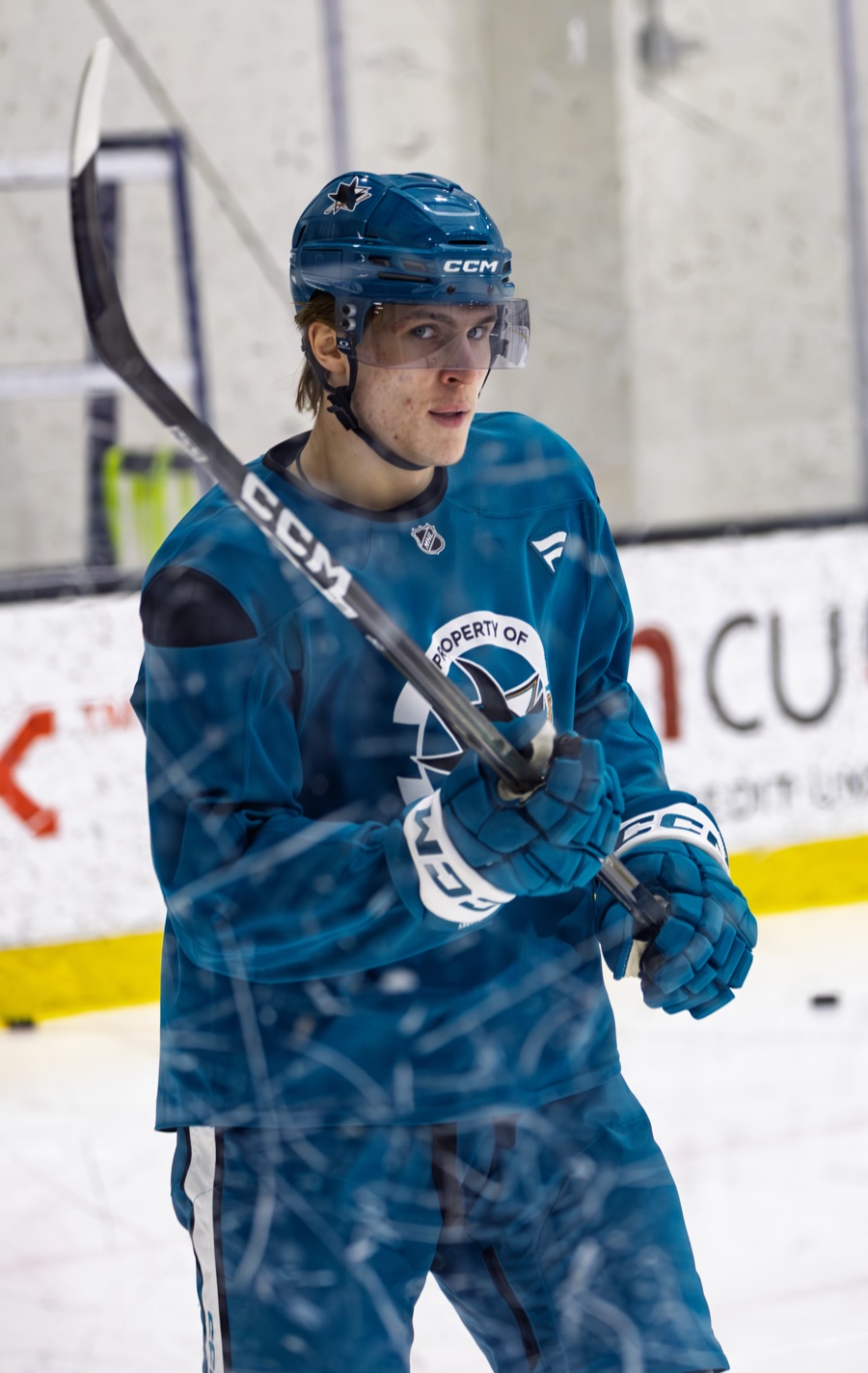
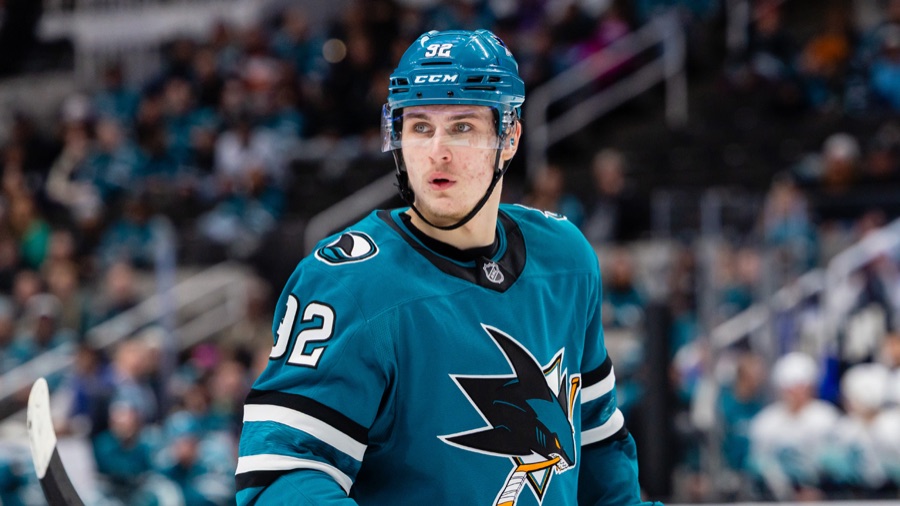
The forward plan had one unresolved call: is Chernyshov ready to open the season on Celebrini's left wing, or does he need the softer second-line spot while Eklund moves up? Here is the lucky part. Unlike Bystedt and Musty, who are pure projection, Chernyshov already auditioned for this exact role. When Smith went down in December, the Sharks put Chernyshov on the top line, and he played 28 NHL games there. We do not have to guess what he would do. We have the tape and the numbers.
The short version: he passed. Start him on the top line in October. But the reason why is more interesting than the verdict, and it tells you exactly what he is and is not.
1. The translation says "useful winger." The NHL sample says "more."#
Run the standard lens first. His résumé below the NHL is real: a point-per-game-plus OHL season in his draft-plus-one (23 games, 19-36-55 with Saginaw), then a Barracuda co-Rookie-of-the-Year year (41 games, 13-20-33, a 0.80 AHL points-per-game). Push that AHL rate through the usual translation and you get a roughly 28-to-30-point NHL baseline, a useful middle-six winger.
Then he went out and blew past it:
| 2025-26 NHL (28 GP, top line) | Chernyshov |
|---|---|
| Goals-Assists-Points | 9-10-19 (0.68 / game) |
| Full-season pace | about 56 points over 82 |
| Ice time / plus-minus | 15:03, plus-2 (on a bad team) |
| Power-play points | 5 (3 goals), net-front |
A 0.68-point-per-game rookie winger at age 20 is a genuinely good result. The gap between the 28-point translation and the 56-point pace is the whole story, and it has a name: Celebrini.
2. Was it real, or was it Celebrini? Both, and that's the point.#
Here is where most people stop and argue. The honest answer is that the production is real and heavily role-dependent, and those are not contradictions:
| Signal | Reading |
|---|---|
| 52% on-ice xGF at 5v5, plus-3 relative to team | He did not drag the line down. Real. |
| 9 goals on 8.12 individual xG (6 on 5.84 at evens) | Finished at expectation, not a fluke. Real. |
| 72.7% offensive-zone starts | Heavily sheltered, the opposite of Dickinson. Role-given. |
| 19.6% shooting | Will regress. The pace comes down. |
So who is he? A finisher, not a driver. He did not carry his own line at 20, he was fed offensive-zone starts and Grade-A net-front looks by a generational center and he buried them. That sounds like a knock. It is not, because the thing a Celebrini line needs is exactly a finisher. Celebrini creates, Smith creates, and the line was crying out for a right-shot trigger to stand at the net front and shoot. Chernyshov is that, and the chemistry was documented all spring. Asking him to be a play-driver on that line is asking him to do the one job the line does not need.
3. So why was this ever an argument?#
Because Eklund is the safer, more proven winger, and the instinct is "put your best players together." That instinct is wrong here, and the reason is the same finisher-versus-driver point. Eklund's value is his play-driving, and play-driving is exactly what the younger second-line center (Misa) needs. Chernyshov's value is Celebrini-specific finishing, which transfers to no other line nearly as well. Put bluntly: Eklund makes Misa better; Chernyshov mostly makes Celebrini's chances go in. You maximize the top six by sending each to where his specific skill is scarcest, which is Chernyshov up, Eklund to Misa. That is the configuration the plan already has, and the 28-game sample is the evidence for it.
The verdict#
The fallback (Eklund up, Chernyshov to the second line) was never really about whether Chernyshov could handle it. He already handled it for 28 games with positive underlying numbers and goals backed by expected goals. It was about optimization, and the optimization answer is to keep him with Celebrini, because that is where his finisher profile is worth the most and where his lack of self-driving offense matters the least. The burden of proof has flipped: he does not have to win the job in camp, he has to lose it.
What to actually watch (the honest caveats), not as a reason to demote him but as a trigger to revisit):
- Shooting regression. 19.6% becomes 12-to-14% over a full year, so expect the points pace to settle from the high-50s into the 40-to-50 range. That is still a very good top-line complement; just do not panic when the goals-per-game dips in November.
- The 82-game grind. 28 games is not a season, and the Barracuda-era consistency questions are fair. If he disappears for three weeks against tougher matchups and harder zone starts, that is the moment to try the Eklund-up swap, not before.
- Can he take a real D-zone draw? He has never had to. A top line over 82 games eats some defensive starts; his 72.7% offensive tilt will not survive a full season, and how he handles the other 27% is the one genuinely untested part of his game.
NHL line and bio from NHL.com (28 GP, 9-10-19, 15:03, born 2005, 6-2/195, shoots R, 33rd overall 2024). Underlying numbers (52% on-ice xGF, plus-3 relative, 72.7% O-zone starts, 8.12 individual xG) from MoneyPuck. AHL and OHL lines from NHL.com season history. Pairs with the forward-lines plan at docs/2026-offseason/2026-06-07_forward-lines-plan_top12-and-deployment.md, which this analysis resolves.