Twelve throws on third-and-short, three sacks: what Jim Harding inherits
Michigan has run 27 times on third down with 3 yards or fewer to go and converted 17. It has thrown 12 times and converted 5, and 3 of those throws ended in sacks. Its offensive line coach now calls the plays, starting Saturday at Oregon.
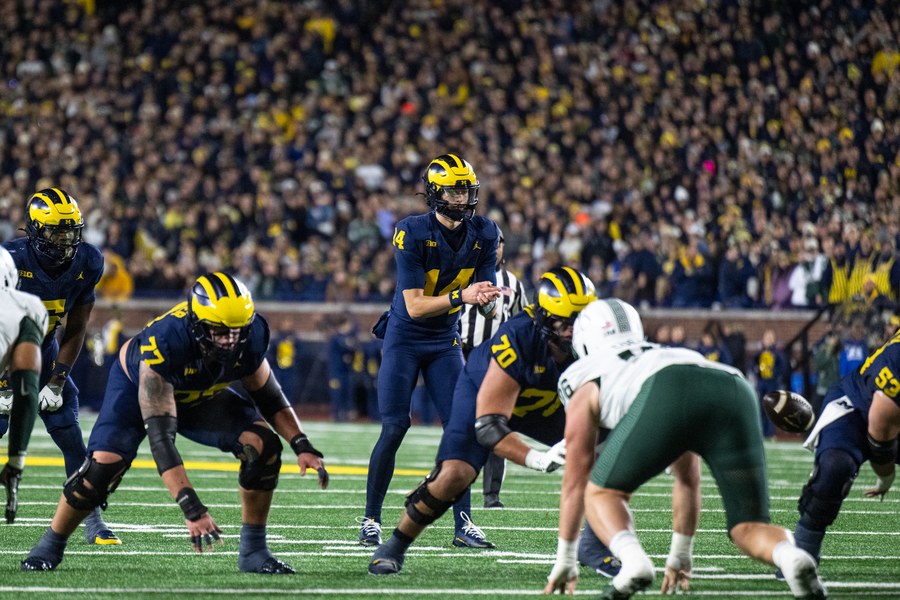
Michigan has faced 39 third downs this season with 3 yards or fewer to go. It ran on 27 of them and converted 17. It threw on 12 and converted 5, and on 3 of those 12 the quarterback was sacked. All three sacks came in one game, the 13-6 loss to Indiana on October 24: on third-and-3 for a loss of 12, on third-and-1 for a loss of 13, and on third-and-3 again for a loss of 5.
Those counts come from CollegeFootballData's play-by-play for Michigan's nine games, with a clock-stopping spike at the end of the UTEP game left out. They are small numbers and they should be read that way. But the gap is the size of a decision, not a rounding error: 63% when Michigan runs on a short third down, 42% when it throws, and a sack on one throw in four.
That is the inheritance Jim Harding takes to Eugene. Michigan fired its offensive coordinator, Jason Beck, on Sunday. "There's just too much regression in the offense in that particular game, and that's what led to the decision," Kyle Whittingham said Monday, per The Detroit News. Harding coaches Michigan's offensive line. Since Sunday he is also its interim offensive coordinator, for the rest of the regular season, per the program's release. Whittingham also said Harding "doesn't have extensive play-calling experience," and added, "But really nobody on the offensive staff has been in that role," per MLive's Andrew Kahn. Play-calling will be collaborative, as it was under Beck, and Mike Lynch, the assistant line coach, will help Harding with the line, MLive reported. Michigan plays at Oregon on Saturday at 12:30 p.m. Pacific.
Why short third downs are the line coach's question#
Whittingham was plain about the limits. "You can't do major changes at this juncture," he said, per MLive. "There'll be a few different wrinkles for sure. But to say there's going to be a complete overhaul, that's not really feasible."
A wrinkle is a small thing. Which play Michigan calls on third-and-2 is exactly that size. It needs no new install. It needs a coordinator who trusts the five men in front of the ball more than the man behind them, and the man calling plays now is the one who coached those five all year.
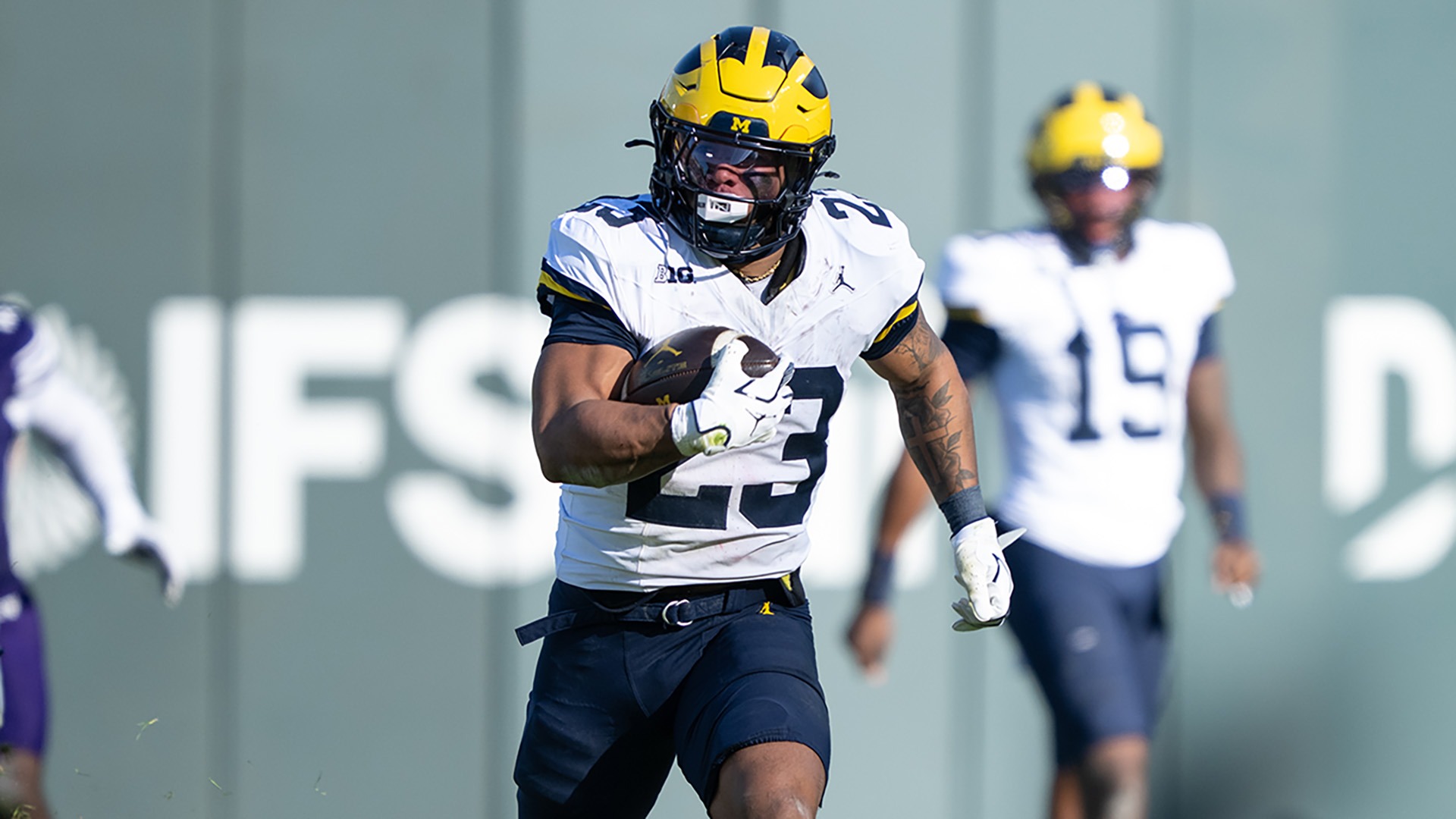
Michigan's own split argues for that trust. The split holds on both sides of the quarterback change. In the first five games, with Bryce Underwood starting, short-yardage runs converted 9 of 13 and throws 1 of 4. In the four games since, which Tommy Carr has started or finished, runs converted 8 of 14 and throws 4 of 8. Neither stretch made throwing on a short third down better than handing off.
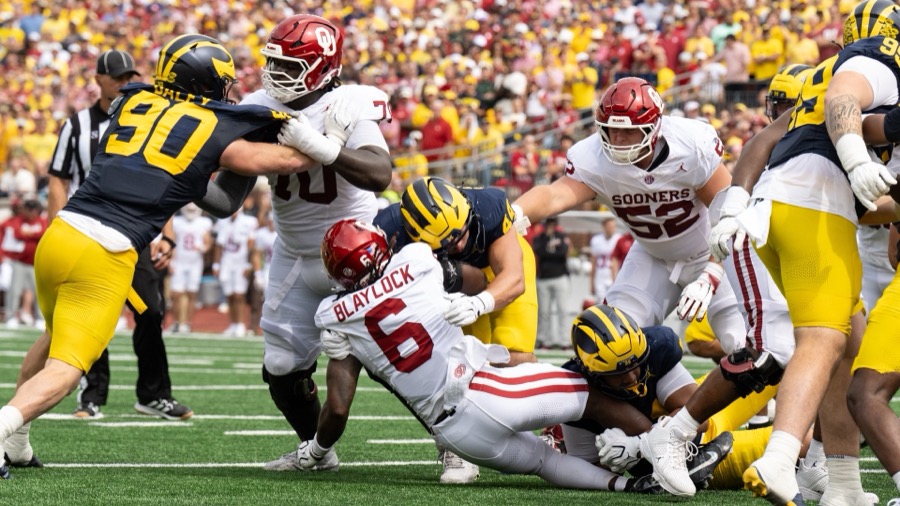
Saturday's loss to Michigan State had two short third downs. On third-and-3 Michigan threw deep right to JJ Buchanan, incomplete. On third-and-1 it ran and lost a yard. Michigan went 2 of 10 on third down that night, per its official box score, and the other eight were 6 yards or longer.
The protection got worse after the quarterback changed#
The second thing the numbers show is the one Harding cannot fix with a play call alone.
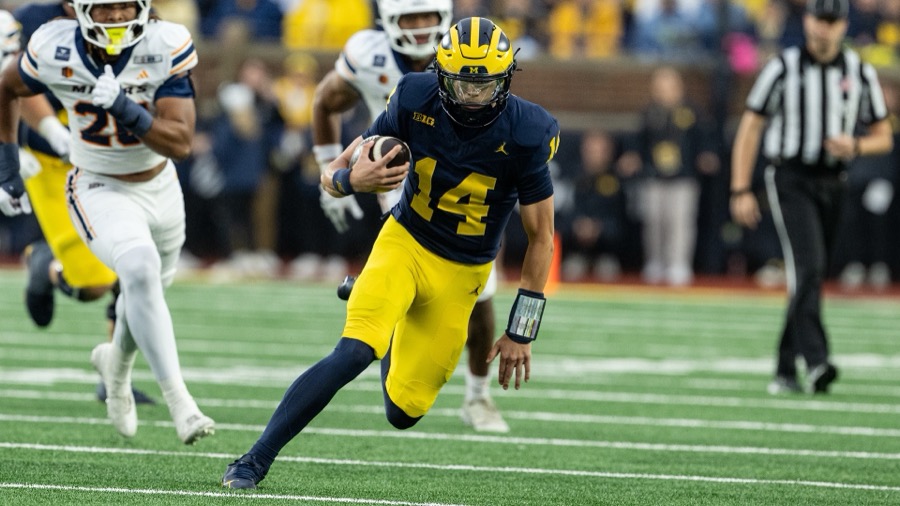
With Underwood throwing, the play-by-play shows 7 sacks on 130 dropbacks, about 1 in 19. With Carr, who replaced him during the October 17 game against Penn State, it shows 11 sacks on 104 dropbacks, about 1 in 9. The play-by-play lists one fewer sack than the season's game statistics do, in the UTEP game. Even if that one was Underwood's, his rate is 1 in 16, and the comparison stands.
Those figures cannot say who is at fault. A sack belongs to a protection, a route that did not come open and a quarterback who held the ball, in proportions no box score separates. Injuries have also moved Michigan's line around: Brady Norton went down at Rutgers and was back at right guard against Michigan State, where Jake Guarnera started at center.
What the play-by-play can separate is the running game, and it moved the same way. On first and second down, kneel-downs left out, Michigan ran 135 times in its first five games and lost ground on 8 of them, 1 in 17. In the four games since, it ran 106 times and lost ground on 10, about 1 in 11. Six of the 10 came in the home losses to Indiana and Michigan State, five of them against Indiana. A run for a loss is the clearest thing a line can do wrong, and it is the thing a line coach sees first on film.
The two trends meet on third down. Michigan has faced 17 third downs of 11 yards or longer this season and converted one, a 16-yard completion against UTEP. A sack or a run for a loss on first or second down is how a drive gets there, and against Michigan State both of them, third-and-19 and third-and-16, followed a sack on second down.
What Oregon brings#
Oregon is 6-3 and won 41-28 at Ohio State on Saturday, per CollegeFootballData. Its defense has at least 2 sacks in each of its last 6 games, by CollegeFootballData's game statistics, which also credit it with 44 tackles for loss. Opponents have converted 43 of 132 third downs against it, 33%, and 43 of 123 with Portland State left out.
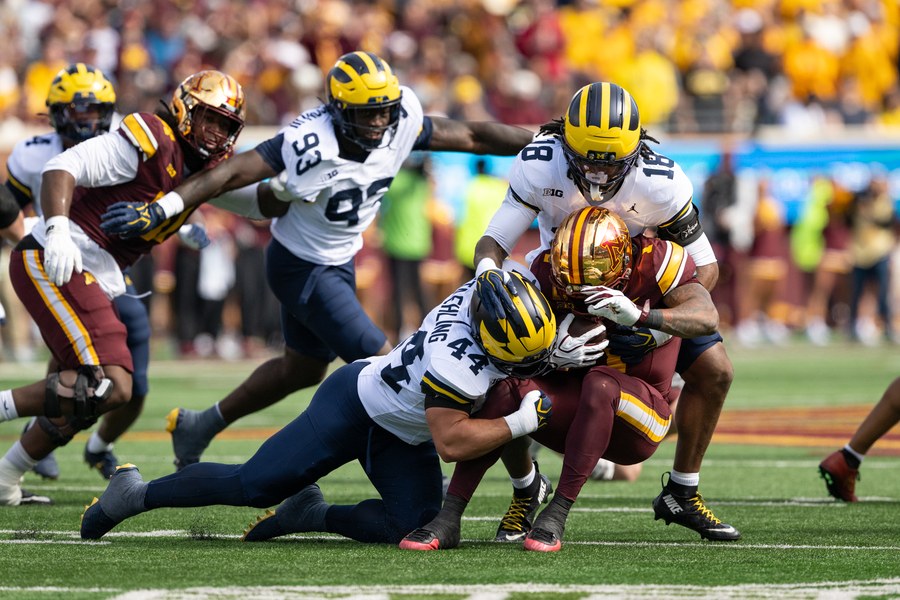
Oregon has also given up yards to good offenses: 554 to Oklahoma State, 456 to Northwestern, 446 to USC and 413 to Ohio State. It is not a defense that shuts everything down. It is one that gets to the quarterback often enough to turn a third-and-4 into a third-and-11, which is where Michigan is 1 of 17.
What one week can and cannot tell us#
Whittingham said Monday that the starting quarterback at Oregon is "to be determined," per SB Nation's Von Lozon, and that Michigan will "take a look at everything again and see what gives us the best chance to win." If Underwood starts, the sack rate is worth watching first, because it is the one number on this list with a clear before and after attached to a quarterback.
The rest is a sample problem. Thirty-nine short third downs over nine games is about four a week. Harding could call a run on every one at Autzen Stadium and convert them all, and it would still be four plays. A good day on short yardage would not prove the old calls were wrong, and a bad one would not prove the new ones are.
What would be real, and visible in one game, is the shape of the calls. If Michigan hands the ball off on third-and-2 at Oregon, the line coach is calling plays like a line coach. If it throws, the change on Sunday was a change of title.
The call: Michigan is sacked three or more times at Oregon. The other side is live. Michigan has allowed two or fewer in 6 of its 9 games, per CollegeFootballData's game statistics, and in its last road game, at Rutgers on October 31, it allowed one.
Sources: CollegeFootballData play-by-play and game team statistics for Michigan's and Oregon's 2026 regular-season games, read November 9, 2026; Michigan Athletics official box score, Michigan State at Michigan, November 7, 2026; Michigan Athletics release, "Whittingham Announces Change to Offensive Coaching Staff," November 8, 2026; Michigan Athletics, "Michigan Monday: Game 10 at No. 18 Oregon," November 9, 2026; MLive (Andrew Kahn), November 9, 2026, via Yahoo Sports; The Detroit News (Angelique S. Chengelis), November 9, 2026, via Yahoo Sports; SB Nation (Von Lozon), November 9, 2026, via Yahoo Sports.