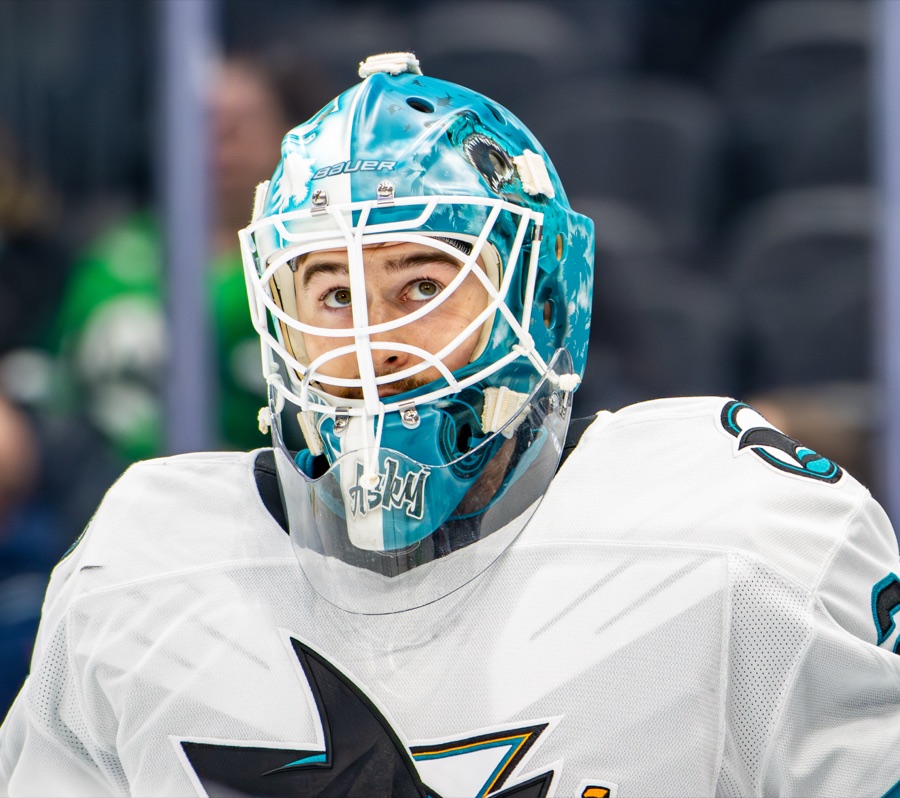
The Sharks cost eight cents to trade. The 49ers cost one.
San Jose's make-the-playoffs contract is sixty bid and sixty-eight ask on Kalshi this morning. San Francisco's is sixty-eight bid and sixty-nine ask. The two numbers answer the same kind of question on the same exchange in the same four minutes, and the gap between them has nothing to do with hockey or football. It tracks how many people are holding the contract, measured across a hundred and sixty-three of them.
Eight cents.
That is what it costs to hold an opinion about the San Jose Sharks this morning and then change your mind. The identical round trip on the San Francisco 49ers costs one cent.
Kalshi quotes San Jose making the 2027 playoffs at sixty bid, sixty-eight ask. It quotes San Francisco making the NFL playoffs at sixty-eight bid, sixty-nine ask. I read both four times between 10:25 and 10:29 a.m. Pacific today and neither quote moved a cent across the four reads.
Three words, because the rest of this is arithmetic sitting on top of them. The bid is the most anybody will currently pay. The ask is the least anybody will currently sell for. You buy at the ask and sell at the bid, so the spread between them is what the venue charges you for the privilege of being in and then being out, and you pay it whether you are right or wrong.
San Jose's spread is eight cents on a contract worth sixty-four at the midpoint. That is 12.5 percent of the position. San Francisco's is one cent on sixty-eight and a half, which is 1.5 percent. Golden State, for a third reading, is forty-six bid and forty-eight ask: two cents, 4.3 percent.
Same exchange. Same question, asked of three Bay Area teams. Eight times the toll on one of them.
The room, not the sport#
Open interest is the count of contracts currently held by somebody. It is published next to every quote and almost nobody looks at it.
San Jose's playoff contract has 1,084 of them outstanding. San Francisco's has 26,263. The whole thirty-two-team NHL playoff board holds 10,304 contracts, and the whole thirty-two-team NFL board holds 1,080,143, which is more than a hundred times as many. Behind the median NHL market on that board stand 140 contracts. Behind the median NFL market, 18,472.
San Jose is not even the quiet end of its own board. It holds more open interest than every NHL club except Chicago. The Sharks contract is one of the two things propping that board up, and the board is still a hundredth the size of the football one beside it.
So I measured it properly rather than asserting it. Every open market on Kalshi's five season-long qualification boards, NFL, NHL, NBA, MLB and the College Football Playoff, read this morning in the same four-minute window. A hundred and sixty-three contracts. For each one, the posted spread against the posted open interest.
What a contract costs to trade, sorted by how many people hold it
All 163 open markets on Kalshi's NFL, NHL, NBA, MLB and College Football Playoff qualification boards, read 2026-09-18 between 10:25 and 10:29 a.m. Pacific. Each bar is the median bid-ask spread of the contracts in that open-interest band. Bar length is scaled to the widest band.
The two thinnest bands sit on top of each other, and the one with less behind it is the tighter of the two, so this is not a clean staircase and I am not going to draw it as one. The break is at ten thousand. Below it the median contract costs three to five cents to trade. Above it, one.
Across all 163 contracts the rank correlation between open interest and spread is minus 0.660, which is a way of saying that if you sorted the list by how many people hold each contract you would have very nearly sorted it by what it costs to trade, backwards. A rank correlation of zero would mean the two have nothing to do with each other and minus one would mean the ordering is exactly reversed.
One weakness sits under that number and it is worth naming, because no other figure here is asked to carry as much. A spread is quoted in cents, and a contract trading at three cents cannot carry an eight-cent one. The College Football Playoff board is fifty-one teams competing for twelve places, which makes its contracts the cheapest in this set by a distance: fifty-one of them sum to 12.09, where thirty-two NHL contracts sum to 16.51. It is also one of the two most heavily held boards here. So fifty-one of the hundred and sixty-three rows are cheap and busy at the same time, and some of what the correlation reads there is arithmetic rather than liquidity. The ordering survives it at the board level, where the two busiest boards are also the two tightest. But the chart below is the stronger leg of this argument, because it watches one board's own contracts get cheaper without changing what they are.
The same board, seven months ago#
The football number is not football being football. Kalshi keeps a daily record of every quote it has ever posted, so the NFL playoff board can be watched growing up.
Kalshi's NFL playoff board taught itself to be cheap before a game was played
Median bid-ask spread across the 32-team KXNFLPLAYOFF board at each day's close, from the exchange's public daily candlestick record at a 1440-minute interval, read this morning. Total open interest across the board is printed beside each date. On 2026-02-15 only 21 of the 32 markets were quoting both sides; every other row has all 32.
Sixteen cents in February. One cent by the first of May, four months before anybody played a down. The board did not get cheap because football arrived. It got cheap because people arrived.
Two readings cut against the simple version and both belong here. The NHL board sits at four cents today on 10,304 contracts, and the NFL board was at eight cents on 14,810, so hockey is being quoted tighter than football was at the same size. Somebody is working that book harder than the raw count deserves. And the NBA playoff board holds 119,519 contracts, nearly twelve times the hockey board, and its median spread is also four cents. All that extra participation bought basketball nothing. Whatever gets a board from four cents to one, it is not open interest by itself.
What the eight cents costs you in the number#
A board like this carries a second charge, and it takes one subtraction to find.
Sixteen NHL teams make the playoffs, so the thirty-two quotes on that board should add up to sixteen dollars. The midpoints come to 16.505. The bids come to 15.77 and the asks to 17.24, which puts the buy side a dollar twenty-four above where the arithmetic says the board should sit and the sell side twenty-three cents below it.
Scale the whole board down until it sums to sixteen and San Jose's sixty-four becomes 62.0. The ask is sixty-eight. You are paying six cents over the number the board's own total implies, which is 9.7 percent of it.
Run the same subtraction on the other two. San Francisco's field-scaled number is 67.4 against an ask of sixty-nine, so 1.6 cents over. Golden State's is 45.2 against forty-eight, 2.8 cents over.
That scaling is a model and I want to be plain about its weakness, because the number above depends on it. Dividing every quote by the same figure assumes the board's excess is spread evenly across thirty-two contracts, and on binary markets it usually is not, because longshots normally carry more of it than favourites. That correction would move San Jose's fair number up and shrink the six cents. The part that survives with no model at all is the posted board. You pay sixty-eight. You can sell at sixty. Nobody has to agree with my arithmetic for those two numbers to be what they are.
The case against all of this#
A spread is a cost, not a swindle. Nobody is hiding it, it is printed beside the price, and it is the fee for somebody standing ready to take the other side of a hockey opinion in September when almost nobody wants one. Thin books are thin because the room is empty, and an empty room is an unpaid job.
The stronger argument is the one that inverts the whole piece. If somebody actually knows something about the Sharks, the empty room is where that edge would live. A board with 1,084 contracts on a team is not a board that has thought hard about that team, and eight cents of transaction cost is cheap against a number that is wrong by fifteen. Every one of these figures says the NHL board is expensive to trade. None of them says it is inaccurate. Those are different claims and only the first one is measured here.
And the compression is real and is already happening. San Jose's board was quoting a 7.5-cent median on September 1 with 3,603 contracts on it. Seventeen days later that same daily record has it at four cents on 10,270; the live pull this morning read 10,304. The first preseason game is Sunday at Anaheim and the regular season opens October 1 at home against Florida.
No position, and the number I would want#
I am not filing a bet on the Sharks, because I have measured an instrument rather than formed an opinion about a hockey team, and turning the first into the second requires a playoff model I do not have.
The reading habit is the useful output, and it costs nothing. Before you take any futures number, look at the two figures nobody puts in the headline: the spread, and the open interest behind it. If the contract is held by fewer than ten thousand people, assume three to five cents of toll and price your entry accordingly. On this specific board that means the sixty-eight is the wrong end of it. A resting order at sixty-two or better is the same opinion at the board's own implied price, and if it never fills, the eight cents told you something true about how badly the market wanted your business.
The call, and what would break it#
On 2026-11-20 the median bid-ask spread across all open markets in Kalshi's KXNHLPLAYOFF series will be two cents or tighter. Today it is four cents across thirty-two open markets. By that date San Jose will have played roughly seven weeks of a real season and the board will have had every reason to fill up. It grades off one pull of the exchange's public market data and a stranger can compute the median in a single line.
What would make this wrong, and the argument is decent. Hockey is a small betting market and Kalshi's customers skew to football and to elections, so the NHL board may be a courtesy rather than a business, and a four-cent quote that nobody ever lifts can sit at four cents forever. The basketball board is the evidence for that reading and it is the reason I am not shorter on this. Nearly twelve times the open interest, and the same four cents. If participation alone were enough, the NBA board would already be at one, and it is not.
The half I am least sure of sits underneath both charts. Every figure above measures what a contract costs to trade, and I have leaned on it as a proxy for how hard the market has thought about the team. Those two things travel together most of the time. Where they come apart, a cheap board is a lazy board and a costly one is a careful one, and the whole reading runs backwards.
San Jose's make-the-playoffs contract is sixty bid and sixty-eight ask on Kalshi; San Francisco's is sixty-eight bid and sixty-nine ask. That is 12.5 percent of the position against 1.5 percent, for the same kind of opinion on the same exchange in the same four minutes. The NHL playoff board holds 10,304 contracts and the NFL board holds 1,080,143. Across 163 contracts on five boards the rank correlation between open interest and spread is minus 0.660, and the NFL board itself went from sixteen cents to one between February and May as its open interest went from 2,830 to 98,538, four months before a game was played. Scaled to a board that sums to sixteen, San Jose's fair number is 62.0 and the ask is sixty-eight. None of this says the Sharks are mispriced; it says the Sharks are expensive to trade, which is a different sentence. Before you take a futures number, read the spread and the open interest under it. Nothing here is advice. It is a public record of calls made at stated prices, and every figure in it can be re-pulled by anyone who wants to check me.
Prices, spreads and open interest from Kalshi's public market data, read 2026-09-18 between 10:25 and 10:29 a.m. Pacific across four separate pulls: the KXNHLPLAYOFF, KXNFLPLAYOFF, KXNBAPLAYOFF, KXMLBPLAYOFFS and KXNCAAFPLAYOFF qualification boards, each taken as the live bid and ask rather than the last trade. The San Jose, San Francisco and Golden State quotes were identical in all four pulls. Board histories from the same exchange's public daily candlestick record at a 1440-minute interval, reduced to each day's closing bid and closing ask, with days of zero open interest dropped. The rank correlation is Spearman's, computed over all 163 open markets on those five boards. San Jose's preseason opener at Anaheim on September 20 and the regular-season opener against Florida at SAP Center on October 1 are from the NHL's published club schedule.
Betting content is for readers 21 and over. If gambling stops being entertainment, the National Problem Gambling Helpline is 1-800-522-4700, free, confidential, and answered 24 hours a day.