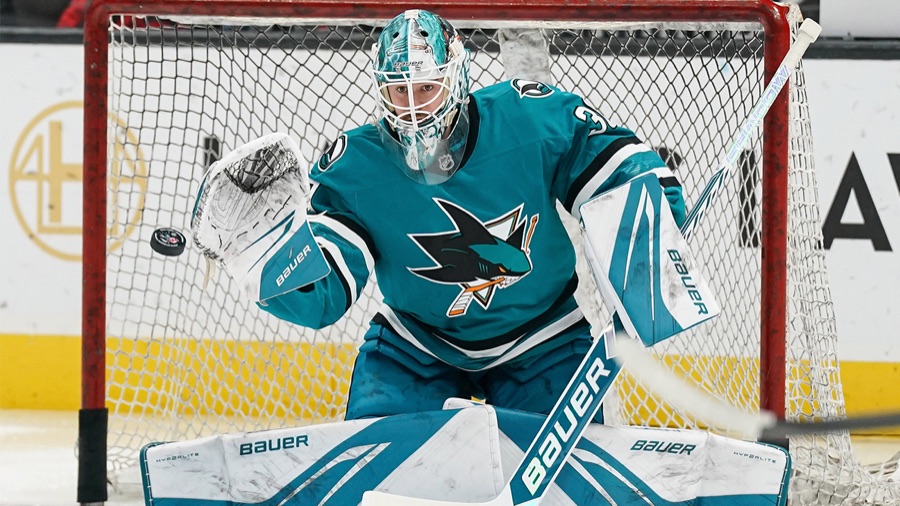
The Askarov verdict: is he actually the franchise goalie?
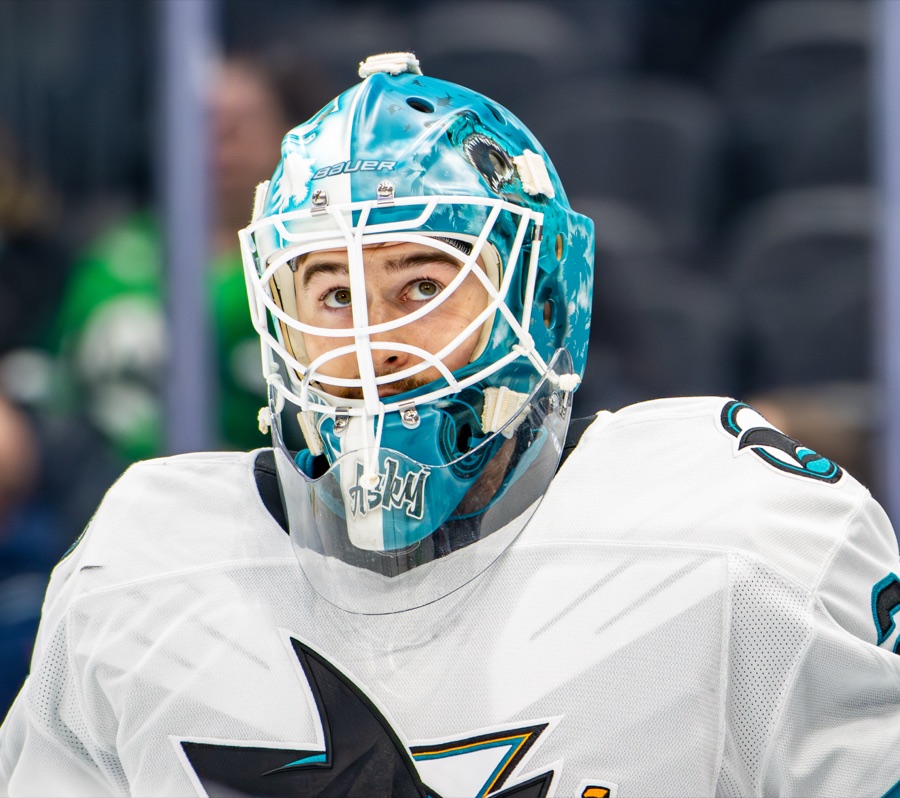
Every analysis we have run this month ended at the same door. The value board said the skaters are fine and the season swings on the crease. The contention clock said the Star Goalie slot is the highest-variance bet on the board. The 2026-27 projection said the entire 89-to-97-point band is one man. So let us finally open the door and look at Yaroslav Askarov directly, with the expected-goals data, a same-team control test, and the career-stage comps, and give a verdict instead of a shrug.
1. The raw indictment#
The headline line is bad and there is no way to dress it up: 47 games, .883 save percentage, 3.63 goals-against average, 21-20-4, zero shutouts. By MoneyPuck's expected-goals model he faced 138.1 expected goals across all situations and allowed 157, a Goals Saved Above Expected of minus-18.9. Nineteen goals worse than an average goalie on the same shot diet, in 47 starts, is not a rounding error. It is roughly six standings points, which on an 86-point team that missed the second wild card by a handful is, well, the season.
2. The "bad team in front of him" excuse, tested and mostly executed#
The obvious defense is that the Sharks allowed the third-most goals in hockey and played bottom-third defense, so of course the kid's numbers are ugly. Here is the control test: Alex Nedeljkovic stood behind the exact same defense for 40 games and posted a minus-1.2 GSAx, dead league-average, with a .896. Same blue line, same system, same penalty kill, thirteen points of save percentage and seventeen-plus goals of difference. The bad team explains the workload. It does not explain the gap between the two men sharing the crease. One more exoneration worth logging while we are here: on the penalty kill Askarov allowed 31 goals against 31.5 expected, exactly at expectation, which confirms what the PK autopsy found, the 28th-ranked kill was the skaters' fault, not his.
3. The autopsy: he robs banks, then loses the money on the walk home#
Now the part that changes the conversation. Split his 157 goals against by chance quality and the minus-18.9 stops being one number and becomes three very different ones:
| Danger tier | Shots / xGA / GA | GSAx | Reading |
|---|---|---|---|
| High danger | 149 / 48.8 / 36 | +12.8 | Elite. A .758 on the hardest chances in hockey. |
| Medium danger | 372 / 45.5 / 54 | -8.6 | Below NHL average, bottom-quarter territory. |
| Low danger | 1,467 / 43.9 / 67 | -23.1 | The catastrophe. Sixty-seven goals on the softest shots there are. |
Read that top row again. On breakaways, slot one-timers, and rebounds, the chances that actually decide playoff games, Askarov was thirteen goals better than expected, which is franchise-goalie material, full stop. Then he handed back thirty-two goals on shots from the parking lot. This is precisely the pattern Professor Hockey flagged in May (high-danger fine, medium bottom-25 percent, low-danger bottom-12 percent), and now we have the goal-level decomposition to put weights on it. The man does not have a talent problem. He has a focus problem. Those are different diseases with different prognoses, and the second one is the one coaches believe is treatable, because athleticism cannot be taught and attention can.
4. The comps: he is behind the franchise-goalie track, honestly behind it#
Where were the goalies we want him to become at the same career stage? Treat these as career-stage launch points rather than exact lines:
| Goalie, same stage | Launch point | What happened next |
|---|---|---|
| Hellebuyck, age 23 | about .907 as a young starter | Leapt to .924 and a Vezina finalist year at 24 |
| Wolf, age 23 | about .910, Calder runner-up | Arrived ahead of schedule |
| Swayman, age 24 | about .920 in a tandem | Never had a bad early season to outgrow |
| Askarov, age 23 | .883, minus-19 GSAx | To be determined |
The honest read: he is 25-to-35 points of save percentage behind where the modern franchise goalies launched from. The hope cases are real, goalies are voodoo and late bloomers exist (Hellebuyck added 17 points of save percentage in one summer, Demko went from ordinary at 24 to a Vezina finalist, Bobrovsky was traded at 24 and won two Vezinas), but every one of those hope cases launched from .905-or-so, not .883. The cautionary comp nobody wants to say out loud is Carter Hart's age-22 .877, the season that looked like variance and turned out to be the profile. The thing that separates Askarov from the cautionary pile is the high-danger row above, and the fact that we watched the ceiling happen: a November where he was, per Professor Hockey, the best goalie in the NHL for a month (9-5-1, nightly 35-of-36 performances carrying a wild-card climb), and a 5-1-0, .915 finish over his last six starts. The ceiling is not theoretical. It has dates.
The verdict#
No, he is not the franchise goalie yet, and anyone telling you the crease is solved is selling something. But the question is no longer "is he good enough," it is "can he stop donating soft goals," and that is a narrower, more answerable, more fixable question than the raw .883 suggests.
A true franchise goalie steals you games. Askarov currently steals you the hardest saves in hockey and then gives the game back from fifty feet. The good news is the asymmetry: the part he is bad at is the part that gets fixed (focus, structure, lapse prevention), and the part that cannot be taught (elite response to elite chances) he already has. If the low and medium-danger numbers merely normalize to league average, the high-danger excellence is still sitting there and the whole profile flips to a top-ten goalie. That is a real path, not a prayer. It is just not a promise.
And the calendar forces the answer, which is the best part. He is an RFA in July 2027, so 2026-27 is the audition year with the contract decision waiting at the end of it, exactly one season of evidence before the Sharks have to price him. The repo's own trigger still stands: if he is sub-.890 at U.S. Thanksgiving, you go get a veteran starter at the deadline and stop pretending. And behind him sits the second lottery ticket, Ravensbergen, the system's No. 1 prospect, on a timeline that arrives right as Askarov's second contract would be maturing. The Sharks do not need to believe in Askarov. They need one of two tickets to hit, and they get to watch this one cash or bounce on a one-year clock.
What to watch in 2026-27, in order: the low-danger and medium-danger save percentages (the entire fix lives there), whether the November-type heaters get longer and the lapse stretches get shorter, and the .890 Thanksgiving line. Ignore his goals-against average all year; in front of this defense it will lie in both directions.
GSAx and danger-tier decomposition: MoneyPuck 2025-26 goalie data, all situations (xGA 138.1 / GA 157; HD 149 shots, 48.8 xGA, 36 GA; MD 372/45.5/54; LD 1,467 unblocked attempts/43.9/67), pulled June 10. Note GSAx is model-specific; Evolving-Hockey's figure would differ slightly in magnitude, not direction. Raw line (47 GP, .883, 3.63) verified against state/counting_stats.md; the danger-zone pattern independently matches the Professor Hockey May 23 percentile breakdown filed there. Comps are career-stage approximations, not exact lines. November and final-six stretches per the season summary. Contract timing and the Thanksgiving trigger per docs/offseason-outline.md; Ravensbergen ticket-two framing per docs/Sharks_contention-clock_Cup-Checklist-gap-analysis.md.