Are the 2026-27 Sharks actually a playoff team? The number, and the honest yes/no
Every roster plan I have written keeps using the phrase "playoff-fringe," and a phrase is not a projection. So let me stop hand-waving and put a number on it: model the points, find the bar, and answer the question with a yes or a no instead of a vibe.
The honest starting point#
2025-26: 39-35-8, 86 points, 5th in the Pacific, minus-41 goal differential. That was a 34-point leap and the best season since the 2019 Western Conference Final team, so the trajectory is real. But read the differential, not the feel-good story. The Sharks scored a respectable 249 goals and allowed 290 (3.54 a game, third-worst in the league). An 86-point team with a minus-41 differential is exactly what it looks like: a team that was fun, young, and clearly not yet good enough. They held a wild-card spot in December and then went 2-9 after the deadline, which is the whole point, a roster this thin gets exposed over a long season.
The model: differential in, points out#
You do not project a team by adding up vibes; you project the goals for and against and convert the differential to points (roughly three goals of differential per standings point). Here is the build:
| Input | 2025-26 | 2026-27 projection | Why |
|---|---|---|---|
| Goals for | 249 | ~255 | Young core grows (Smith, Misa, Chernyshov full year), Carlson helps the PP; lose some Klingberg offense. Roughly flat-to-up. |
| Goals against | 290 | ~272 | Carlson over Klingberg, Kesselring, Desharnais re-signed, Dickinson takes a step. A real but modest fix; still no true No. 1, and the kill loses Ferraro. |
| Differential | -41 | ~-17 | A 24-goal swing, almost all of it on the defensive side. |
| Points | 86 | ~93-94 | 86 plus about 8 points from the differential improvement. |
So the central projection is roughly 93 to 94 points. But the honest version of any projection is a range, and this range has one enormous lever inside it.
If Askarov takes a real step and is a genuine top-15 starter over a full season, goals-against can fall toward 262, the differential pushes to about minus-7, and this becomes a 97-point team that makes it. If he is a league-average starter and the defense improves only at the margins, goals-against stays near 282, the differential sits around minus-27, and this is an 89-point team that misses. Same skaters, same plan, eight points of swing, one goaltender. The crease decides the season, which is the same conclusion the contention-clock work reached from the other direction.
The bar, and the teams in the way#
A Western Conference second wild card typically lands around 94 to 96 points. Put the projection next to the bar and the Sharks land right on the line, a point or two short of the midpoint. And the bar is not holding still, the Pacific got tougher under them, not weaker:
- Above them, likely out of reach: Vegas (a Cup-tier roster), and the established Edmonton and Los Angeles playoff teams. The Sharks are not catching that group in one summer.
- The team that just passed them: Anaheim, which rose into a second-round team last spring. Worth noting the plan actually weakens them slightly, since the Carlson the Sharks want to sign is Anaheim's.
- The actual fight: the bubble scrum with Seattle, Calgary, Utah, and Vancouver for the final spot, plus the Central teams who also feed the two wild cards. The Sharks do not have to pass the whole conference. They have to pass one or two of the teams directly around them and hold off the risers, which is a real but narrow ask.
(Honest caveat: I am anchoring on the Sharks' own verified finish, 86 points and 5th in the Pacific, and the historical wild-card bar, rather than inventing exact point totals for the other Pacific teams that I cannot verify. The landscape reads above are directional, from where teams drafted and finished, not a fabricated standings table.)
The risks that could pull the number down#
- The offense is dangerously Celebrini-dependent. He produced 46 percent of the scoring and the gap to the second-leading scorer was 56 points. A Celebrini injury or even a normal regression from a 115-point outlier season, and the 255-goal projection craters. The young core has to diversify the offense, not just inherit it.
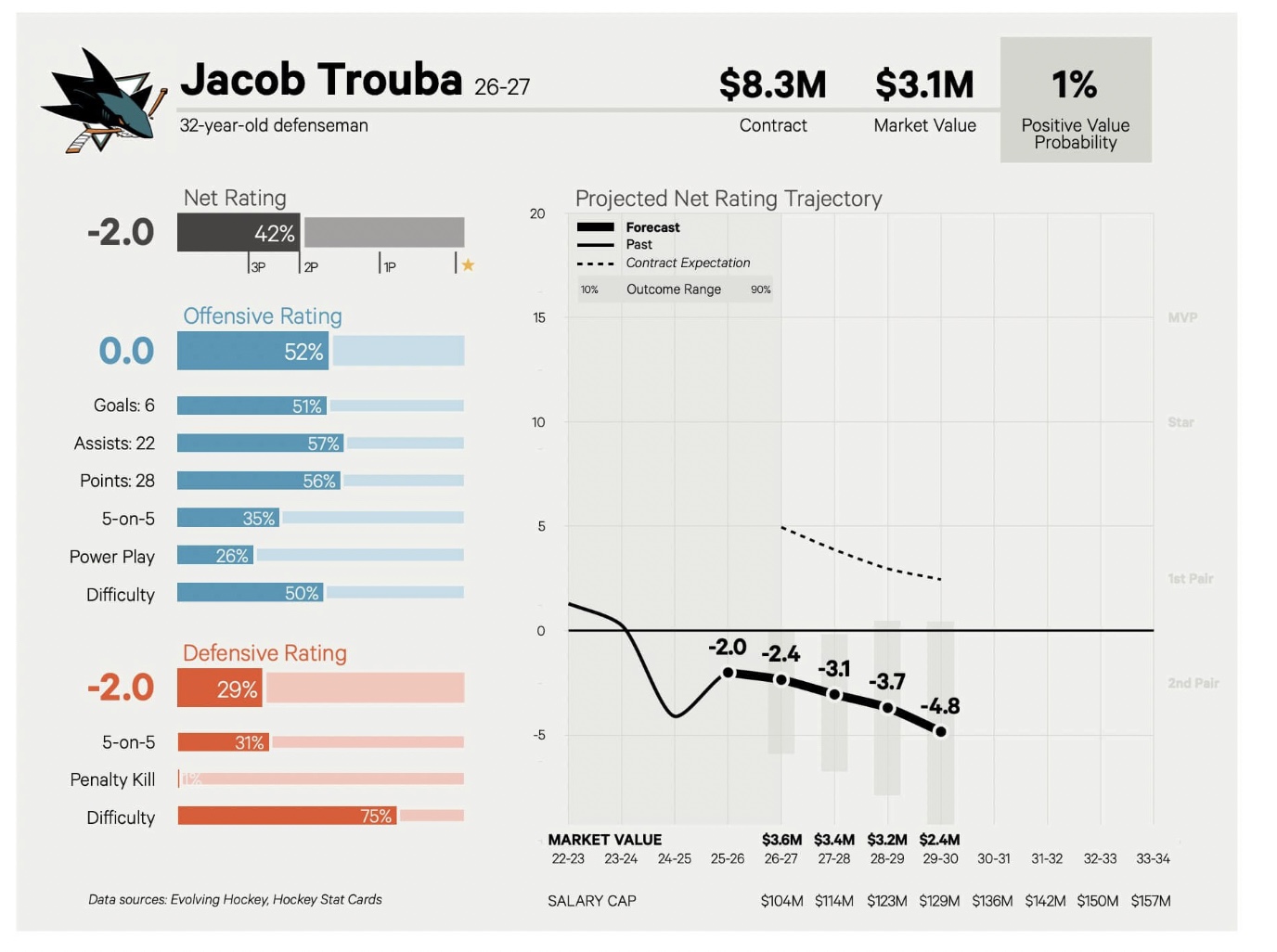
- The defense fix is modest, not transformational. The plan upgrades the blue line, but it does not add a true number-one, and it loses Ferraro's 268 penalty-kill minutes off a unit that already ranked 28th. The 272 goals-against projection assumes the kill does not crater.
- The post-deadline collapse is a feature of thin teams, not a fluke. They were in a playoff spot in December and faded. A deeper roster fades less, but this is still a roster that will lean hard on a 20-year-old core over 82 games.
The answer: a number and a yes/no#
Projection: about 93 points. Verdict: not quite, but it is a coin flip, and the coin is Askarov.
"Playoff-fringe" turns out to be the exactly correct label, not a hedge. The Sharks project as a genuine bubble team that, in a typical Western Conference, misses by a point or two more often than it makes it. The skaters are essentially a playoff-caliber group already; the difference between watching the playoffs and playing in them is the crease. If Askarov is a top-15 goalie, they are in. If he is average, they are the first team out, in the building on the final weekend with their season on the line. So the honest answer to "are they a playoff team" is: no, most likely, by the smallest of margins, and yes the moment Askarov proves he is the real thing. Which is a wonderful problem to have, because it means the roster is finally good enough that the only thing standing between this team and January-meaningful hockey is the one position you were always going to have to bet on anyway.
Baseline (86 points, 39-35-8, 249 GF / 290 GA, 5th Pacific) from docs/Sharks_2025-26_Season_Summary.md. Projection uses a goal-differential-to-points conversion (about three goals per point) applied to a modeled 2026-27 goals for and against, with the planned roster (blue-line and forward plans). The Askarov-driven band and the Celebrini-dependency are the two largest sources of variance. Wild-card bar is the historical Western second-wild-card range, not a projection of specific rival point totals.