The Giants calls that carried a price hit 11 of 20. The prices expected 9.4.
Sixty-six Giants calls were graded in 2026 and 38 held up. Only the last twenty came with a price attached, and the gap between those prices and the results comes from one kind of call.

How good were the Giants calls on the Called Shots ledger this season? The count is easy. Sixty-eight rows on the Giants ledger have resolved. Thirty-eight were right, 28 were wrong, and 2 were voided on their own terms. That is 38 of 66 graded calls, or 58 percent.
That number answers almost nothing. A forecaster who only calls things that are nearly certain will hit 90 percent and know nothing. One who only calls long shots will hit 30 percent and might be the sharpest person in the room. A hit rate means something only next to the odds the calls were made at.
On this ledger, those odds exist for twenty of the sixty-six.
The record, by byline#
| Byline | Right | Wrong | Void | Still open |
|---|---|---|---|---|
| Grant Lombard | 25 | 21 | 2 | 14 |
| Andie Townsend | 8 | 4 | 0 | 6 |
| Jamie Silva | 5 | 2 | 0 | 0 |
| Casey Montgomery | 0 | 1 | 0 | 2 |
| Posey Thompson | 0 | 0 | 0 | 1 |
| House | 0 | 0 | 0 | 1 |
| Total | 38 | 28 | 2 | 24 |
A 95 percent interval around 38 of 66 runs from about 46 percent to about 69 percent. The rows cannot be compared with each other as rates, because the calls behind them were made at different odds, and for 46 of the graded calls no odds were written down at all.
The twenty with a price#
Every call made from September 2 onward carries the writer's own price in American odds. A price of +150 means the writer thought the call would land about 40 percent of the time. A price of -150 means about 60 percent. Add up those implied probabilities across a set of calls and you get the number of hits the writer expected.
Twenty priced Giants calls have been graded. The prices expected 9.4 hits. There were 11.
Split by side of even money, the picture separates cleanly.
The Giants favorites hit every time. The long prices hit about as often as they said they would.
Share of graded Giants calls that held up, by the writer's own price, against the share those prices implied. Calls dated September 2 through September 25, 2026; graded rows only.
Read each bar against the implied share written under its label. The fifteen plus-money calls expected 6.4 hits and got 6, which is as close to on the number as fifteen coin flips of different weights can get. All of the gap sits in the top bar. Five calls priced between -140 and -170 expected 3.0 hits and got 5.
If those five prices were exactly right, all five landing would happen about 8 percent of the time. That is unusual. It is not rare enough to conclude anything from five calls. Across all twenty, a result of 11 or more hits would happen about 31 percent of the time if every price were correct. The spread on that expectation is about 2.2 hits, and 11 sits less than one spread above 9.4.
So the numbers say the priced calls were consistent with calibrated, with a lean toward the favorites being priced too long. In units, where a hit pays at its own odds and a miss costs one, the twenty came out 2.2 units ahead. The favorites made 3.3 of that. The long prices lost 1.1.
The desk also prices every call blind, without seeing the writer's number. Fifteen of the twenty carry a clean desk price. On those fifteen, the desk's prices expected 7.4 hits, the writers' expected 7.3, and there were 9. By Brier score, a standard measure of forecast error where a coin flip scores 0.25 and lower is better, the desk scored 0.197 and the writers 0.212. Fifteen calls cannot separate those two.
The house line, a third price set blind by a handicapper, exists on two graded Giants calls. Both hit. Two is not a sample.
One night, four rows#
On September 21, San Francisco beat Minnesota 5-2 at Oracle Park, and the lineup card settled four rows at once.
That day the club placed Jung Hoo Lee on the injured list with a groin contusion and selected the contract of Bo Davidson from Triple-A Sacramento. Davidson started in right field, batted third, and went 1-for-4 with a stolen base in his debut. Marcelo Mayer came off the injured list the same day and started at designated hitter, batting fourth, 0-for-4.
The four rows:
- Davidson does not appear in a major league game in 2026 (made August 15). Wrong.
- San Francisco selects Davidson's contract by season's end (made August 31). Right.
- Mayer does not appear in a major league game in 2026 (made August 22). Wrong.
- San Francisco gives seventeen or more players their debut in 2026 (made August 30). Right. Davidson was the seventeenth.
The first two were written as opposite halves of the Davidson question, sixteen days apart. A pair built that way produces one hit and one miss whichever way the club goes. It tells a reader something about the question and nothing about the forecaster, and it drags the hit rate toward 50 percent by construction.
The ledger has three other pairs that ask one question twice in the same direction: Zach Morgan appearing in a game (two rows, both wrong), the count of August contract selections (two rows, both wrong), and Willy Adames and Matt Chapman staying put at the deadline (two rows, both right). Collapse each of those to one row and drop the Davidson pair, and the record becomes 36 of 61, or 59 percent. The duplicates did not flatter the number. They cost it about a point and a half.
Two misses, two hits, all mine#
The misses get the same space as the hits. These four are mine.
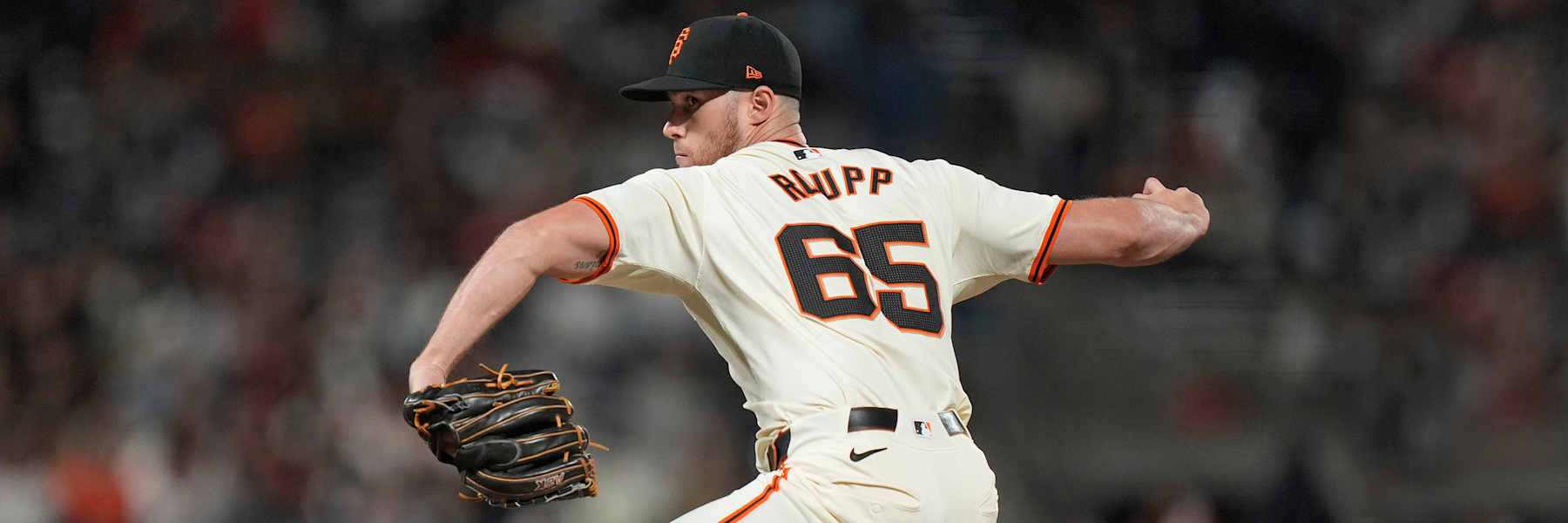
Miss: Robbie Ray finishes 2026 with an ERA above 4.00. He finished at 3.59. The argument was his FIP, fielding independent pitching, an ERA estimate built only from strikeouts, walks, hit batters and home runs. In late July it was 4.66 against a 3.34 ERA, and it said the ERA would rise. It rose after the trade: Ray posted a 5.02 ERA in 43 innings for San Diego. But he took 122 2/3 innings of a 3.08 ERA with him from San Francisco. To finish above 4.00 in the innings he actually threw, he needed to allow 32 earned runs in San Diego, a 6.70 ERA. He allowed 24. The direction was right and the magnitude was not, and that is scored a miss.
Hit: Tyler Mahle posts a lower ERA than Ray from August 1 on. Same argument, framed as a comparison rather than a threshold. Mahle finished that window at 2.55 in 60 innings, almost all of it for Atlanta. Ray finished at 5.02. A comparison does not need the banked innings to cooperate, which is the whole ballgame between these two rows.
Miss: San Francisco makes two or fewer contract selections from August 14 to season's end. It made seven: Matt Wilkinson, Braxton Roxby, Seth Lonsway, Yunior Marte, Cesar Perdomo, Scott Bandura and Davidson. The bar fell on August 29. The call read a 40-man roster with one open spot as a constraint on a last-place club. The club made room every time it needed to: eight transfers to the 60-day injured list and three players designated for assignment in the same window. A second row on the ledger asked nearly the same question from August 9 and missed the same way.
Hit: San Francisco finishes 2026 with fewer walks than any club in baseball. It finished with 449. Toronto had 459 and Atlanta 465. It was priced at -150 and settled by a season total with a ten-walk margin.
What is still open#
Twenty-four Giants rows have not resolved. Two are due on October 5. Two more land on December 2. Six resolve on Opening Day 2027, and the rest run through the 2027 season. None of them is counted above.
Eleven hits against 9.4 expected is a result a calibrated forecaster would produce about a third of the time. The data cannot yet say whether the favorites were underpriced or whether five calls went the same way. Another season of priced calls can.
Sample: every row in the Giants section of the Called Shots ledger as of October 1, 2026: 92 rows, 68 resolved (38 right, 28 wrong, 2 void), 24 open. Voids are excluded from every rate. Ownership follows the byline on the row or, where none is set, the byline of the article that made the call. Prices: implied probability from the writer's American odds, with no margin removed. Twenty graded rows carry a writer price; none dated before September 2 do. Desk prices start September 5; one graded row whose desk price the desk itself labelled contaminated is excluded from the desk comparison. Uncertainty: the 11-of-20 probability treats each call as an independent event at its own price. Several calls share a cause (a September call-up settles more than one row), so the true spread is wider than stated, not narrower. Weakness: twenty priced calls is a small sample. The favorites finding rests on five.
Sources: Called Shots ledger, Giants section. MLB Stats API: box score for game 823169 (September 21, 2026); San Francisco transaction log, August 14 to September 28; 2026 team hitting totals for all 30 clubs; season and date-range pitching splits for Robbie Ray and Tyler Mahle; San Francisco's full-season roster with debut dates.