Every Under Is A Man Coming Off A Lost Season
Seventeen lines on the 2026 season, one side of each, thirteen of them filed to the ledger and graded in public when the regular season ends. Thirteen overs, three unders and one head to head, and the unders share a shape.
The season opens Thursday against the Rams at the Melbourne Cricket Ground, the first NFL regular-season game ever played in that city. A forecast published the week of the opener should have to pay for its opinions, so here are seventeen lines on the 2026 49ers with one side taken on each. Thirteen of the seventeen file to the Called Shots ledger and grade in public when the regular season ends. Four do not, and they are marked where they appear. At an honest price each of those four is closer to a statement than a call, and a ledger is only worth keeping if it says which is which.
The scoring rules, once: every line resolves off official NFL regular-season statistics. Over means strictly more, under means strictly fewer, and a season that lands exactly on a whole-number line grades the stated side wrong. The head to head grades on regular-season rushing yards, and a tie grades it wrong too.
Three of the seventeen come back under, and all three are men whose last season ended early: Mike Evans at eight games, George Kittle in January, Nick Bosa in Week 3. That pattern is the forecast. The volume arguments all point up. The medical ones do not.
The team#
Wins, 9.5: over. San Francisco went 12-5 last season with the fewest sacks in the league, 20.0 across seventeen games, and with Brock Purdy for nine starts. The roster that did that then spent March adding Evans, Osa Odighizuwa and Dre Greenlaw, spent April drafting De'Zhaun Stribling and Kaelon Black, and spent August getting Deebo Samuel back. The line asks whether this team loses three more games than last year while getting deeper. Nothing in the offseason argues that direction.
The quarterback#
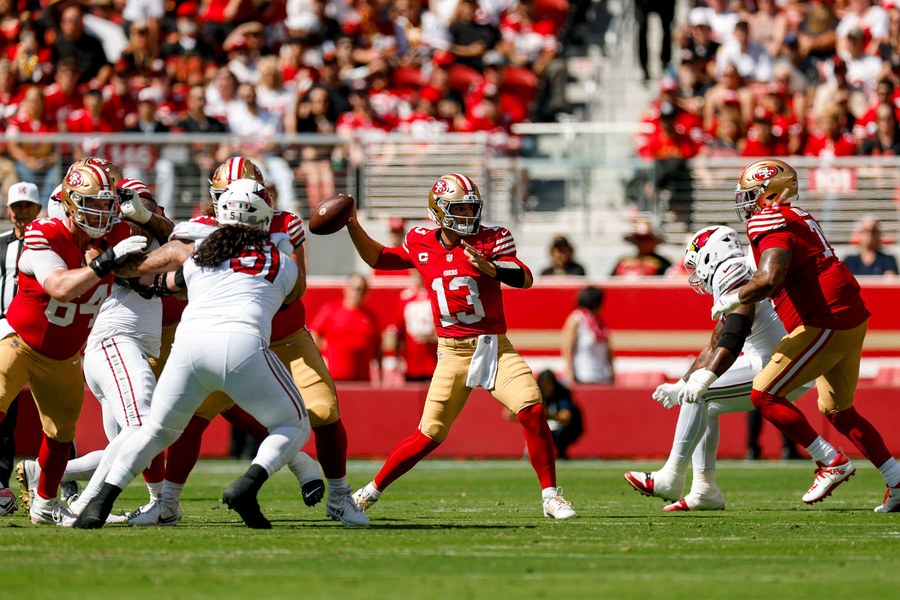
Brock Purdy passing yards, 3,600: over. Purdy threw for 2,167 yards in nine starts last season, 240.8 a game. Fifteen starts at that rate clears the line, and the room catching those passes added Evans, Samuel and Stribling since. Put differently: 3,600 across a full season is 212 a game, a number he beat by 29 in the season his receiving corps was the thinnest of his career.
Purdy touchdowns, passing plus rushing, 27: over. Twenty passing and three rushing in those nine starts, 2.6 a game combined. The line works out to 1.6 a game across a full season. He could lose a third of his scoring rate over seventeen games and still clear it.
The backfield#
Christian McCaffrey rushing yards, 900: over. McCaffrey ran for 1,202 yards on 311 carries last season, at 3.9 a carry, and played all seventeen games. The line asks for three quarters of that. The risks are real and worth naming: the average was his worst since 2020, he has not practised since August 8 with what the club calls soreness and Shanahan calls tightness, and the backfield behind him has churned through five transactions since August 2. But the churn is the argument. Nobody in that room has taken the volume away from him, and 900 yards is 53 a game.
McCaffrey touchdowns, 12.5: over. Seventeen total last season, ten rushing and seven receiving, on 413 regular-season touches. The under requires him to lose more than a quarter of his scoring in the same season the club added red-zone help around him, while still owning the goal-line carries. Volume wins this one the same way it wins the last one.
Kaelon Black against Jordan James, rushing yards: Black. The club drafted Black in the third round in April knowing James was already on the roster. Black started in the game book at the Chargers on August 20 in his preseason debut, two days after his first full-pads practice since early August, and carried eight times for 33 yards. James has not been on a field since fracturing a rib in late July, and his rookie season was seventeen offensive snaps. Availability is the whole race so far, and only one of them has had any.
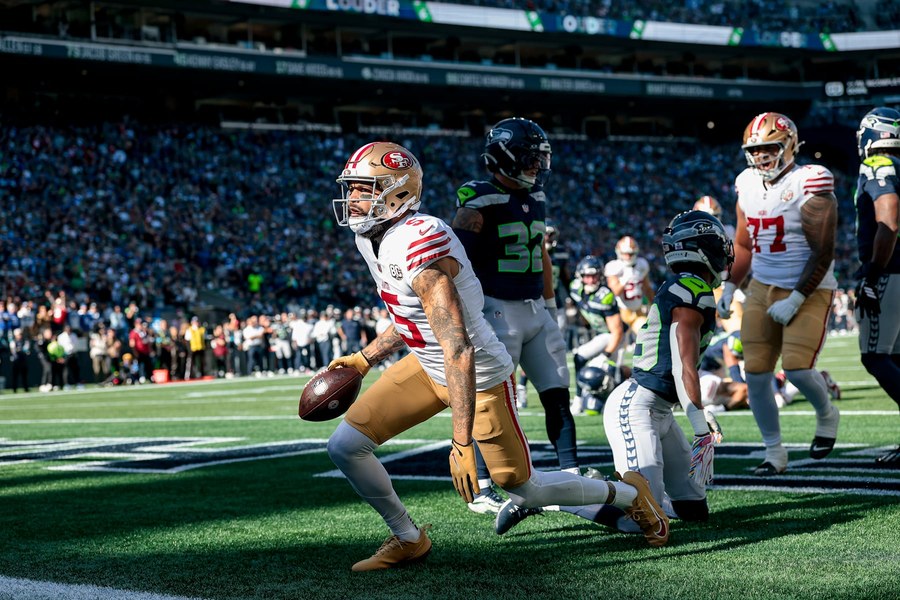
Deebo Samuel rushing yards, 50: over. Washington handed Samuel seventeen carries all last season and he still gained 75 yards on them. The offense he re-signed into is the one that built the wide-runner role in the first place, and even the slot-heavy usage his contract implies comes with sweeps attached in this system. In the offense that barely wanted him as a runner, he beat this line by half. Argued and not filed: the honest price is -600, and a number that short is reasoning rather than a call.
The pass catchers#
Mike Evans receiving yards, 900: under. The first under. Evans played eight games for Tampa Bay last season, caught 30 passes for 368 yards, and the run of eleven straight thousand-yard seasons ended with it. The setting is better now and the math is harder: 900 yards means 53 a game for seventeen weeks, in the most crowded target room he has played in, at the end of a camp in which a quad strain cost him most of the practice time. In the games he did play last season he averaged 46.0. This is a call about arithmetic, not decline, and arithmetic is enough.
De'Zhaun Stribling receiving yards, 550: over. The second-round rookie has caught nearly everything since July: seven of eight targets for 63 yards against Tennessee, four catches for 46 at the Chargers including all three passes Purdy threw him, and Tim Kawakami's verdict that no receiver in camp after Evans had been more impressive. Ricky Pearsall's season ended on injured reserve on August 2 and those targets went somewhere. The line is 32.4 yards a game. Rookie receivers miss that bar all the time, which is why the usage is the tell: first-team slot reps in July, the first offensive snap of the preseason thrown his way.
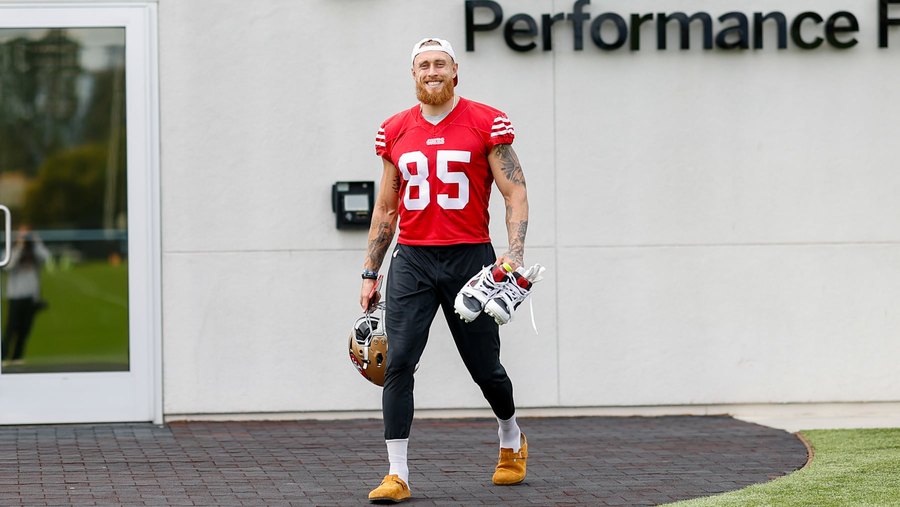
George Kittle receiving yards, 700: under. The administrative version of this call is dead, so the line is re-argued rather than re-dated. Kittle tore his right Achilles on January 11 in Philadelphia, came off the physically-unable-to-perform list on August 23, took his first team reps on August 31 by John Lynch's dating, practised three days running, and boarded the flight to Melbourne. The club's own roster page carried him on the active roster on Saturday afternoon, which means no four-game minimum applies and he is available from Week 1. What is left is the harder case. When he played last season he was still himself: 57 catches, 628 yards and seven touchdowns in eleven games, 57.1 a game, a 970-yard pace across seventeen. The under now needs missed games or a smaller share rather than a rule, and it is asking a 32-year-old tight end eight months off a torn Achilles to average 44 a game in the most crowded target room he has had. The ledger already carries a house call that he misses the opener, and that call is the only absence still doing any work here.
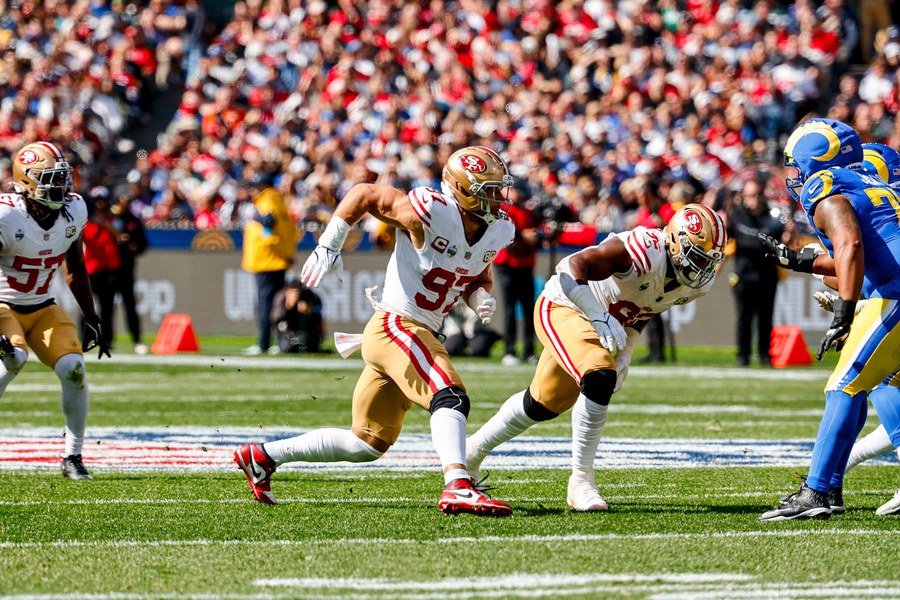
The defense#
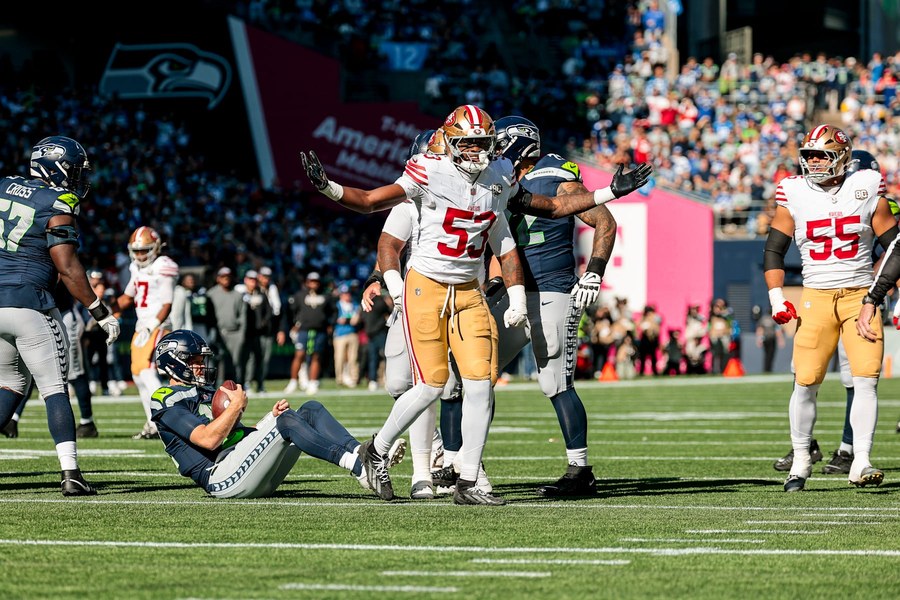
Nick Bosa sacks, 12: under. The hardest argument on the card, and the one that gave the piece its headline. Bosa's season ended in Week 3 last year with the second torn anterior cruciate ligament of his career, two sacks in three games. What followed is no longer an absence: he practised on September 2 in individual drills and in team periods, his first full session since the tear, and gave the reason nobody in the building had given, that he ramped the football work too fast a month earlier and it told him to back off. He said afterwards that he is confident about Week 1, and he is in Melbourne. So the case is not that he will be missing. It is that a managed return is still managed. Raheem Morris was asked how the snaps get handled, said the staff has a real plan and declined to describe it, and the ledger already carries a call at -130 that Bosa plays fewer than half of San Francisco's defensive snaps in the opener. Bosa's career works out to 64.5 sacks in 85 games, a 12.9 pace over seventeen, so 12 asks for close to a full healthy season at his career rate, twelve months from surgery, in a new scheme, with the snap count in somebody else's hands. Argued and not filed: the honest price is -350, and a number that short is reasoning rather than a call.
Osa Odighizuwa sacks, 4: over. He has hit the quarterback 23 times in each of the last two seasons in Dallas and come away with 4.5 sacks and then 3.5, which is the gap this line lives in. The over only asks him to match his 2024. The hit count says the pressure is real and repeatable; the sack total is the part that bounces around, and it has landed on both sides of this line in consecutive years. He also stops being the man the protection slides toward the moment Bosa is on the field. San Francisco traded a third-round pick for exactly this bet in March.
Team sacks, 35: over. The 2025 total was 20.0, the fewest in the league, and that number explains most of the offseason: the Odighizuwa trade, Ogbo Okoronkwo and his 17.0 career sacks signed in August, Mykel Williams entering year two, whatever amount of Bosa the calendar allows. The new coordinator has the first team practising out of five-man fronts. The ledger has carried a house call of forty or more since July, so this line sits five beneath a bar the building already set. Over 35 is 2.1 a game from a front that managed 1.2 with none of those additions.
Defensive yards allowed per game, 310: over, meaning they give up more. Last season this defense allowed 5,784 yards, 340.2 a game, twentieth in the league. Getting under 310 means finding thirty yards a game of improvement in the first year of an install, under the fifth defensive coordinator in five seasons, with the edge room the thinnest group on the roster and the best defensive player a medical question. The pass rush should improve. The yardage will lag it. Argued and not filed: at an honest price this is a statement that a twentieth-ranked defense does not become a top-eight one in the first year of an install, which is closer to a fact with a date on it than to a call.
Defensive yards per play allowed, 5.2: over, same direction. Opponents averaged 5.6 a play against this defense last season, on 1,028 plays. A 5.2 season is a top-shelf number, and top-shelf defensive numbers are not what first-year installs produce. The picks on this side of the ball are consistent on purpose: more sacks, similar yardage, better on the scoreboard than on the stat sheet. Argued and not filed, for the same reason as the line above it: 5.2 a play allowed is a top-five number, and saying a defense will not post one is not a forecast anybody would take the other side of.
The offense as a unit#
Offensive yards per game, 360: over. The 2025 offense gained 5,974 yards, 351.4 a game, with Purdy for nine starts, Kittle for eleven games, and none of Evans, Samuel or Stribling on the roster. Purdy averaged 240.8 passing yards in his starts; Mac Jones averaged 195.5 in his appearances. The eight and a half yards a game this line asks the offense to find are sitting in the quarterback column alone.
Offensive yards per play, 5.6: over. The closest call of the seventeen. Last season came in at 5.5 on 1,082 plays, and the drag is the run game: 3.8 a carry, thirtieth in the league, from a line that added no starting guard and a lead back whose average was his worst in five years. The case for over is the pass side, where more than half the plays live: Purdy's net yards per attempt was 7.2 against Jones's 6.7, and a full Purdy season moves the blend on its own. Over, barely. If this one lands under, the left guard battle is where it happened.
Thirteen of the seventeen are on the ledger. The season starts Thursday.
Sources: Pro Football Reference, 2025 team and player pages for San Francisco, Tampa Bay, Washington and Dallas; the clubs' official game books and transaction logs; 49ers media availabilities as published by the club and the Bay Area beat.