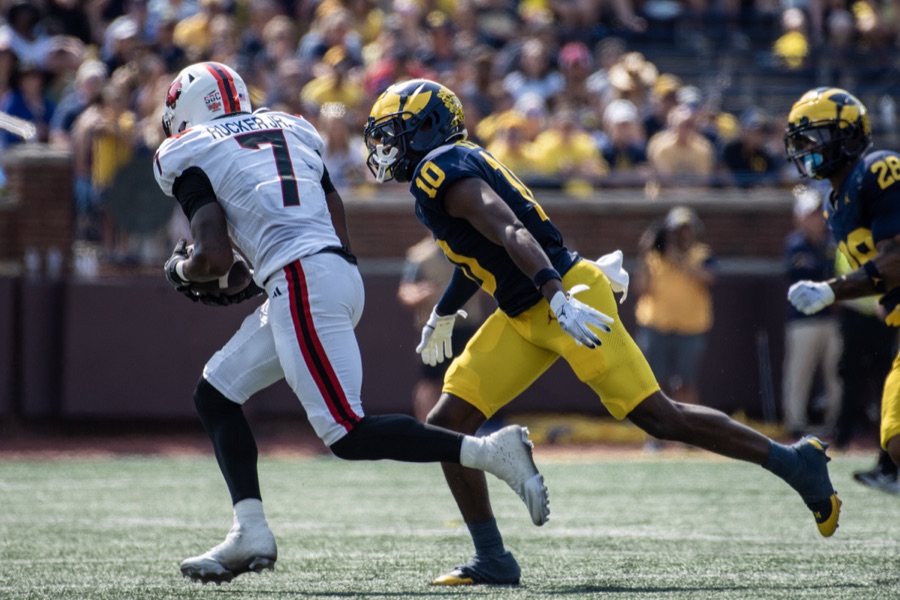
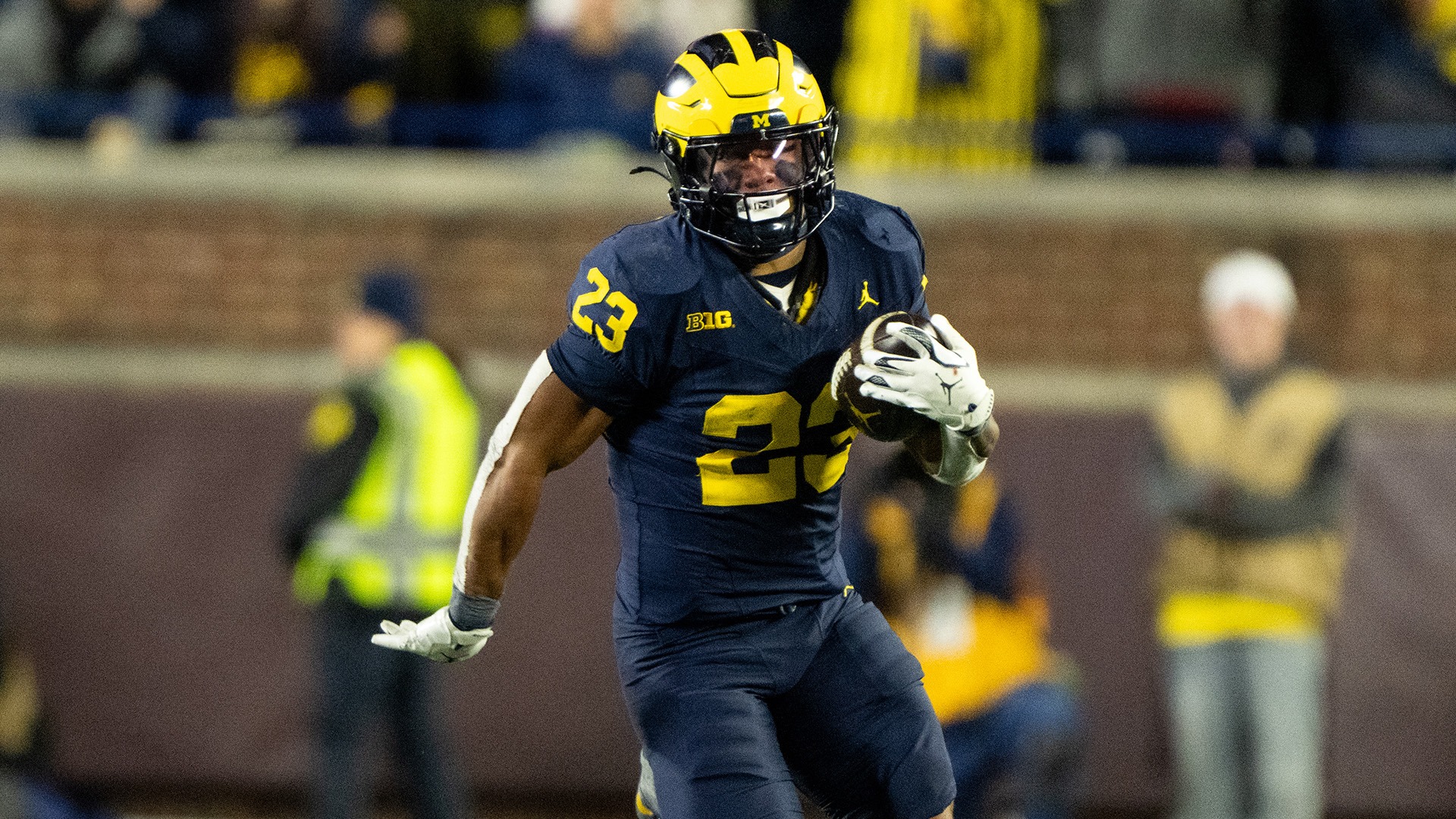
The NCAA says the replay broke protocol, and Michigan keeps the win anyway
The Division I FBS Oversight Committee reviewed the end of Michigan's 13-12 win over Western Michigan and found that instant replay protocols were not followed on the second-to-last play, and that the outcome would have been different if they had been. It also said it cannot change anything and will not be speaking about it again.
A college football replay official who wants to put time back on the clock at the end of a half is allowed to look at two things. The NCAA printed both of them on Wednesday. First, the game clock embedded in the program feed. Second, if the broadcaster cannot supply one, the clock graphic on the broadcast.
The Big Ten has been on the record since the early hours of September 6 about what its replay crew looked at in Ann Arbor, and it is neither of those.
"As shown in the provided video of what was viewed during the replay process, a side-by-side view of the play and the game clock, using a direct shot of the game clock in the stadium, was used to determine the final ruling," the conference said in the statement it released after Michigan beat Western Michigan 13-12.
A camera pointed at the scoreboard. That is the third clock, and it is the one that put a second back on the board and gave Bryce Underwood the throw that JJ Buchanan caught.
(Three clocks in one stadium, all of them running, and the sport has spent thirteen days deciding which one it meant.)
What the committee actually found#
The Division I Football Bowl Subdivision Oversight Committee published its statement on September 16, under a headline that gives away the ending: "Outcomes cannot be overturned after officials have declared a game has ended."
Most of it is about authority. The committee reviewed the play because the Mid-American Conference wrote and asked it to hand the game to Western Michigan. It cannot. It quotes two rules to say so. Rule 1-1-3-b: when the referee declares that the game is ended, the score is final. Rule 5-2-9: no rule decision may be changed after the ball is next legally snapped, legally free-kicked, or the second or fourth periods have ended.
Then three sentences at the bottom that are not about authority at all.
"The committee consulted with national officiating leadership regarding the instant replay protocols. Based on that information, the committee agreed that the instant replay protocols were not followed in the contest's second-to-last play. Had the protocols been followed, the outcome of the game would have been different."
That is the NCAA's own committee, in writing, saying a Michigan win came off a replay its crew ran wrong. It is not a conference lodging a grievance and it is not a coach on a podium. And having said it, the committee closed with a sentence that reads like a door being pulled shut behind someone: "This will be the Division I FBS Oversight Committee's only statement on this matter."
The chronology matters, and it cuts both ways#
Two things about that two-clock list are true together. The NCAA did not invent it after the fact to convict the Big Ten with, and it did not exist in that published form on September 5.
Here is the order. The game was Saturday, September 5. The Mid-American Conference accepted the Big Ten's explanation at first and then reversed itself, writing to the committee to ask that the outcome be overturned and saying, in the NCAA's summary of the letter, that end-of-game timing procedures had not been followed. On Tuesday, September 8, Matt Young, the NCAA secretary rules-editor for football, issued his interpretation on game timing. The NCAA's own description of what Young was doing is the word to hold onto. He issued it "to reinforce the proper procedures."
Reinforce. Not write. The committee's finding eight days later is in the past tense about a protocol it treats as having already existed.
So the Big Ten is not being judged against a rule published after its crew went to the monitor. It is being judged against a rule the NCAA says was always there, restated on a Tuesday because a Saturday had exposed it.
Nobody has said the stadium clock was wrong#
The two sides here have been answering different questions from the start.
The Big Ten's defense was about accuracy. Ross Dellenger reported at Yahoo Sports the morning after the game that NBC's replay was not in sync with the clock the conference's replay center in Chicago was working from, per both the video the Big Ten released and what it told Western Michigan, and that a broadcast clock graphic does not always match a stadium clock, because it is shot by a camera and then projected on screen. Western Michigan president Russ Kavalhuna said Big Ten commissioner Tony Petitti confirmed to him that the broadcast had shown a different clock from the one the officials had.
The NCAA's finding is not about accuracy. It does not say the stadium clock read the wrong thing. It says the protocols were not followed, which is a claim about which instrument the crew was permitted to consult, not about what that instrument said.
Those can both be true. A clock can be right and ineligible in the same second.
Anyway.
What it costs Michigan#
On the record, nothing. The win stands, the record is 2-0, and the College Football Playoff confirmed on Thursday that it has no power over regular-season results either.
The CFP left one door ajar, and it left it ajar on purpose. "The CFP Selection Committee evaluates all teams on a comprehensive body of work over a full season, driven by how teams perform in each game," it said in the statement the Associated Press carried Thursday night. "The Committee's evaluation is informed by a broad range of inputs, not just wins and losses." The performance of both teams, it said, will be evaluated as played.
Which is a sentence with exactly as much in it as the reader wants to put there. Selection committees have always looked past results. What is different is that one of the results on Michigan's profile now carries a finding from another NCAA body saying it was produced by a procedural error, and the people who weigh profiles have been told they may weigh more than the column of wins.
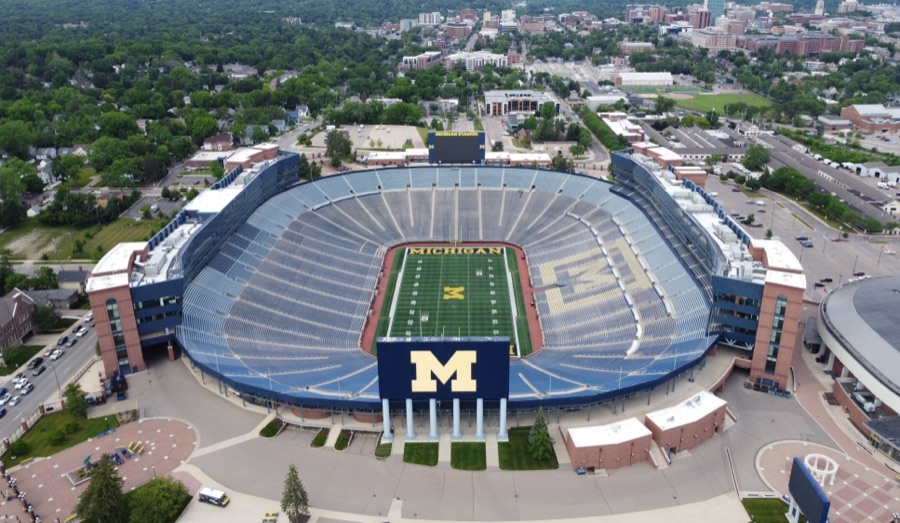
Michigan is 19th. It was 16th in the preseason ballot, out of the poll entirely the Sunday after Western Michigan, and back in it after beating Oklahoma 17-10. (Oklahoma, the only ranked team Michigan has beaten, went from 11th to 24th in the same ballot.) UTEP comes to Michigan Stadium on Saturday at 3:30 Eastern, and nothing in any of the last two weeks has anything to do with that.
The committee will not be commenting further.
Sources: the Division I FBS Oversight Committee statement of September 16, 2026, read at ncaa.org, for the finding, the two rule citations, the Matt Young interpretation and the closing line; the Associated Press, September 17, 2026, for the College Football Playoff statement, the Big Ten's post-game statement and the poll history, with the CFP statement first reported by The Athletic; Ross Dellenger at Yahoo Sports, September 6, 2026, for the Big Ten statement's wording, the clock-sync explanation and the Petitti and Kavalhuna conversation; mgoblue.com for the schedule, the results and the kickoff time.