The Giants made five trades in two days. Graded on August 3, one of them is a C+
Five trades filed between Sunday evening and Monday's 3 p.m. deadline, graded on the documents of that week and nothing after: the league's transaction log, the contracts as they stood, the salary reporting, and Kiley McDaniel's August 4 ranking of every prospect who moved. Two of the five come in at A-. The Mahle trade does not.
These five grades are dated August 3, 2026, and they were written on September 22. Everything below comes from documents dated August 2 to August 4: the league's transaction log, the salary and service-time reporting at MLB Trade Rumors that week, the Baseball America and MLB.com trade reports, Kiley McDaniel's ESPN ranking of every prospect who changed teams, published August 4, and each player's line as the league's feed showed it through August 3. Nothing that has happened since is in the argument. A process grade asks one question, whether the club made the right trade at the right price at the right time on the information it had, and the answer to that question does not change when the players do. The result gets a grade of its own when the season ends on September 27, and that one changes every time it is asked.
At 3 p.m. Pacific on August 3 the Giants were 47-65, 11 games out of the last wild card as of the previous morning, and two hours from first pitch in Arlington. Between Sunday evening and the deadline they filed five trades. Six players came off the 40-man roster and eight came back, and the three contracts everybody had spent July attaching to a prospect stayed where they were, two of them behind full no-trade clauses. Buster Posey, on a call with reporters about half an hour after the deadline, per NBC Sports Bay Area: "I guess the message is we're not satisfied with the way that we've played this year and the last few years and we're trying everything we can to continue to build a product that we can all be excited to come and watch."
Each trade is graded on the same three questions: the right trade for a 47-65 club, the right price against what the market was paying that week, the right time. The scale runs A+ to F in thirteen steps.
| Trade | Filed | Grade |
|---|---|---|
| Tyler Mahle to Atlanta for Anthony Molina | Aug. 2 | C+ |
| Luis Arraez and Caleb Kilian to Philadelphia for Ramon Marquez and Marty Gair | Aug. 3 | A- |
| Robbie Ray to San Diego for Miguel Mendez and Joniel Hernandez | Aug. 3 | B+ |
| Heliot Ramos to New York for Henry Lalane and Kaeden Kent | Aug. 3 | B |
| Erik Miller and Carlos Gutierrez to Boston for Marcelo Mayer | Aug. 3 | A- |
Mahle to Atlanta: C+#
The first filing came Sunday evening, a day before the deadline. Tyler Mahle, 31, on a one-year, $10 million contract, to the Braves for right-hander Anthony Molina. Atlanta took the roughly $2.1 million left on the $7 million salary; the $3 million signing bonus, payable in January, stayed with San Francisco, per MLB Trade Rumors on August 2.
What Atlanta was buying was 18 starts of a 5.13 ERA over 94 2/3 innings, and the shape underneath it: a 6.04 ERA across 11 starts in April and May, 3.60 across two in June, 2.82 across four in July, and then Saturday night in San Diego, nine strikeouts and five runs in 5 2/3 innings. Better stuff than results all season, and the stuff was what a rotation with Reynaldo Lopez newly on the injured list, Spencer Strider shut down and Spencer Schwellenbach out for the year was shopping for. That was in the same August 2 report.
What San Francisco was buying is harder to describe as a purchase. Molina, 24, throws 96 to 97, had been optioned four times this season, is in the second of three option years, and has not reached arbitration. His Triple-A line at Gwinnett through August 3 was a 3.64 ERA over 54 1/3 innings, with 56 strikeouts and 20 walks among 225 batters, 24.9 percent and 8.9 percent. His major league record was 55 appearances and a 6.89 ERA, most of it in Colorado, per NBC Sports Bay Area, with a career strikeout rate of 15.1 percent in just under 100 innings, per MLB Trade Rumors. McDaniel ranked 86 prospects who changed teams at this deadline, and Molina is not on the list. The Giants optioned him to Sacramento the day the trade was filed.
Selling was right. A 31-year-old on an expiring deal with a 5.13 ERA had no place in a 47-65 club's September, and clearing $2.1 million of a rental's salary is what a seller does. The price is where the grade sits. The Braves came to this market with a rotation crisis in the reporting the same day, and San Francisco sold to them a day early, for a 40-man arm with a 6.89 major league ERA that it did not want on its own roster. A lottery arm in the low minors would have cost no roster spot; Molina costs one. C+: the right decision, taken at the floor of its market, from a buyer with reasons to pay more.
Arraez and Kilian to Philadelphia: A-#
Luis Arraez, 29, in the only year of a one-year, $12 million contract, and Caleb Kilian, 29, controllable through 2031 on a near-minimum salary, to the Phillies for right-handers Ramon Marquez and Marty Gair. Philadelphia took all of the roughly $2.97 million left on Arraez's salary and the $252,700 left on Kilian's, per MLB Trade Rumors on August 3. Arraez had no no-trade clause.
Arraez was the cleanest asset the club owned: .324/.360/.440 across 464 plate appearances with 21 strikeouts, a 4.5 percent rate, and a fourth All-Star selection in July. Kilian was 44 1/3 innings of a 4.26 ERA in relief, 53 strikeouts and 20 walks among 193 batters. The market for a rental bat that week priced underneath Saturday's Tarik Skubal trade, and the expectation going into Monday was an arm rather than a bat, and nobody's headliner.
What came back is the best prospect in any of the five deals. Marquez, 20, signed out of Mexico in January 2025, had thrown 59 innings between Single-A Clearwater and High-A Jersey Shore with a 1.68 ERA, 93 strikeouts and 19 walks among 222 batters, a 41.9 percent strikeout rate. MLB Pipeline had him fourth in Philadelphia's system. McDaniel put him in the 50 Future Value tier, seventh of the 86 prospects who moved, and described a plus-plus changeup, a fastball at 94 to 96 touching 98, an 88-to-90 cutter-slider, and command enough to start, with "a potential No. 3/No. 4 starter" as the projection. He also said Marquez was in the mix for the back of his top 100 and just outside it for now. Gair, 23, a 13th-round pick in 2023, was the second piece: 66 strikeouts among 148 batters in 36 low-minors innings, 44.6 percent, with 22 walks, 14.9 percent, and a 4.50 ERA. McDaniel graded him 35 FV, 69th of 86.
The right trade at the right time, at a price above what the week had been paying for a rental bat. Philadelphia paid every remaining dollar. Arraez had no leverage to stop it and no future with a club that will not contend during the only season it controlled him. The step short of an A is the distance: a 20-year-old with 30 High-A innings is three or four years from the question he was acquired to answer, and the second piece is a 23-year-old reliever who walked one batter in seven.
Ray to San Diego: B+#
Robbie Ray, 34, in the final season of the five-year, $115 million contract he signed with Seattle after his 2021 Cy Young, to the Padres for right-hander Miguel Mendez and shortstop Joniel Hernandez. About $7.66 million of his $25 million salary remained, plus a $1 million assignment bonus, and the clubs split both, about $4.33 million each, per MLB Trade Rumors on August 3. San Francisco paid to move him, which had been reported four days earlier as the intent: prospects over payroll relief.
Ray's surface was the best in the rotation: a 3.08 ERA across 122 2/3 innings in 21 starts, six innings of one run in San Diego on July 30 in his last outing, and six earned runs over his last seven starts, 43 innings. The components were not the surface. He had walked 57 of 512 batters, 11.1 percent, and his ERA sat about a run and two-thirds below his expected fielding-independent mark by Jamie Silva's valuation the week before the deadline. A buyer in August pays for the 3.08. This one did.
What came back was two prospects at opposite ends of the calendar. Hernandez, 17, a shortstop the Padres signed out of Cuba in January for $1.4 million, the largest bonus in their class, was hitting .316/.439/.519 across 197 plate appearances in the Dominican Summer League, with 34 walks and 31 strikeouts. Baseball America's August 3 report described a lithe athlete with the actions to stay at shortstop, above-average arm strength, and 90th-percentile exit velocities near 103 mph, with pitch recognition still to sharpen. McDaniel graded him 45 FV, 13th of 86. Mendez, 24, a right-hander with a fastball Baseball America clocked near 102, was the nearer piece and the injured one: on the injured list from April 24 to May 12 and again from June 27, shoulder trouble per MLB Trade Rumors, and two innings into a rehab assignment at Fort Wayne on the day of the trade. His Double-A line before the shoulder was 34 2/3 innings, a 4.93 ERA, 38 strikeouts and 17 walks among 153 batters. Pipeline and FanGraphs had him fourth in San Diego's system; Baseball America had him tenth. McDaniel: 40 FV, 26th.
Right trade, right week. A rental left-hander with that walk rate is sold on the ERA before the ERA catches up, and the price beat what was expected for him going into the weekend, an upper-minors starter outside a buyer's top ten with money attached. The money was attached anyway. The minus against the plus: $4.33 million bought a shortstop who turned 17 in March and a starter who was on the injured list the day the paperwork was filed. The better piece is five years away and the nearer one was not pitching.
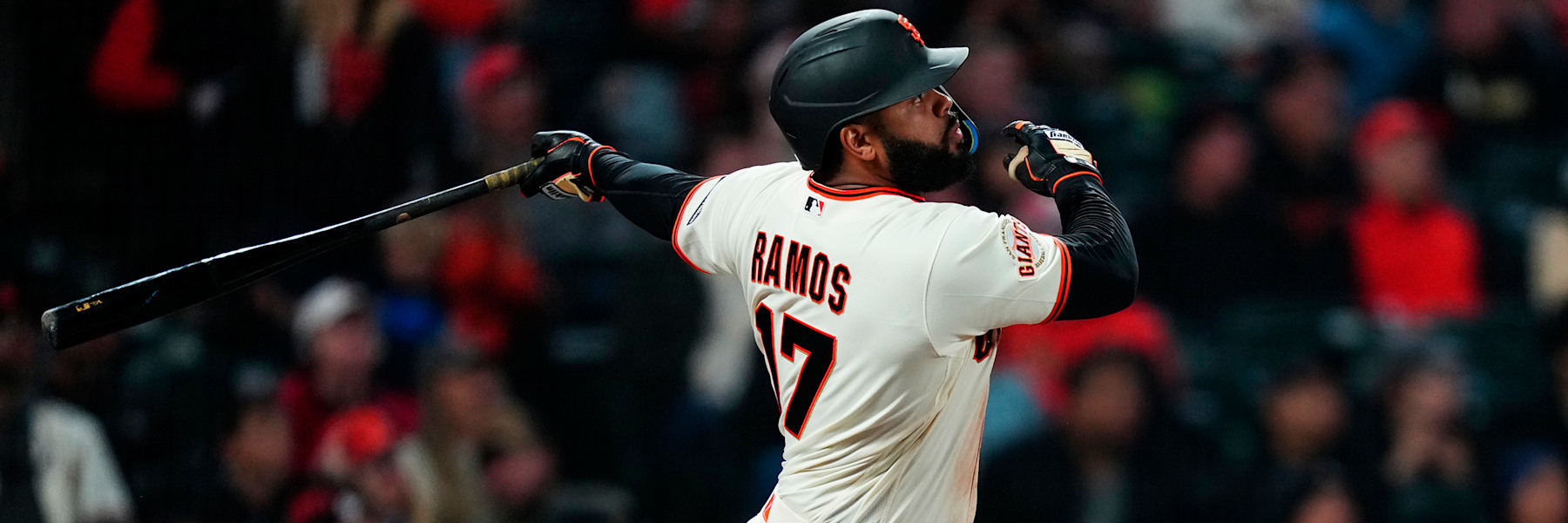
Ramos to New York: B#
Heliot Ramos, 26, the nineteenth pick of the 2017 draft, earning $810,000 and due his first of three arbitration hearings this winter, controllable through 2029, to the Yankees for left-hander Henry Lalane and shortstop Kaeden Kent. MLB Trade Rumors' August 3 account of the trade carries no cash in either direction.
This was the trade the club did not have to make, and the one where the price of control was the whole question. Ramos was an All-Star in 2024 on .269/.322/.469 with 22 home runs in 121 games. In 2025 he played all 157 and hit .256/.328/.400 with 21. Through August 3 of this season he was at .264/.304/.424 with nine home runs in 306 plate appearances, having lost May 16 to June 28 to a right quad strain, with 82 strikeouts, 26.8 percent, and 16 walks, 5.2 percent. An on-base percentage of .322, .328 and .304 across the three seasons. Combined across the three public defensive measures, per MLB Trade Rumors on August 3, he stood at minus-17 over roughly 3,100 outfield innings. What New York was buying was a right-handed bat hitting left-handers at .292/.343/.492 this season, per Yahoo Sports, for an outfield without Aaron Judge since June, a rib stress fracture, and without Cody Bellinger, a hamstring strain, with a first arbitration salary due in the spring.
Lalane, 22, six-foot-seven, born in the Bronx and signed out of the Dominican Republic in 2021 for $350,000, had thrown 78 innings between Single-A Tampa and High-A Hudson Valley with a 2.77 ERA, 98 strikeouts and 26 walks among 310 batters, 31.6 percent and 8.4 percent, with a fastball at 94 to 98. The same August 3 report noted that shoulder trouble had limited him in 2024 and 2025. Pipeline and Baseball America each had him fifth in New York's system; McDaniel, 45 FV, 15th of 86. Kent, 22, a third-round pick out of Texas A&M in 2025 and Jeff Kent's son, was hitting .302/.359/.433 with 20 stolen bases across 354 plate appearances at High-A, 29 walks and 57 strikeouts, after a .186 debut over 106 plate appearances the summer before. He had not played since July 5. Hudson Valley placed him on the seven-day injured list on July 6, and he was on it the day of the trade. Pipeline had him 13th in the Yankees' system, Baseball America 14th; McDaniel 40 FV, 24th.
The argument for holding him was stated before the deadline and it was real: controllable through 2029, a roster with nothing behind him after Casey Schmitt's torn meniscus, and a market that pays for control, all of which read as a club selling low. The argument for selling is in the lines above and the arbitration clock. A corner outfielder with an on-base percentage under .330 three seasons running, a strikeout rate above a quarter and that defensive record is about to cost more each winter than he did this one, and a buyer that had lost two everyday outfielders to the injured list was on the phone. Selling into that was the right time. A 45 FV arm with a shoulder history and a 40 FV infielder on the injured list is a fair price, not a strong one. B.
Miller and Gutierrez to Boston: A-#
Left-hander Erik Miller, 28, and outfielder Carlos Gutierrez, 21, to the Red Sox for Marcelo Mayer, 23. MLB Trade Rumors' August 3 account of the trade carries no cash.
Miller was, per NBC Sports Bay Area, the best reliever on the staff: 38 appearances, 32 2/3 innings, a 2.76 ERA, four saves and ten holds, 45 strikeouts among 142 batters, 31.7 percent. He had also walked 22 of those 142, 15.5 percent, on top of 20 walks in 30 innings the year before, when he ran a 1.50 ERA. He entered the season with exactly two years of service, is arbitration-eligible for the first time this winter, and carried three and a half seasons of control, per MLB Trade Rumors. Gutierrez was hitting .271/.385/.441 across 357 plate appearances at High-A Eugene, with 54 walks, 15.1 percent, 70 strikeouts, 19.6 percent, nine home runs and 26 stolen bases in 28 tries. Pipeline had him 17th in the Giants' system, per NBC Sports Bay Area; Baseball America 24th; FanGraphs 33rd; McDaniel 40 FV, 31st of 86. The FanGraphs description carried by MLB Trade Rumors was an advanced pure hitter without big physical tools and a decent chance of a fourth-outfielder profile, and Baseball America's August 3 note said he would have to produce more power to profile in left.
Mayer was the fourth overall pick of the 2021 draft and rose as high as fifteenth on Baseball America's top 100. He debuted at third base for Boston on May 24, 2025, hit .228/.272/.402 in 136 plate appearances, and had that season ended by wrist surgery in August. In 2026 he opened as Boston's second baseman, played 70 games, 45 at second and 24 at short, and hit .220/.282/.312 with three home runs in 228 plate appearances, 16 walks and 44 strikeouts, with an average exit velocity of 86 mph and hard contact on 35 percent of batted balls, per MLB Trade Rumors. Boston placed him on the ten-day injured list on June 26 with a bone stress reaction in his left ulna, the forearm bone on the bottom hand of a left-handed swing, and he had not played since June 25. He passed one year of service this season, holds a full set of minor league options, and does not reach free agency until after 2031. His career major league line on the day of the trade was 114 games, 364 plate appearances, .223/.278/.346, seven home runs.
For a 47-65 club, the shape of this trade is the one it should be looking for on every call. A reliever at the top of his market, a 2.76 ERA in August with three arbitration years attached, at an age and a walk rate that make relievers the least stable asset a seller can hold, went out with a fourth-outfielder prospect. Five and a half seasons of control over a 23-year-old came back, at a price set by the injury and by 364 plate appearances of not hitting, for a player whose draft slot and prospect ranking were three years old. The risk was known and specific: a wrist in 2025, a forearm in 2026, and a bat that had not driven the ball in the majors. A-. The step short of an A is the wait. Mayer was on the injured list with no reported timeline, and a club that buys an injured hitter with a healthy reliever has bought time as well as a player, and the length of it was not in any document on August 3.
What August 3 did not settle#
Six players off the 40-man, eight back. Among the eight: one prospect in McDaniel's 50 tier, two in his 45 tier, three in his 40 tier, one in his 35 tier, a former fourth overall pick on the injured list, and a 24-year-old optioned to Sacramento on arrival. The process on all five holds on the documents of that week. Every sale was of a player the club could not use in 2027 or should not have wanted to pay for, and every purchase was of control. What the documents could not say was how long Mayer's forearm takes, whether Mendez's shoulder and Lalane's hold, and whether a 20-year-old with 30 High-A innings is a starter or a story. The season ends September 27, and that is the first date the result gets a letter of its own. The question the process grade leaves open is the one it cannot answer by design: which of the eight players San Francisco bought turns out to be the one the deadline was for?
Sources: MLB Stats API (transactions for the Giants, August 1 to 4, and for each traded player; player lines by date range through August 3 at every level; game logs; the schedule feed for the club's record); MLB Trade Rumors (Anthony Franco, August 2, on the Mahle trade; AJ Eustace, August 3, on Arraez and Kilian; Steve Adams, August 3, on Ray; Connor Byrne, August 3, on Ramos; Anthony Franco, August 3, on Mayer, Miller and Gutierrez); Kiley McDaniel, ESPN, August 4, ranking the 86 prospects who changed teams; Baseball America (Josh Norris, August 3, on Mendez and Hernandez; August 3, on Gutierrez); NBC Sports Bay Area (Taylor Wirth, August 2, on Mahle and Molina; Angelina Martin, August 3, on Mayer and Miller; August 3, for Posey's remarks); MLB.com (Maria Guardado, August 3, on Ramos, Lalane and Kent); Yahoo Sports (Jack Baer, August 3, on the Yankees' outfield); Grab Some Pine, August 2 (the deadline forecast, carrying Jamie Silva's Ray valuation and the Skubal price) and August 5 (the deadline report, for the no-trade clauses and Mayer's injury status as of August 3).