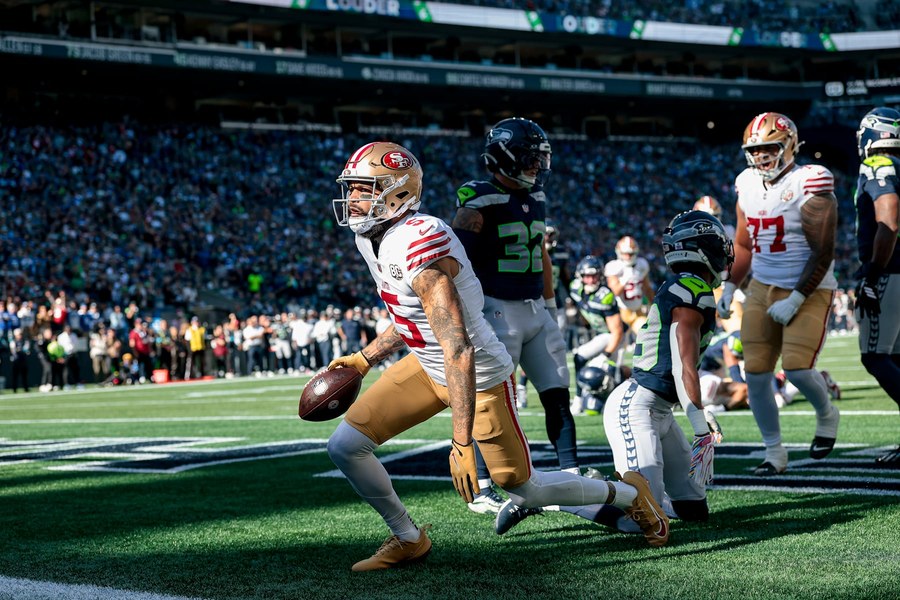
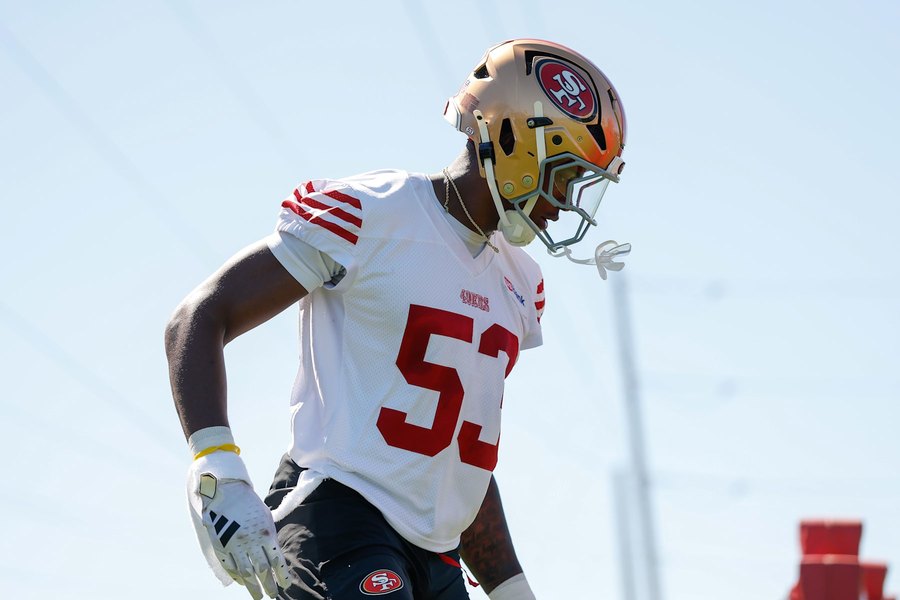
Keenan Allen used to beat his teammates. For three seasons, he has trailed them
San Francisco paid a 2027 sixth-round pick and $920,000 for the 34-year-old receiver. Measured per target against the men he shared a room with, his last three seasons say what kind of receiver that price buys.
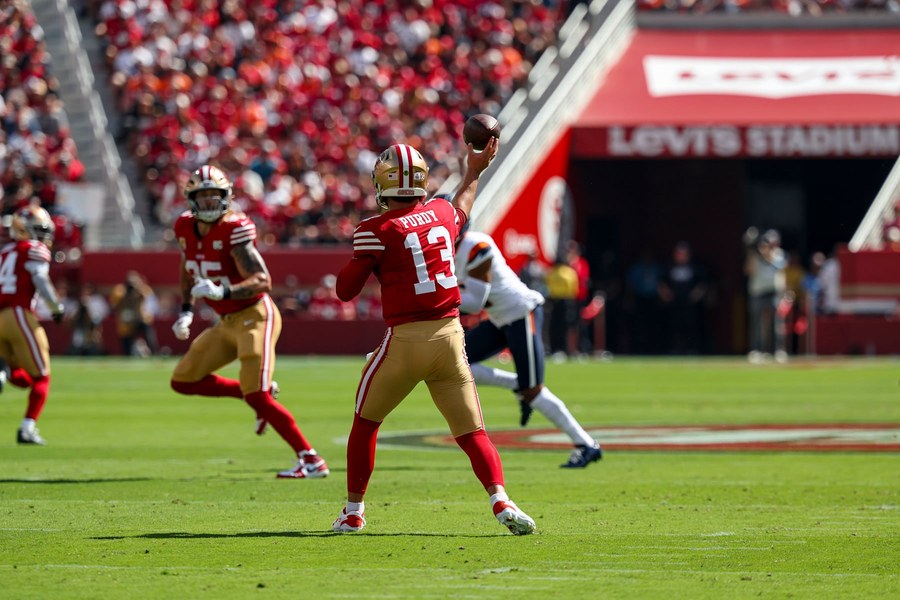
Half a yard.
That is how far Keenan Allen has trailed his own teammates on every target for three seasons, after adjusting for how far downfield each ball was thrown. In 2022 and 2023, with the Chargers, he beat them by 1.3 yards a target. Then he played for Chicago, for the Chargers again and for Indianapolis, and in all three rooms the sign flipped.
San Francisco acquired Allen from the Colts on Tuesday for a 2027 sixth-round pick. He is 34. He counts $920,000 against the 49ers' 2026 cap, which is what remains of a one-year deal: $650,000 in base salary and $270,000 in per-game bonuses, $30,000 for each of the nine games left in which he is active. The 49ers are 7-1 and play at Dallas on Sunday, with Mike Evans and Deebo Samuel Sr. both inactive last week.
The question a sixth-round pick asks is modest. What does a receiver like this add per target, against the receivers who would otherwise catch the ball?
The raw number#
Allen lost two yards a target in 2024 and has not found them since
Receiving yards per target, regular season. Targets are pass attempts aimed at him, sacks excluded. The bottom row is every wide receiver in the league, 2022-26, n = 45,453 targets. 2026 is through Nov. 9.
Read the top two bars against the bottom one. Allen was a little better than the league's average receiver in 2022 and 2023. The three highlighted bars sit about two yards lower and almost level with each other: 6.1, 6.4, 6.1. Three teams and three quarterback situations produced the same number.
The fall arrived at 32, not 34. That matters for a 49ers fan reading the age first. The aging curve for wide receivers is real but gentle at this end. Across the 39 receiver seasons at 34 or older in 2000-02 and 2010-25 with at least 40 targets in that season and the one before, yards per target fell by about 0.4 on average. Allen took his drop early and all at once, and nothing in the last two seasons says a second one has started.
Two things the raw number gets wrong#
Short throws gain fewer yards than long ones, and Allen's targets are short. His average target over the last three seasons traveled 8.7 yards in the air. A league-average receiver catching passes at exactly those depths would gain about 7.3 yards a target, not 8.0. So about 0.7 of his 1.8-yard raw gap is where he lines up rather than what he does there.
The rest needs a second control, because a bad passing offense drags every receiver in it. The Colts' wide receivers as a group were 28th of 32 this season in yards per target against what their depths predict. So I compared Allen with his own teammates instead of with the league: the same team, the same games, every target adjusted for depth. His teammates in those games ran about half a yard below expected themselves, which is the offenses. The remaining 0.55 is him. That is the half yard in the first sentence, and the table puts it next to the only baseline that makes it mean anything.
| Receiver | Seasons | Targets | Yards per target vs. his own teammates, depth-adjusted |
|---|---|---|---|
| Teams' No. 1 receivers | 2022-25 | 15,729 | +0.68 |
| Teams' No. 2 receivers | 2022-25 | 10,313 | +0.10 |
| Teams' No. 3 receivers | 2022-25 | 6,665 | -0.29 |
| No. 4 and below | 2022-25 | 4,996 | -0.45 |
| Allen, Chargers | 2022-23 | 239 | +1.32 |
| Allen, three teams | 2024-26 | 301 | -0.55 |
The four league rows rank every receiver by targets within his own team and season, minimum 20 targets. They fall in order, which is the first thing to check about a measure like this: the receivers quarterbacks choose most gain the most per throw. Allen in 2022 and 2023 sat above the average No. 1. Allen since 2024 sits a shade below the average No. 4, while drawing more targets than all but one teammate in each of those seasons.
How sure#
Not very, on the size. Receiver efficiency is noisy. Across 208 pairs of back-to-back seasons since 2022 in which a receiver drew at least 50 targets both years (40 in this partial season), this depth-adjusted number correlates at 0.35 from one year to the next, so a single season is mostly noise. That is why the table pools three seasons rather than leaning on any one of them.
Pooled, the noise is still wide. Resampling Allen's targets and his teammates' 4,000 times puts his three-season gap anywhere from -1.5 to +0.4 in 90 percent of draws, and below zero in about five draws of six. What survives is the change. Going from plus 1.32 to minus 0.55 is a fall of almost two yards a target, nearly twice its own sampling error, and the later gap is lower in 97 of every 100 resamples. That is enough to call it a real decline. He has trailed his teammates in each of the three seasons. Whether that is a receiver now slightly worse than the men around him, or one level with them who ran cold, three seasons cannot say.
Veteran savvy does not have a column in the play-by-play, so it is not in the table either.
The room he joins#
The 49ers' receivers have gained 10.5 yards a target this season, 2.0 more than their depths predict, which ranks first of 32 teams on that measure. That is 105 targets, and 39 of them went to Evans. Without him the rest of the room is still 1.2 yards above expected. In 2025, the 49ers' receivers were 0.4 above, 11th.
Blending the two seasons gives the room about plus 0.85. Start from what Allen's 2026 target depths predict (7.2 yards), add the room, subtract his own half yard, and my estimate for Allen as a 49er is about 7.5 yards a target. That is model output, built on three noisy parts, and the room is the noisiest of them.
The targets he is most likely to absorb belong to Brandin Cooks and Jacob Cowing, who have 21 targets between them this season at 5.2 yards a target. n = 21 proves nothing about either man. It does describe the bar Allen has to clear in the weeks Evans and Samuel are back.
The price#
A sixth-round pick is a long shot before anyone spends it. Of the 393 players taken in the sixth round of the 2011 through 2020 drafts, 108 were a primary starter for at least one season, by Pro Football Reference's count, and 56 never played an NFL game. The 49ers traded a pick that fails to produce a starter about three times in four for nine games of a receiver whose last three seasons look like a fourth receiver's.
The money is the smaller half. The $920,000 is the 49ers' cap charge and, if he is active every week, their cash outlay too, because all of it is weekly salary and per-game bonus. No years are attached. Allen's deal ends with this season.
Priced that way, the trade is a fourth receiver at a fourth receiver's cost, with a small option on 2023 attached. The number and the price agree.
The call#
The call: Keenan Allen averages fewer than 8.0 receiving yards per target across his 2026 regular-season games for San Francisco, minimum 20 targets. Check it Jan. 11, after the finale in Arizona.
The case against starts with Adam Thielen. In 2024, at 34 and with Carolina, he gained 9.9 yards a target after gaining 7.4 the year before. He was not alone: 12 of the 39 receiver seasons at 34 or older in the aging sample reached 8.0. And Allen is moving from an offense whose receivers were 28th by this measure to one whose receivers are first, which is the largest single input my 7.5 leaves room to be wrong about.
Data: nflverse play-by-play, regular seasons 2022-26 (2026 through the Nov. 9 games). Targets are pass attempts with a named receiver and a recorded air distance; sacks, spikes and two-point tries are out. Depth adjustment: each target's expected yards is the league average for wide receivers at that air distance, in nine bands, recomputed each season. The gap is a receiver's yards over expected minus his teammates' in the games he played. The tiers: wide receivers ranked by targets within team and season, minimum 20 targets, 2022-25, weighted by targets. Aging: the nflverse season file for 2000-02 and 2010-24 plus play-by-play for 2025. The 2003-09 seasons are left out because the season file's target counts for those years are incomplete. Weakness: depth is the only control. Coverage faced, route, down and quarterback within a team are not adjusted for, and the estimate for San Francisco assumes the 49ers use Allen at his 2026 depths.
Sources: nflverse play-by-play, season statistics, player and draft files; ESPN career statistics for Keenan Allen and Adam Thielen; Over The Cap, San Francisco 49ers 2026 salary cap table; NFL transaction wire, Nov. 10; ESPN, 49ers schedule and standings.