Seth Trimble's Fifth Season At Louisville Depends On A Reply Brief Due Monday
A federal judge in Denver certified a nationwide class of athletes who ran out of eligibility in the spring and ordered the NCAA to make them eligible again. She refused to pause her own order on Monday. The NCAA's answer, on Tuesday, was that there will be no blanket waiver and the Tenth Circuit should erase the whole thing.

Seth Trimble committed to Louisville on Wednesday, which is an ordinary sentence about a good guard changing schools, and it is not an ordinary sentence at all.
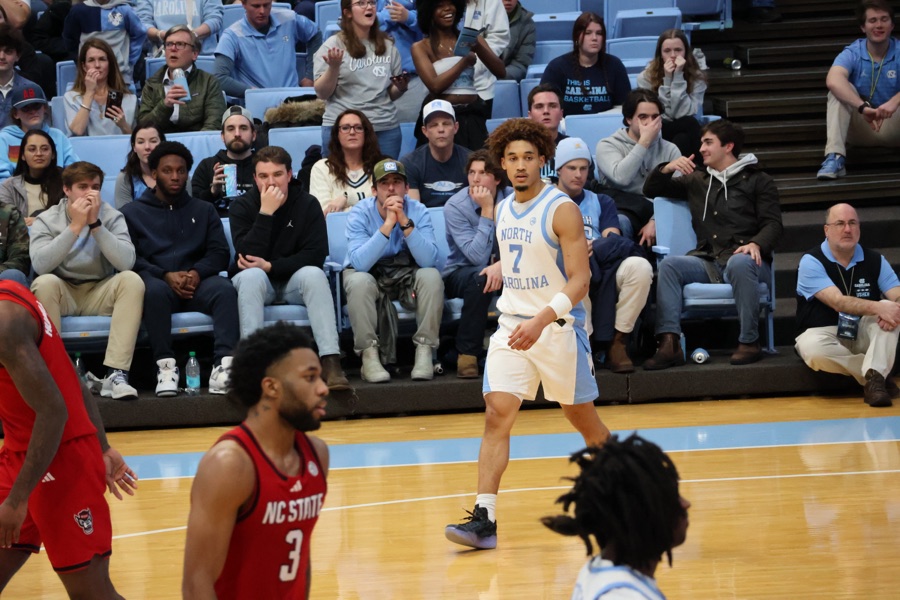
Trimble played 126 games at North Carolina across four seasons and scored 971 points in them. Last season he averaged 14.0 points, 3.8 rebounds and 3.0 assists a game while shooting 47.1 percent from the floor and 28.6 percent from three. The best night of his career came against Louisville: 30 points on 11-of-16 shooting in a 77-74 North Carolina win on February 23, including the two free throws with 12.3 seconds left that settled it.
He is on the other side of that now. Probably.
The fifth season he intends to spend there exists because Judge Charlotte N. Sweeney of the United States District Court for the District of Colorado says it does, and the NCAA has been trying to switch her order off since August 3.
The class is everyone who ran out in the spring#
On July 31, Sweeney certified a nationwide class and granted a preliminary injunction in Wisne v. NCAA, No. 26-cv-03063. The class is not a list of names. It is a description, and the description is the whole story:
All persons in the United States who began to play in collegiate sports in the 2022-2023 season, competed in NCAA Division I sports, and completed four years of eligibility as defined by the NCAA's prior rules by the conclusion of the 2025-2026 season.
That is the high school class of 2022, in full, in every Division I sport. The NCAA adopted an age-based five-year eligibility model in June and declined to apply it backward, which left the people who had just finished their fourth season watching a fifth year get handed to everybody a year younger than them. Sweeney ordered the NCAA to declare them immediately eligible.
(The association's own Division I Cabinet considered making the rule retroactive and decided against it. That deliberation is now the thing it has to defend in front of an appellate court.)
A bind of its own making#
The NCAA filed its notice of appeal on August 3, docketed in the Tenth Circuit as No. 26-1309, and moved for a stay so the injunction would not operate while the appeal ran.
Sweeney denied it on Monday, August 10, in an opinion and order that declined to soften the point. The association, she wrote, is "in a bind of its own making."
The NCAA had argued that the injunction threatened to upset already settled rosters and destabilize the 2026-27 season. The judge's response was that the chaos is downstream of the association's own business judgment, and she left the order standing.
On Tuesday the Tenth Circuit set a briefing schedule on the stay motion the NCAA had filed there. The reply brief is due Monday, August 17.
Also on Tuesday, NCAA chief legal officer Scott Bearby made the association's position unusually plain:
The Division I Cabinet, including its student-athlete members, carefully considered whether to make the age-based eligibility rule apply retroactively, and decided that doing so would not be in the best interest of all current and future college athletes. We stand behind and will continue to fully defend the membership's decision. The injunction should never have been granted, and we have asked the Tenth Circuit to permanently reverse it.
Read that as an administrator rather than as a fan. It says there will be no blanket waiver, which means the association will not be quietly making the problem go away by declaring everybody eligible and moving on. Every player in the class is eligible by court order and by nothing else.
Anyway.
The fifth year does not come with a locker#
Here is the part that will decide how many of these players actually appear in a box score, and it is not the appeal.
Sweeney issued a clarification order on August 2, and most of it is a list of things her injunction does not do. Class members over 24 do not return, because the NCAA may still enforce an age limit. Players who signed professional contracts do not return. The NCAA's transfer rules remain fully enforceable, so a player who never entered the portal cannot simply pick a school in August. And schools remain bound by the revenue-sharing cap and the roster limits set by the House v. NCAA settlement.
That last one is the wall. The injunction manufactures eligible players. It manufactures no roster spots to put them in, and every Division I basketball program is already carrying a roster built in the spring against a hard cap, with the money allocated.
Eligibility is permission to be considered. It is not a jersey. A court can order an association to stop calling you ineligible and it cannot order a coach to want you, which is why the interesting number this winter will not be how many players won their eligibility back but how many of them found a program with a seat still open.
Trimble said as much himself, in the flattest possible terms. He told Pete Thamel of ESPN that he considers North Carolina home and appreciated his four years there, and that a roster logjam is what sent him looking somewhere else. He won a year in a Denver courtroom and then ran into the arithmetic in Chapel Hill. Those are two different problems and only one of them had a judge.
Trimble found one at a school that just assembled the top-rated transfer class in the country, headlined by Flory Bidunga out of Kansas. Not everybody in his position is walking into that.
(Louisville's response to a hard roster cap was to spend it on the best transfer class in the country and then add a fifth-year guard on top of it. Somebody in that building is very comfortable with how Monday goes.)
The contract he did not sign#
There is one more reason Trimble is eligible to do any of this, and it is a piece of paperwork that does not exist.
He went undrafted in the 2026 NBA Draft and agreed to an Exhibit 10 deal with the Washington Wizards in June, then played summer league. An Exhibit 10 is a one-year minimum contract, and in practice it is a training camp invitation. Agreeing to one and signing one are different acts, and as of August 7 he was among 27 undrafted free agents who had reached tentative Exhibit 10 terms without formally signing.
Sweeney's clarification bars class members who signed professional contracts. Trimble did not sign.
So the sequence that put him on a Louisville roster runs: do not get drafted, agree to a deal, do not sign the deal, wait for a federal judge in Denver to certify a class you happen to be in, and then move before an appellate court in the same city decides whether any of it holds. Twenty-seven players were holding the same unsigned paperwork on August 7.
The season opens in November. The reply brief is due Monday.
The injunction is holding for now, and the district court has already refused once to pause it, which is the strongest signal available about how the same facts read to a judge who has seen all of them. Called Shot: Seth Trimble appears in a Division I regular-season game for Louisville on or before December 31, 2026. The risk is not that Louisville changes its mind. It is that the Tenth Circuit stays the injunction before November and a whole class of players goes back to being ineligible between a commitment and an opener.
Sources: Wisne v. NCAA, No. 26-cv-03063 (D. Colo.), Judge Charlotte N. Sweeney, for the July 31 order granting class certification and a preliminary injunction, the August 2 order clarifying the injunction's scope, and the August 10 opinion and order denying a stay pending appeal; the docket sequence including the NCAA's August 3 notice of appeal (10th Cir. No. 26-1309) and the Tenth Circuit's August 11 briefing schedule via the College Sports Litigation Tracker, with the class definition and the clarification's terms as summarized by Kutak Rock LLP. Sweeney's quoted language and the August 17 reply-brief deadline via Yahoo Sports. Scott Bearby's statement via Yahoo Sports, August 11. Trimble's commitment, his 126 games and 971 career points, and his own account of the North Carolina roster logjam via Pete Thamel at ESPN, August 12, 2026; his 2025-26 averages and shooting splits and Louisville's transfer class via CBS Sports. The February 23 career high of 30 points in a 77-74 North Carolina win via the University of North Carolina athletics department's own game recap. The Exhibit 10 distinction and the count of 27 undrafted free agents with tentative deals via Hoops Rumors, August 7, 2026. Nobody from this site was in a courtroom or spoke to any party.