The Fifth Year Only Moves You If You Were Already In The Portal In April
Seth Trimble is at Louisville and Jalen Washington is at Tennessee, and neither of them got there on eligibility alone. The motion that would let the rest of the class of 2022 follow them has been fully briefed since Monday, and Judge Sweeney said in a footnote that day that she would address it in a forthcoming order.
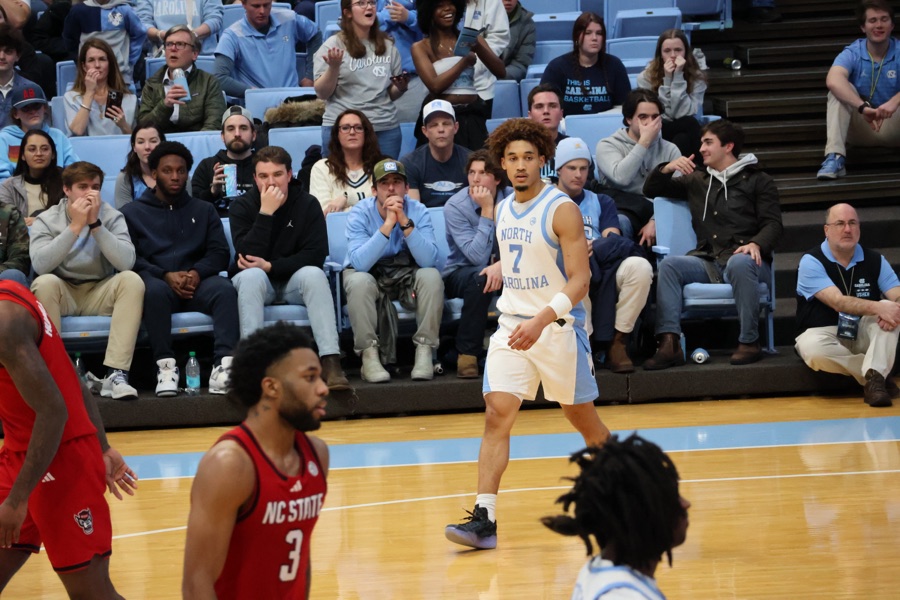
Seth Trimble is going to play at Louisville this season. Jalen Washington is going to play at Tennessee. Both of them graduated high school in 2022, both of them were out of Division I eligibility in the spring, and both of them are on rosters now.
They were teammates for three years at North Carolina, which makes them a decent natural experiment, because they did not get here the same way and the difference between the two routes is the only thing worth knowing about college basketball this month. Washington spent his fourth season at Vanderbilt, in Nashville.
Washington won his year in a Nashville courtroom. He was the lead plaintiff on a temporary injunction signed July 31 by Chancellor I'Ashea L. Myles of the Davidson County Chancery Court, which covered nineteen named players and, crucially, ordered the NCAA to open the transfer portal for those nineteen from noon on August 3 until 8 a.m. on August 10. Washington committed to Tennessee on August 3. He had a year and he had a door, and he went through the door on the first afternoon it existed.
Trimble was not in that case. He is in the other one, the enormous one, and his year comes from Judge Charlotte N. Sweeney of the United States District Court for the District of Colorado, who on the same Friday certified a nationwide class and enjoined the NCAA from keeping it off the floor. That class is not nineteen people. It is this:
All persons in the United States who began to play in collegiate sports in the 2022-2023 season, competed in NCAA Division I sports, and completed four years of eligibility as defined by the NCAA's prior rules by the conclusion of the 2025-2026 season, and are therefore barred from playing a fifth season due to the NCAA's adoption and immediate implementation of the Five-Year Eligibility Rule.
(Note what the definition asks of you. Nobody joins this class on the way up.)
Sweeney gave that entire population a season. She did not give it a door.
Trimble did not need one, because he was already in the portal. He entered it following the season, after averaging 14 points a game in his fourth year at North Carolina, and then went undrafted in June. The main window for the 2026 cycle opened April 7 and ran fifteen days, which is to say he put his name in months before a Colorado judge had ruled on anything, for his own reasons, at a time when the fifth season did not exist. It turns out that is the qualification that matters.
Read the class definition again and you will see the problem, which is that the class is defined by having finished. Every person in it is somebody who completed four years and was told that was the end. Those are, almost by construction, the players with the least reason on earth to have put their name in a transfer portal in April.
Anyway. The distinction is not academic, and the plaintiffs said so in writing eleven days ago.
The August 2 clarification order is six pages long and it contains both halves of this fight. One half is the sentence the NCAA likes: "The Court's order does not enjoin the operation of transfer rules." The other half is the operative language, which appears twice, and which says the NCAA is enjoined from prohibiting class members from competing in a fifth season "under the Rule (as defined in the preliminary injunction order) or any NCAA Bylaw."
The transfer rules are NCAA bylaws. That is the argument, in four words, and it is not a stretch.
On August 4, two days after that order, the plaintiffs filed an emergency motion to enforce the injunction, contending the association was using portal windows and the threat of penalties against schools to take back with one hand what the court had granted with the other. Sweeney set a schedule the same day: the NCAA to respond by August 6, the plaintiffs to reply by August 10, and no extensions "absent truly extraordinary circumstances." Both sides filed on time. The reply arrived with fifteen attachments, ten of them declarations from individual people, three of whom are named plaintiffs. An eleventh declaration was filed separately the same day, having been left out of the first batch, with apologies.
Then on August 10, Sweeney denied the NCAA's motion to stay her injunction pending appeal, in sixteen pages that did not go out of their way to be gentle. The association, she wrote, is "in a bind of its own making," and its own business judgment "gave rise to exactly the 'chaos' about which the NCAA now complains." When the NCAA argued that the players would suffer only minimal harm without a stay, she answered in one word: "Nonsense."
On page four of that order, in footnote two, is the sentence the entire class is waiting on.
The Court shall address Plaintiffs' enforcement motion in a forthcoming order.
That was Monday. Since then the docket in Denver has recorded three notices of appearance, on three consecutive days, and nothing else.
(The lawyers are showing up. The order is not.)
Meanwhile the appeal is running exactly on time. The NCAA's Tenth Circuit case number is 26-1309, the class filed its response to the stay motion there on Friday, and the association's reply is due Monday. That track has deadlines, and the deadlines are being met, and it is the track that draws the attention.
It is the smaller question this season. The appeal decides whether the fifth year survives at all, which matters enormously and will take months. The motion sitting in Denver decides whether the fifth year is worth anything before November to a player who is not already in a portal, which is nearly all of them.
Washington had a chancellor who wrote him a window. Trimble had a spring in which he happened to file. Everyone else in the class has a court order, a phone, and a rule that says the door closed in April.
Eligibility and mobility are separate things, and the Colorado injunction so far grants only the first. Called Shot: whatever order Judge Sweeney issues on the plaintiffs' motion to enforce, it will not direct the NCAA to open a transfer window for the certified class. She has now written twice, in an order the NCAA itself asked for, that she did not enjoin the transfer rules. Rewriting that while the same order sits in front of the Tenth Circuit is a much larger step than the four words invite.
Sources: the docket in Wisne v. National Collegiate Athletic Association, No. 1:26-cv-03063-CNS-KAS (D. Colo.), read directly, including the entries and filing dates for ECF 40, 41, 43, 46, 47, 50 through 59. The August 2 clarification order (ECF 41) and the August 10 order denying a stay (ECF 56) were opened and read in full; the class definition, both quoted passages from the clarification, and the "bind of its own making," "chaos," "Nonsense" and footnote two language are quoted from those two documents. The Tenth Circuit case number 26-1309 is cited in ECF 56 at footnote 3; the August 14 filing of the class's response there and the August 17 reply deadline are via the College Sports Litigation Tracker, and this site did not open the appellate docket. The Myles injunction, its nineteen plaintiffs, the August 3 to August 10 window and the April 7 main-window date are from the Order Granting Temporary Injunctive Relief in Washington et al. v. NCAA, No. 26-0896-III (Chancery Court for Davidson County, Tenn., 20th Judicial District, entered July 31, 2026); Washington's three seasons at North Carolina via 247Sports, his fourth season at Vanderbilt via ESPN, and his August 3 commitment to Tennessee via WVLT. Trimble's entry into the transfer portal following the 2025-26 season, his August 12 commitment and his 14.0 points a game via ESPN and Forbes, both opened. Nobody from this site spoke to any party and nobody from this site was in any courtroom.