How far back was Underwood when Minnesota got to him?
None of Minnesota's three sacks of Bryce Underwood came quickly. Where two of them ended is something an FBS offense has suffered in 24 of 542 team-games this season.
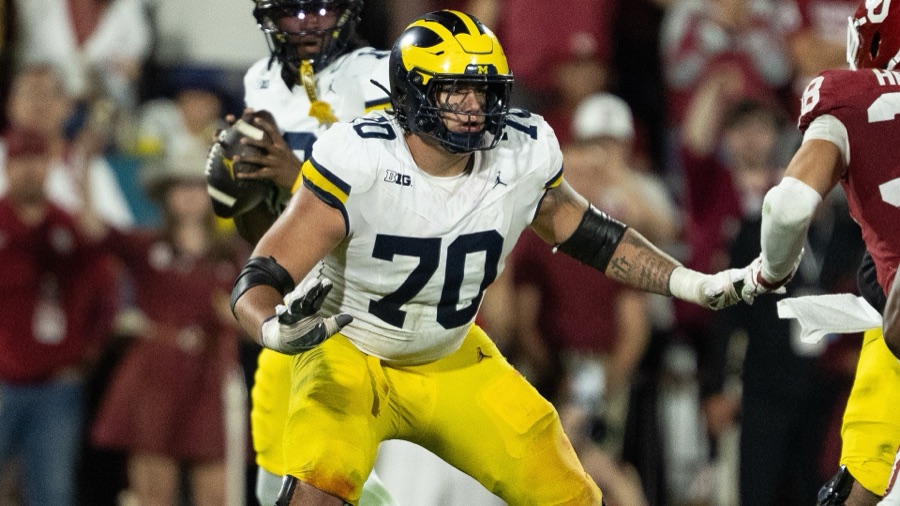
Kyle Whittingham went through what Michigan's offense did wrong at Minnesota on his Monday radio show, and the pass protection was on the list. "Didn't protect the quarterback like we needed to," he said on "Inside Michigan Football," in remarks reported by Clayton Sayfie of The Wolverine. He also said of the offense's afternoon, "this is not all on Bryce."
On Saturday the same subject had been a question. Minnesota sacked Bryce Underwood 3 times in its 20-14 win, and Whittingham said afterward that Michigan had to work out whether those were coverage sacks, breakdowns in the protection, or the quarterback holding the ball too long. "So, we've got to figure that out." In what has been reported from Monday's show, he did not say which it was.
Two things about those sacks can be measured from outside the building, how long each took and how far back each ended. The time says little. The yardage says more.
Three sacks by the clock#
Timed off the Fox broadcast, from the first movement at the snap to Underwood on the turf, the 3 sacks took about 3.7, 3.6 and 4.1 seconds. Each is good to about 0.3 of a second.
Second quarter, 1:33, first-and-10 at the Michigan 30, Michigan ahead 14-7. About 3.7 seconds, a loss of 12, credited to TJ Bush Jr.
Fourth quarter, 8:54, third-and-10 at the Minnesota 39, Michigan behind 20-14. About 3.6 seconds, a loss of 3, credited to Bush and Anthony Smith. Michigan punted on fourth-and-13.
Fourth quarter, 4:14, second-and-10 at the Michigan 37, still 20-14. About 4.1 seconds, after a play fake, a loss of 10, credited to Riley Sunram and Bush.
Bush, a senior who transferred from Cal, had a hand in all 3. Smith plays the other end and led the Big Ten with 12.5 sacks last season, by Minnesota's count.
No source found here gives a college average for time to sack. The two figures found are from the NFL, and they disagree. PFF's Khaled Elsayed wrote in 2013 that the average NFL sack took 3.8 seconds. An NFL.com Next Gen Stats note in 2016 put the league average over one three-week stretch at 4.52. Against either, Michigan's 3 were sacks of ordinary length, in a different league and a different decade.
Elsayed's piece also draws two lines. PFF, he wrote, gives a rusher more credit for a sack that arrives in under 3 seconds, and past 4 seconds he put a sack on the passer or on the coverage. All 3 of Michigan's cleared the first line, even at the fast end of the timing. Only the last reached the second, and only on the middle reading.
So the clock supports one narrow statement, that none of the 3 plays was lost at the snap. That does not clear the line. A block that holds for 3.5 seconds and then fails is still a failed block, and the broadcast angle does not show which block gave way.
Two of them ended 10 yards back#
The 3 sacks cost 25 yards. Underwood's first 5 sacks of the season, across 4 games, cost 16, on losses of 2, 2, 7, 3 and 2.
Through 5 weeks, CollegeFootballData's play-by-play has 1,016 sacks in the 271 games between two FBS teams, counting every sack whose loss is stated in the play description and leaving out plays wiped out by penalty, intentional grounding and sacks reversed on review. The median loss is 6 yards. Of the 1,016, 149 lost 10 yards or more, 14.7%, or about 1 in 7.
Michigan took 2 of those in one afternoon. An offense has taken at least 2 that deep in the same game 24 times in the 542 team-games in that set, 4.4%. The 12-yard loss came on first down, where 21 of 327 sacks, 6.4%, have cost 12 or more.
Depth records where the quarterback was when he was caught. The play-by-play has Underwood in the shotgun on all 3, and a shotgun snap is caught about 5 yards behind the line. On the first sack he set up about 8 yards back, by the yard lines on the broadcast, and was tackled 12 behind the line. The last came off a play fake and ended 10 behind it. On the 3-yard loss he moved up toward the line.
Both deep sacks ended with Underwood farther from the line of scrimmage than a shotgun quarterback starts, and the next line of the play-by-play has the price each time. One was second-and-22 inside the last 2 minutes of a half Michigan led. The other was third-and-20 in the last 4 minutes of a game it trailed by 6. Michigan punted both times.
What Drain saw and what Whittingham said#
Alex Drain charted Minnesota's 7-sack win at Washington a week earlier for MGoBlog. He had Minnesota blitzing on 33.9% of its snaps, and he wrote that its 4-man rushes were not wrecking the pocket right away and that Washington's quarterback held the ball until the pressure arrived. His stated worry for Michigan was Underwood leaving pockets and not reading the field.
After the game Drain wrote that Underwood "sacked himself" on the first sack, with no receiver he liked and no throwaway, and more or less did the same on the third-down sack. On the last one, he wrote, "the pocket compressed and Underwood ran right into the pressure." He judged the pass protection okay, and probably better than the quarterback made it look.
A broadcast frame shows the whole rush on one of the 3, the third-down sack, with 4 Minnesota rushers engaged about a second after the snap. A fifth coming late cannot be ruled out.
Drain's is a same-day reading, and Whittingham has the coaches' film. His Monday sentence puts protection on a list of 5 things that went wrong. It does not divide 3 sacks among the 3 explanations he gave on Saturday. On the same show he described an interception, not one of the sacks, on which he said Andrew Marsh was open downfield and Underwood did not see him.
Michigan started Evan Link, Nathan Efobi, Jake Guarnera, Brady Norton and Blake Frazier for the third straight game, with right tackle Andrew Sprague out for a third straight. Neither measurement says what that cost, and The Wolverine's report of Monday's show does not mention Sprague.
What 5 games say#
Underwood was sacked on 3 of the 24 plays at Minnesota that ended in a throw or a sack, 12.5%. In the 4 games before, it was 5 of 97, 5.2%. The box score does not separate scrambles from called runs, so both counts of pass plays run a little low.
PFF's season charting has two rankings that bear on the third of Whittingham's explanations, and they point in different directions. Among the 122 college quarterbacks in its file with at least 100 dropbacks, Underwood's average time to throw is tied for 70th-longest, so more than half of them hold the ball longer than he does. His pressure-to-sack rate, the share of a quarterback's pressures that end in sacks, is tied for 27th-highest. Minnesota's 3 are among the 8 sacks inside that rate.
That is 5 games of a quarterback who gets the ball out in ordinary time and goes down more often than most when the rush gets there. What would divide Saturday's 3 sacks among Whittingham's 3 explanations is the routes on each play, which the coaches' film shows and the broadcast does not.
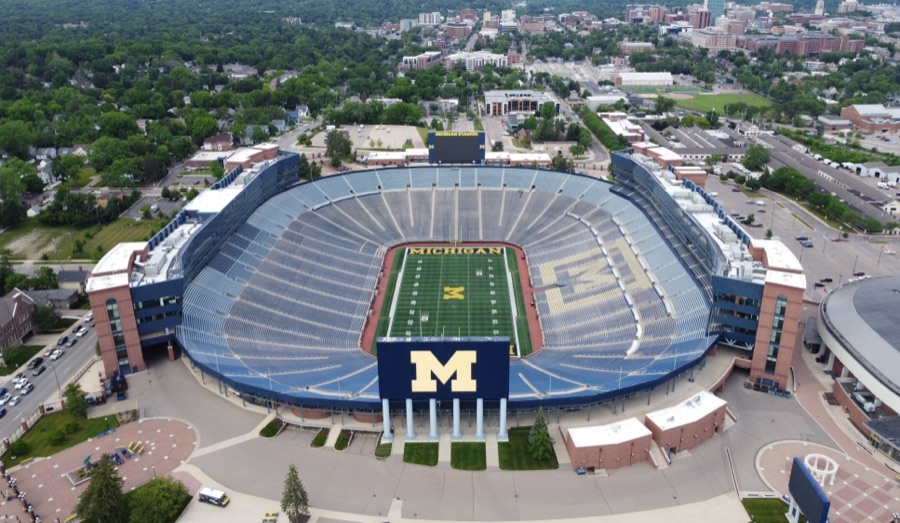
Michigan is off this week and plays Penn State at Michigan Stadium on October 17.
Sources: Kyle Whittingham on the "Inside Michigan Football" radio show as reported by The Wolverine (On3), Clayton Sayfie, October 5, 2026, and his postgame press conference as transcribed by Sayfie, October 3, 2026; Michigan Athletics' official box score, play-by-play and cumulative statistics for Michigan at Minnesota, October 3, 2026; the Fox broadcast of the game as carried in "Minnesota Football Top Defensive Plays vs. Michigan," Minnesota Athletics, October 2026, timed frame by frame; PFF, Khaled Elsayed, "The Overrated Sack," February 5, 2013, and NFL.com, "Next Gen Stats: Raiders' O-line vs. Chiefs' D-line," 2016, for NFL time to sack; CollegeFootballData's 2026 play-by-play for weeks 1 through 5, sack losses read from the play descriptions; MGoBlog, Alex Drain, "Fee Fi Foe Film: Minnesota Defense 2026," October 2, 2026, and "Minnesota 20, Michigan 14," October 3, 2026; PFF for the two season rankings; Minnesota Athletics' biography of Anthony Smith; the mgoblue.com and gophersports.com rosters.