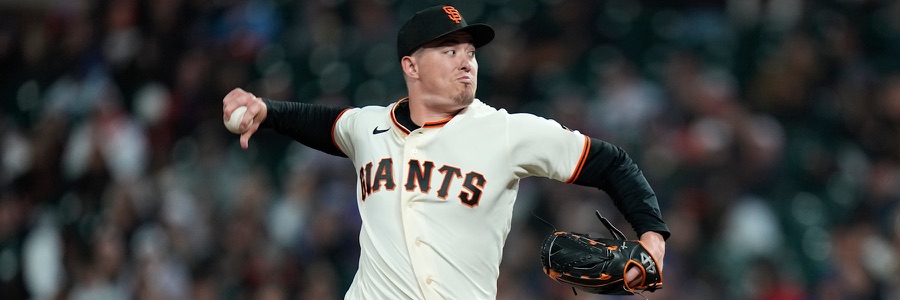
Once Logan Webb Reaches The Fifth Inning He Has A 1.74 Earned Run Average
Webb's earned run average went from 3.22 to 4.31 this season. Nearly half of the runs that did it arrived in the second and third innings, and the last two thirds of his starts have been the best of his career.
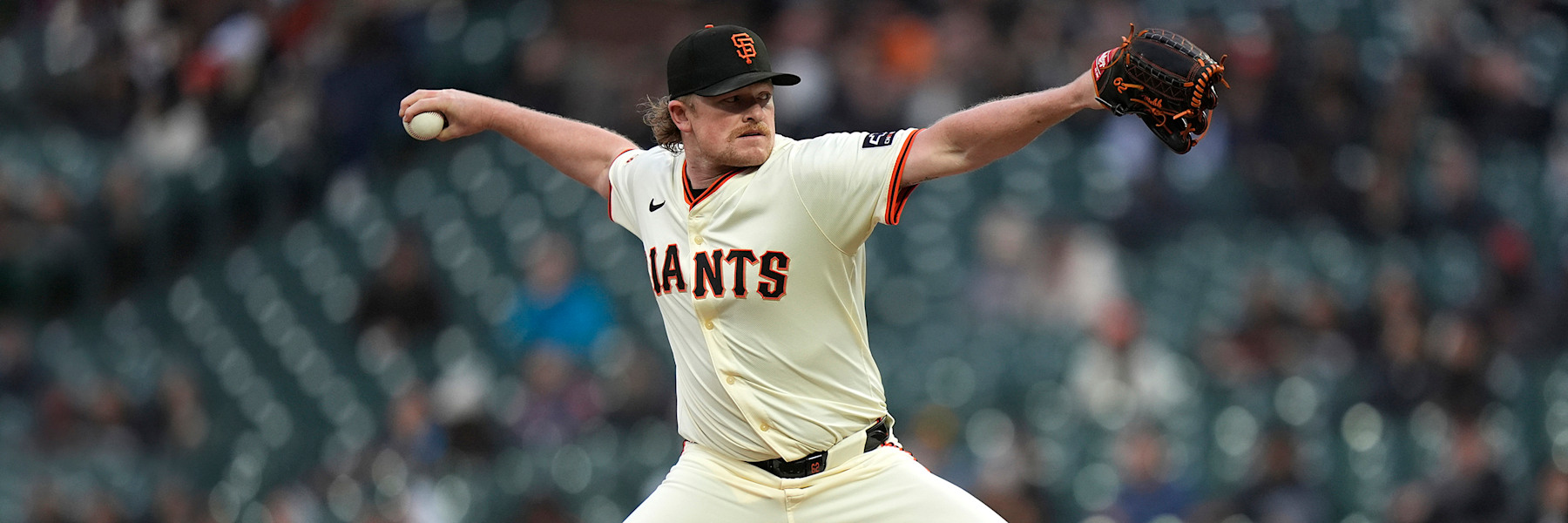
San Diego scored five runs off Logan Webb on Sunday before he had recorded seven outs.
Two in the first, three in the second, and the thing you should know about that afternoon, the thing that makes it worth more than a line in a standings table nobody is reading anymore, is that he struck out seven men in five innings. Only twice all year has he struck out more, and both of those were eight. He threw 60 of 92 pitches for strikes. He walked one.
This was not a man without his stuff. This was a man with his stuff who was down 5-0 before the beer lines had cleared.
The Giants lost 6-4 and are 62-88 with twelve games left, and Webb now carries a 4.31 earned run average into the last two weeks of the worst season he has had since he was a 23-year-old who had not figured it out yet. Last year he finished at 3.22. The year before, 3.47. Before that, 3.25 and 2.90.
So the obvious sentence writes itself. (Logan Webb, 29, is no longer the pitcher he was.) And the obvious sentence is wrong.
Nothing about the man on base has gotten worse#
Here is the part that does not fit.
Webb is allowing 8.23 hits per nine innings this season. Last year it was 9.13. Opponents are hitting .240 against him, his lowest mark in five years, against .264 in 2025. Their on-base plus slugging is .655, down from .694. His walks per nine are 2.30, which is ordinary for him. His WHIP is 1.17, better than either of the last two seasons.
Fewer men are reaching base against Logan Webb in 2026 than reached base against him in either of the two seasons he finished with an earned run average in the low threes.
And he has given up 77 earned runs in 160 and two thirds innings, against 74 in 207 last year. Three more runs. Forty-six fewer innings.
Somewhere between the men who reach and the men who score, 1.09 of earned run average went missing. It is not hard to find. Sixty-six of his 77 earned runs are in the first four innings, and the sharpest of the damage is in two of them.
The second and the third#
Break his season into innings and the shape is not subtle.
| Inning | IP | ER | ERA |
|---|---|---|---|
| First | 27.0 | 14 | 4.67 |
| Second | 27.0 | 17 | 5.67 |
| Third | 25.2 | 21 | 7.36 |
| Fourth | 24.0 | 14 | 5.25 |
| Fifth | 22.1 | 4 | 1.61 |
| Sixth | 20.0 | 4 | 1.80 |
| Seventh | 10.2 | 3 | 2.53 |
Thirty-eight of his 77 earned runs have come in the second and third innings. That is 49 percent of the runs in 33 percent of the innings.
Now the number that decides whether that means anything, because a pitcher's worst two innings are going to look bad in every season he has ever thrown, and a split that proves a point only when you go looking for it is not a split, it is a mirror.
His combined earned run average in the second and third innings:
- 2022: 2.95
- 2023: 2.94
- 2024: 2.32
- 2025: 3.31
- 2026: 6.49
Four seasons inside a run of each other. Then this one, at nearly double the worst of them. Same two innings, same arithmetic, five years running.
The first inning is not the problem, which surprised me, because "Webb cannot get going" is the story everybody including me would have reached for. His first-inning earned run average this year is 4.67. In 2024 it was 5.18. Opponents are hitting .233 off him in the first, his second-best first inning of the five. He is fine in the first. He comes apart in the two after it.
And then he is the best he has ever been#
Get him to the fifth and the season inverts.
From the fifth inning onward, Webb has thrown 57 innings and allowed 11 earned runs. That is an earned run average of 1.74. The same figure for the four years before: 2.23, 3.63, 3.80, 3.42.
He has never finished a season pitching like that in the late innings of his starts. He is doing it in the year his earned run average went up a run.
I want to be careful here, because this is the move that makes a bad season look like bad luck and it usually deserves the suspicion it gets. Every pitcher who ever lived looks excellent with his worst innings removed. So do not remove them. They happened, they are 38 runs, and they are why the Giants keep needing a bullpen before the fifth. The claim is not that Webb has been good. The claim is that the part of him that stopped working is a specific part, in a specific place, and that everything on either side of it is intact or better.
The same test run a different way says the same thing. Seven times this year he has been charged with five or more earned runs in a start. He did that once in 2022, three times in 2023, three times in 2024 and four times in 2025. Those seven starts cover 28 and two thirds innings and 44 of his earned runs. In the other twenty starts, across 132 innings, his earned run average is 2.25, and that is the lowest that number has been in any season of his career.
The good starts got better. The bad ones got more frequent, and they end in the third.
Two things went away at the same time, and only one of them explains anything#
In the third inning specifically, the two things that make Webb Webb both stopped.
He is a sinkerballer. His whole trade is the ground ball. In the third inning last season he struck out 28.4 percent of the batters he faced and his ground outs outnumbered his air outs by 1.48 to one. This season, third inning: 17.2 percent strikeouts, and a ground-to-air ratio of 1.08. Opponents are hitting .318 against him in that inning with an .832 on-base plus slugging, both the worst third-inning marks of his career.
Season-wide it is the same story in a quieter voice. His ground outs are 59.3 percent of his outs in play, against 65.4, 72.7, 66.3 and 65.0 across 2022, 2023, 2024 and 2025. His ground-out-to-air-out ratio is 1.46, and his previous career low was 1.86. He has turned 14 double plays this year. He turned 22, 30, 25 and 22 in those same four seasons. (The double play is not a statistic that happens to a pitcher. It is the thing his entire arsenal was built to go get.)
So the third inning has an explanation sitting right there, and I am not going to pretend it is the whole thing, because the second inning does not have one. In the second, his strikeout rate is down only modestly, his ground-out ratio is 2.00, which is a perfectly good Logan Webb number, and he has still allowed 17 earned runs where he allowed 10 last year. The balls found grass. That is what I can tell you from the record, and I would rather tell you that than invent a mechanic. Tipping is the easy word for it and there is nothing behind that word but the shape of the runs. Somebody with the pitch-tracking data can tell you more, and probably should.
The month that makes the rest of it ridiculous#
None of this has been a slope. It has been a series of cliffs.
March: 7.36 in two starts. April: 3.27 in five. Then right knee bursitis put him on the injured list on May 9, retroactive to the sixth, and cost him three weeks and a rehab outing in Sacramento.
He came back on May 29 and threw 38 innings in June and gave up three earned runs. A 0.71 earned run average for a month. He was named to the National League All-Star team for the third straight year, after 2024 and 2025.
July: 6.59. August: 2.83. September, three starts: 11.08.
That is not decline. Decline has a direction. This is a pitcher who is either excellent or unrecoverable and who does not seem to know which one he is going to be until somebody has already scored four.
What is left#
Landen Roupp starts at Busch Stadium at 4:45 Pacific and Blade Tidwell goes Tuesday. The club has not named a starter for Wednesday or for anything after it. Webb has worked on five or six days of rest in every start since he came off the injured list, which points at the Dodger series this weekend, but the Giants have not said so and there is no reason they have to.
Eliminated in both columns, twelve games left, and thirteen different men have started a game for this club in 2026. There is an argument for shutting down a 29-year-old whose knee already cost him a month of this season. There is an argument for letting your ace finish, because a man who has made 32, 33, 33 and 34 starts in the four previous seasons is going to finish this one at 27 or 29 (nobody has ever enjoyed being the guy whose card has a short row in it), and the difference matters to him even if it does not matter to the standings.
Either way, the number that goes in the book is 4.31, and the book does not have a column for the fifth inning onward.
Sources: MLB Stats API, read on the morning of September 14, 2026: the season, year-by-year, game log and situational-split pitching records for person 657277 at sportId 1 for 2022 through 2026, using the per-inning situation codes i01 through i09; the 2026 transaction log for person 657277; the boxscore and linescore for gamePk 823171; the 40-man and active rosters for teamId 137; the National League wild card standings; and San Francisco's remaining 2026 schedule with probable pitchers. All-Star selection per MLB.com, "Luis Arraez, Logan Webb to represent Giants at 2026 All-Star Game."